


































Key Highlights
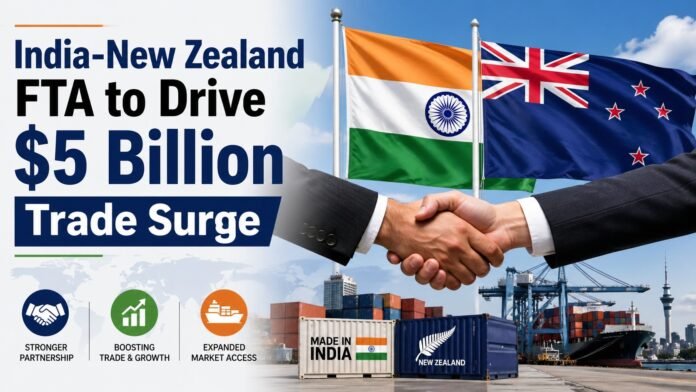
- Trade Target: Ambitious goal to raise bilateral goods trade from $1.3 billion to $5 billion within five years.
- Professional Mobility: 5,000 annual temporary work visas reserved for Indian skilled labor.
- Education Reform: Abolition of student visa quotas and permission for 20-hour weekly work shifts.
- Market Access: Tariffs eliminated or reduced on 95% of New Zealand exports, excluding sensitive Indian sectors like dairy.
- Soft Power: Official recognition of AYUSH and Yoga in New Zealand markets.
- Investment: Projected $20 billion in foreign direct investment (FDI) over the next 15 years.
The comprehensive trade deal between India and New Zealand marks a pivotal shift in Indo-Pacific economic relations. After years of calibrated negotiations, the two nations have moved beyond traditional trade to a partnership that emphasizes human capital and technological exchange. In the 2024-25 fiscal year, trade stood at a modest $1.3 billion; however, the new framework provides the structural support needed to scale this to $5 billion by 2030.
This agreement is a cornerstone of India’s “Market Diversification” strategy, following similar high-impact deals with Australia, the UAE, and the European Free Trade Association (EFTA).
Empowering the Indian Workforce
A standout feature of the agreement is the focus on professional mobility. By securing 5,000 temporary work visas annually, India has paved the way for its “skill power” to integrate into New Zealand’s economy.
The sectors poised for the greatest benefit include:
- Technology & Engineering: Filling critical gaps in New Zealand’s digital infrastructure.
- Healthcare: Deployment of nursing and allied health professionals.
- Traditional Arts: Specific provisions for yoga instructors and practitioners of culinary arts, this initiative ensures that Indian expertise receives formal international recognition while addressing New Zealand’s labor shortages.
Education and Student Welfare
The agreement brings transformative relief to the Indian student community, which represents one of the largest foreign student cohorts in New Zealand. By removing the restrictive visa quota system, New Zealand has opened its doors to a higher volume of academic talent. Furthermore, the inclusion of a 20-hour weekly work permit allows students to gain local professional experience and manage the cost of living, making New Zealand a more competitive destination compared to traditional hubs like the UK or Canada.
Balanced Trade: Protecting Domestic Interests
India has maintained a “prudence-first” approach to market access. While tariffs have been slashed on 95% of New Zealand’s exports, making high-quality wool, timber, wine, and fruits like kiwis and cherries more affordable for Indian consumers, the government has shielded its sensitive agricultural base.
| Sector | Status under FTA | Specific Items |
|---|---|---|
| Liberalized | Tariff Reduction/Elimination | Wool, Timber, Wine, Apples, Manuka Honey |
| Excluded | Protected (No Concessions) | Dairy, Sugar, Onions, Pulses, Edible Oils |
| Quotas | Limited Access | Selected fruits (Kiwis, Cherries) |
By excluding the dairy and poultry sectors, India has ensured that the livelihoods of millions of local farmers remain undisturbed by cheaper imports, maintaining a delicate balance between globalization and domestic stability.
AYUSH and the Global Wellness Economy
In a significant win for India’s soft power, the FTA grants official status to AYUSH (Ayurveda, Yoga, Unani, Siddha, and Homoeopathy) systems. Indian wellness products will now enjoy streamlined regulatory pathways in New Zealand, opening new markets for Indian pharmaceutical and herbal companies. This cultural export is expected to serve as a bridge for further bilateral cooperation in healthcare and research.
Long-Term Economic Outlook
The government anticipates that the FTA will act as a catalyst for $20 billion in foreign investment over the next 15 years. As the world’s fifth-largest economy, India is positioning itself as a reliable hub in the global supply chain, using this agreement to upgrade infrastructure and adopt global quality standards. This partnership is more than a fiscal arrangement; it is a roadmap for mutual growth, trust, and shared prosperity in a volatile global market.