Key Highlights
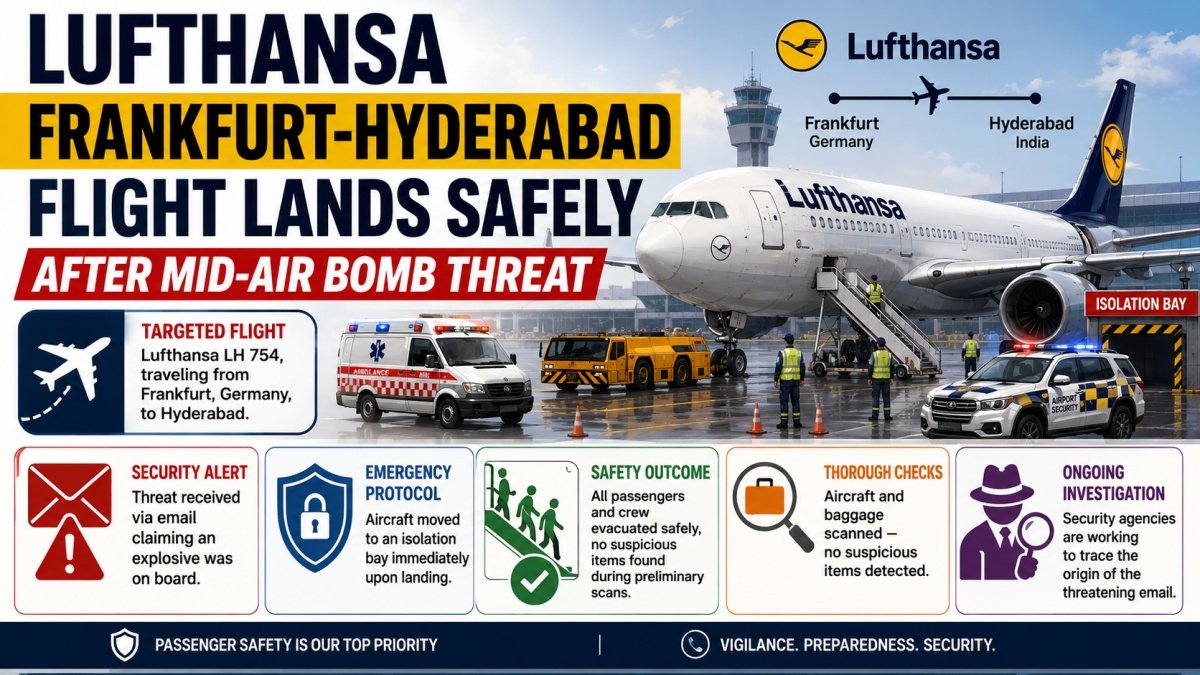
- Targeted Flight: Lufthansa LH 754, traveling from Frankfurt, Germany, to Hyderabad.
- Security Alert: Threat received via email claiming an explosive was on board.
- Emergency Protocol: Aircraft moved to an isolation bay immediately upon landing.
- Safety Outcome: All passengers and crew evacuated safely, no suspicious items found during preliminary scans.
- Ongoing Investigation: Security agencies are working to trace the origin of the threatening email.
High drama unfolded at the Rajiv Gandhi International Airport in Shamshabad on Friday as security agencies were placed on maximum alert following a bomb threat against Lufthansa Airlines flight LH 754. The aircraft, which was en route from Frankfurt to Hyderabad, became the subject of a security emergency after the airline’s customer support team received an alarming email.
The communication claimed that an explosive device had been planted on the plane and was set to detonate before the flight reached its destination. Upon receiving the intel, the airline immediately notified Indian authorities, prompting a coordinated response from Air Traffic Control (ATC), the Central Industrial Security Force (CISF), and the Airport Security Unit.
Isolation and Evacuation Protocols
As soon as the wheels touched down at RGI Airport, the pilot was instructed to taxi the aircraft to a remote isolation bay, a specialized secure zone located far from the main passenger terminals and other parked aircraft. This standard operating procedure ensures that any potential blast or hazard is contained away from airport infrastructure.
The Bomb Threat Assessment Committee (BTAC) took charge of the situation as passengers were disembarked under strict supervision. In accordance with international aviation security protocols, every passenger and crew member underwent a secondary physical screening, and all cabin baggage and checked-in luggage were offloaded for inspection by the Bomb Disposal and Detection Squad (BDDS).
Preliminary Findings and Investigative Focus
While the thorough search of the aircraft and its cargo hold has not yet yielded any suspicious objects, the airport remains under a heightened security blanket. Initial assessments suggest the threat may have been a hoax, a trend that has increasingly plagued the Indian aviation sector in recent months, causing significant operational disruptions and financial losses for carriers.
Security agencies, including the local police and cybercrime units, are now pivoting their focus toward the source of the email. “We are treating this with the utmost seriousness,” stated a senior security official at the airport. “Every lead is being followed to identify the sender and determine the motive behind this act of cyber-terrorism.”
Passengers from flight LH 754 were eventually cleared to enter the terminal after several hours of rigorous security checks. Lufthansa has not yet issued a formal statement regarding the delay of the return leg of the flight, as the aircraft remains grounded for a final forensic sweep.