Key Highlights
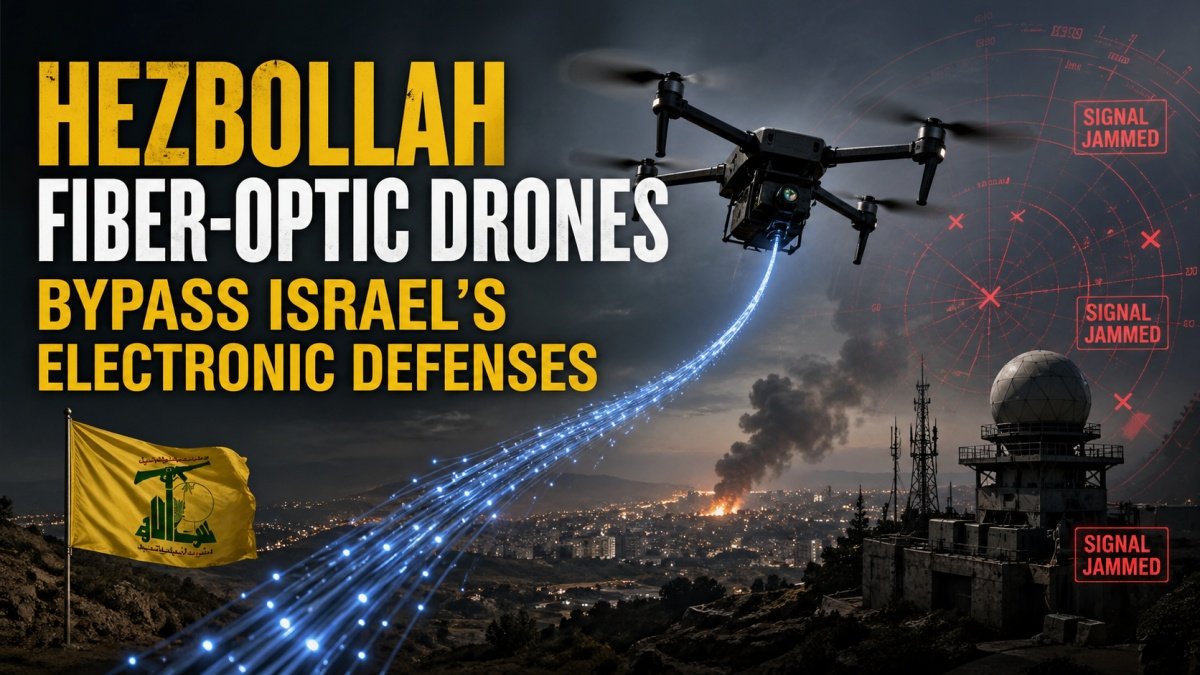
- Jam-Proof Technology: Fiber-optic tethering bypasses all electronic interception and jamming.
- Radar Evasion: Low-altitude flight paths allow drones to slip under the Iron Dome’s detection.
- Global Origins: Tactics adapted from the Russia-Ukraine conflict, featuring cables up to 50 kilometers.
- Tactical Shifts: Israel is resorting to physical netting and cages to protect high-value assets.
- Recent Lethality: Coordinated strikes have targeted ground troops and medevac helicopters with high precision.
The conflict between Israel and Hezbollah has entered a dangerous new phase where electronic superiority no longer guarantees safety. As of May 1, 2026, the introduction of fiber-optic drones has fundamentally altered the tactical landscape, rendering some of the world’s most advanced jamming systems obsolete. This shift from conventional radio-controlled hardware to “invisible” physical links has created a significant gap in border defense.
These weapons are not controlled by radio waves, which are the primary target for Israel’s electronic countermeasures. Instead, they are tethered to the operator by a physical fiber-optic cable, a line as thin as dental floss that transmits commands instantly and securely. Because there is no wireless signal to disrupt, even the most sophisticated signal jammers are powerless to break the link between the pilot and the craft.
Why Conventional Air Defenses Are Struggling
Robert Tollast, a defense analyst at the Royal United Services Institute (RUSI), notes that these drones operate at extremely low altitudes. By hugging the terrain, they remain below the detection threshold of radar systems like the Iron Dome, which was primarily optimized to intercept high-arcing rockets and ballistic missiles.
Ran Kochav, the former head of Israel’s Air Defense Command, has warned that the sheer speed and low flight path of these small craft make them nearly impossible to track in real-time. He acknowledged that while Israel focused heavily on the missile threat, the rapid evolution of miniature drone technology was not accorded the same priority. To mitigate the threat, the Israeli military has begun the widespread installation of protective cages and specialized netting on armored vehicles, a low-tech response to a high-tech evolution.
The Ukraine Connection and Tactical Evolution
This technology was first refined on the battlefields of Ukraine, where both Russian and Ukrainian forces have utilized cables extending up to 50 kilometers. These wires, which spread across border regions like a spider’s web, allow for high-resolution video feedback without the risk of signal loss.
Hezbollah has successfully adapted this technology for use along the southern Lebanese border. Unlike traditional drones that might lose connection due to mountainous terrain or electronic interference, these tethered units remain fully operational in the most contested environments.
Devastation on the Border
The human and material cost of this new technology is mounting. Hezbollah has recently released several videos showcasing the drones’ lethality. In one documented attack, a drone struck an Israeli transport vehicle, and as a medical evacuation helicopter landed to assist the wounded, a second drone arrived to target the aircraft.
These “double-tap” strikes highlight the precision and persistence afforded by the fiber-optic link. For troops deployed along the Lebanese border, these silent, unjammable drones have now emerged as the single most significant threat to daily operations and regional stability.