



























Key Points
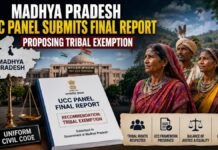
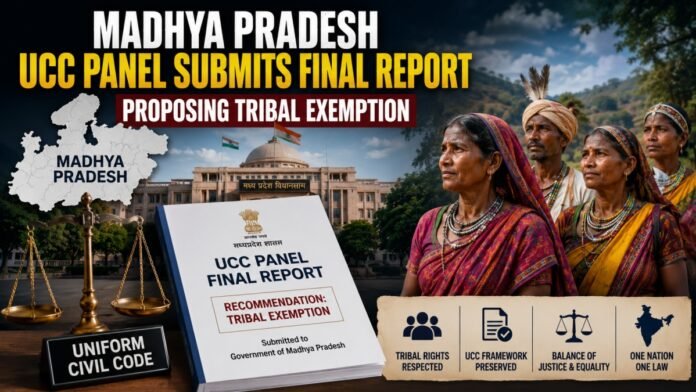
- A high-level committee submitted a final three-volume UCC report to Chief Minister Dr. Mohan Yadav on Monday, July 13, 2026.
- The proposed UCC draft comprises four parts, 404 statutory sections, and seven schedules, covering marriage, divorce, maintenance, and inheritance laws.
- A key recommendation excludes Scheduled Tribes, who constitute 21 percent of Madhya Pradesh’s population, from the code’s jurisdiction.
- The state government will review the draft at a special Cabinet meeting on July 18, aiming to introduce the Bill during the Monsoon Session starting July 20.
- CM Mohan Yadav targeted the opposition Congress party, demanding they abandon their political double standard and clarify their stance on the UCC.
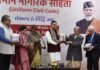
In a decisive stride toward enacting a uniform legal framework, the high-level committee appointed to frame the Uniform Civil Code (UCC) for Madhya Pradesh formally handed over its final report to Chief Minister Dr. Mohan Yadav on Monday, July 13, 2026. The completion of the report within its stipulated operational timeframe marks a significant milestone for the ruling administration’s legislative agenda.
The committee’s extensive findings have been compiled into three distinct volumes, designed to offer a thorough social, legal, and administrative blueprint for the state:
- Volume I encapsulates the committee’s core recommendations, organized across 10 detailed chapters following a rigorous analysis of prevailing international, national, and state laws.
- Volume II contains the complete draft of the UCC Bill, meticulously formatted in accordance with active regulations in Madhya Pradesh, featuring four distinct parts, 404 statutory sections, and seven comprehensive schedules.
- Volume III focuses entirely on the public consultation process, containing granular data from district and state-level town halls as well as the government’s dedicated web portal. The panel received an overwhelming 9.58 lakh public responses, with official records indicating that 95 percent of responding women and 92 percent of men voiced clear support for the implementation of the code.
Strategic Tribal Exemption and Upcoming Legislative Roadmap
The defining highlight of the panel’s submission is its recommendation to keep Scheduled Tribes (STs) entirely outside the ambit of the proposed Uniform Civil Code. With indigenous communities accounting for roughly 21 percent of the state’s total demographic makeup, the committee chose to safeguard diverse tribal customary laws, traditions, and distinct ceremonial practices. The code focuses primarily on reforming, standardizing, and unifying personal family matters, including marriage registration, divorce protocols, maintenance structures, succession, adoption, and the regulation of live-in relationships.
The state government has moved swiftly following the submission. On Tuesday, July 14, Cabinet Minister Chetanya Kumar Kashyap confirmed that the draft text has been routed to the State Law Department for swift legal scrubbing. The administration has scheduled a special Cabinet meeting in Jagdishpur, Bhopal, on July 18, where the Council of Ministers is expected to grant formal executive approval to the draft. Once cleared, the UCC Bill will be introduced to the floor of the Madhya Pradesh Legislative Assembly during the upcoming five-day Monsoon Session, scheduled to run from July 20 to July 24, 2026.
Chief Minister Rebukes Opposition’s Silence on Legal Reforms
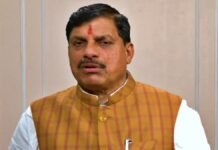
During the official handover event at the Assembly complex, Chief Minister Yadav expressed his deep appreciation to the committee members in attendance, including Prof. Gopal Sharma, Budhpal Singh, Shobha Paithankar, and Member Secretary Ajay Katesaria. He noted that the text balances contemporary legal principles of gender equality with a respectful adherence to constitutional safeguards and public policy.
Turning the event into a political focal point, CM Yadav launched a sharp attack against the opposition Congress party, accusing them of deliberate evasion on a critical national issue. Speaking to reporters after paying floral tributes on the birth anniversary of former Chief Minister late Kailash Joshi, Yadav challenged the principal opposition party to announce a definitive public stance.
Yadav asserted that while members of the Hindu, Muslim, and Christian communities have willingly participated in the state’s democratic consultation, the leadership of the Congress party continues to view the UCC through the lens of vote-bank politics. He demanded that the party abandon its political double standards and state clearly whether they support a uniform legal framework for all citizens, predicting that the political discourse surrounding the upcoming bill will intensify significantly in the coming days.