



































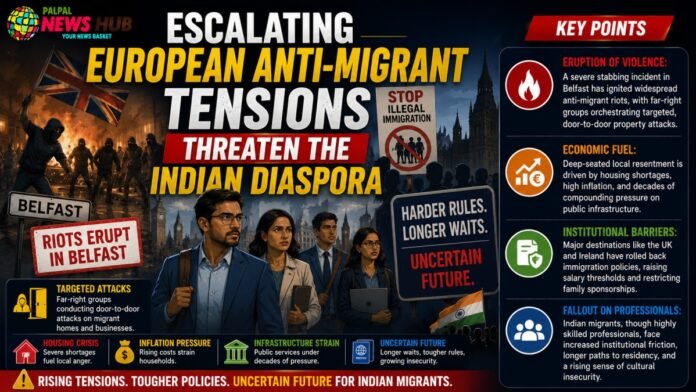
Key Points
- Eruption of Violence: A severe stabbing incident in Belfast has ignited widespread anti-migrant riots, with far-right groups orchestrating targeted, door-to-door property attacks.
- Economic Fuel: Deep-seated local resentment is being driven by critical domestic housing shortages, high inflation, and decades of compounding pressure on public infrastructure.
- Institutional Barriers: Major destinations, including the UK and Ireland, have implemented aggressive immigration policy rollbacks, raising salary thresholds and restricting family sponsorships.
- Fallout on Professionals: While Indian migrants are predominantly highly skilled white-collar workers, they face increased institutional friction, longer paths to residency, and a rising sense of cultural insecurity.
The political and social climate for immigrants traveling to Western Europe has sharply deteriorated, as long-simmering localized frustrations boil over into active hostility. The most acute escalation began in Belfast, Northern Ireland, where widespread rioting erupted following a severe street stabbing incident involving an asylum seeker. Far-right groups quickly leveraged the event to orchestrate coordinated attacks against minority residences, setting fire to homes, vehicles, and businesses, which left dozens of families homeless.
The violence has since triggered secondary protests across Scotland and England, echoing similar large-scale anti-immigration demonstrations seen in Dublin, Ireland. For the millions of foreign nationals residing in these areas, the open hostility marks a dangerous turning point in public safety.
Drivers of Local Resentment
Beneath the immediate triggers lies deep-seated domestic anxiety centered on economic and structural deficiencies. For years, major European hubs have struggled with severe housing shortages and skyrocketing rental prices, pushing local populations to a breaking point.
Furthermore, prolonged inflationary pressures and the compounding demands on social infrastructure, such as healthcare networks, public schools, and local municipal funds since the 2015 refugee crisis, have fostered a widespread perception that open migration policies directly compromise native economic opportunities. These anxieties are frequently amplified by targeted disinformation on social media platforms, transforming localized policy debates into dangerous civil unrest.
Drastic Policy Revisions in 2026
In response to mounting public pressure, European administrations are aggressively dismantling open immigration pathways in favor of restrictive legal barriers.
- The United Kingdom: Following its structural policy shifts, the UK Home Office has enacted a sweeping “Visa Brake” on select national origins alongside a rigid payroll compliance tracking system for Skilled Worker visas. Additionally, strict caps on international students bringing family dependents have taken full effect, and settlement language requirements are slated to elevate sharply.
- Ireland: The Irish Department of Enterprise implemented a significant wage hike for foreign talent, raising the Critical Skills Employment Permit threshold to over 40,000 Euros while simultaneously expanding mandatory pre-entry visa categories to maintain regulatory alignment with the UK and the broader Schengen area.
Implications for the Indian Diaspora
The vast majority of the Indian community residing within Western Europe consists of white-collar professionals, including software engineers, medical practitioners, and academic students. Although this demographic contributes heavily to the host nations’ fiscal revenues and rarely utilizes asylum channels, they face substantial secondary fallout from the broader anti-immigrant landscape.
The immediate challenges do not stem from direct physical targeting, but from institutional friction. Indian professionals now face a highly complicated, expensive matrix to secure work extensions, and the traditional milestones for achieving Indefinite Leave to Remain or permanent residency are becoming increasingly out of reach.
The Macroeconomic Contradiction
This systemic crackdown unfolds against a complex demographic backdrop, as Western Europe deals with a rapidly aging domestic workforce and a critical shortage of skilled labor. While conservative and populist political factions push for tighter borders to secure local voter support, corporate sectors and industrial lobbies are actively pleading for foreign talent to avoid structural stagnation. While high-tier opportunities for elite Indian professionals will not disappear entirely, the seamless migration pathways of the past decade have been replaced by a highly scrutinized, complex bureaucratic journey.