



































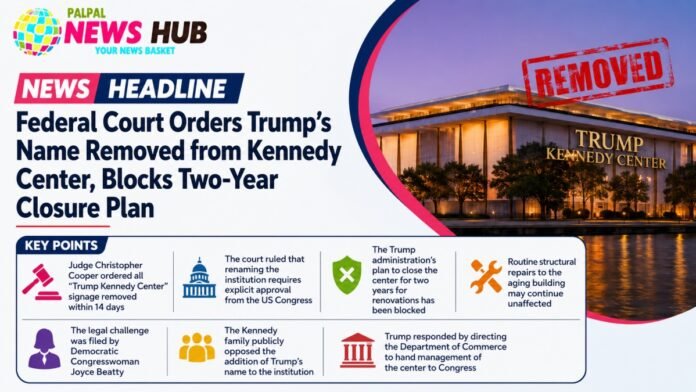
Key Points
- Judge Christopher Cooper ordered all “Trump Kennedy Center” signage removed within 14 days
- The court ruled that renaming the institution requires explicit approval from the US Congress
- The Trump administration’s plan to close the center for two years for renovations has been blocked
- Routine structural repairs to the aging building may continue unaffected
- The legal challenge was filed by Democratic Congresswoman Joyce Beatty
- The Kennedy family publicly opposed the addition of Trump’s name to the institution
- Trump responded by directing the Department of Commerce to hand management of the center to Congress
US President Donald Trump has suffered a significant legal setback over his administration’s attempt to attach his name to one of America’s most celebrated cultural institutions. A federal court in Washington has ruled that Trump’s name must be removed from the Kennedy Center for the Performing Arts, finding that any change to the institution’s official name requires the approval of the US Congress.
Judge Christopher Cooper issued the ruling and granted the Trump administration a strict 14-day window to comply. Within that period, all signage bearing Trump’s name must be taken down from the premises, and the designation “Trump Kennedy Center” is to be discontinued in all official documents and communications.
Congress, Not the President, Holds Naming Authority
At the heart of the court’s decision is a fundamental question of institutional authority. The Kennedy Center was established by an act of Congress as a living memorial to former President John F. Kennedy. The court ruled clearly that the power to change the name of such a congressionally created institution lies exclusively with the legislature, not with the executive branch.
The ruling also blocked the Trump administration’s plan to shut the center for two years to carry out major renovations. However, the court distinguished a full closure and necessary maintenance, permitting ongoing structural repairs to the aging building to proceed without interruption.
How the Dispute Began
The legal conflict was set in motion by a petition filed by Democratic Congresswoman Joyce Beatty. The controversy stems from a decision made by the center’s board, chaired by Trump, which passed a proposal to rename the institution the “Trump and Kennedy Center.” Following that vote, Trump’s name was physically inscribed above Kennedy’s on the main facade of the building, a move that triggered immediate and widespread backlash.
Members of the Kennedy family were vocal in their opposition, strongly objecting to the addition of Trump’s name to a memorial dedicated to the 35th President. Several other members of the center’s own board also raised formal objections, questioning both the process and the legitimacy of the renaming decision.
Trump Pushes Back
President Trump reacted sharply to the court’s ruling on social media. He directed the Department of Commerce to transfer full management and oversight of the center to Congress, effectively distancing his administration from responsibility for the institution. Trump argued that the planned repairs, scheduled to begin next month, cannot be safely carried out while the building remains open to the public, and that the court’s order to keep the center operational poses a genuine risk to public safety.
Part of a Broader Washington Transformation Plan
The Kennedy Center dispute is one element of a sweeping and ambitious plan Trump has been developing to reshape several of Washington’s most prominent landmarks and public spaces. Among the proposals under consideration are the construction of a 250-foot monumental arch and the development of a 90,000-square-foot ballroom, projects that reflect the administration’s broader ambition to leave a visible architectural legacy on the nation’s capital.