



































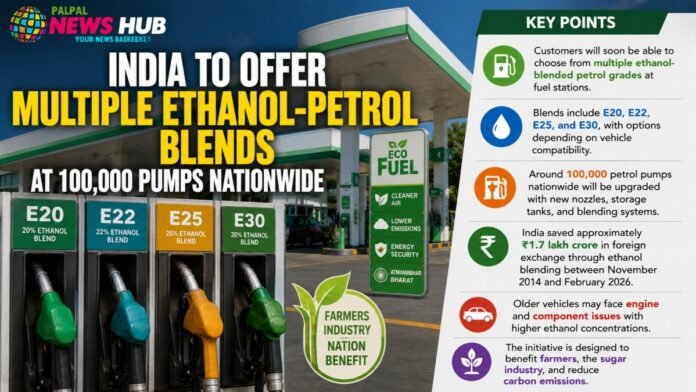
Key Points
- Customers will soon be able to choose from multiple ethanol-blended petrol grades at fuel stations
- Blends include E20, E22, E25, and E30, with options depending on vehicle compatibility
- Around 100,000 petrol pumps nationwide will be upgraded with new nozzles, storage tanks, and blending systems
- India saved approximately ₹1.7 lakh crore in foreign exchange through ethanol blending between November 2014 and February 2026
- Older vehicles may face engine and component issues with higher ethanol concentrations
- The initiative is designed to benefit farmers, the sugar industry, and reduce carbon emissions
India’s petrol retail landscape is on the verge of a significant transformation. The Central Government is moving swiftly toward offering customers a choice of ethanol-blended petrol grades at fuel stations across the country, rather than a single standard fuel option. Implementation is expected in the near future, with both state-owned and private oil companies already directed to begin building the required infrastructure.
Under the proposed framework, customers will be able to select from blends such as E20, E22, E25, or E30, with the appropriate choice depending on their vehicle’s engine type and compatibility. The Bureau of Indian Standards has now established the necessary quality benchmarks for these blends, clearing a key regulatory hurdle and enabling the government to accelerate the rollout.
Understanding Ethanol-Blended Petrol
E20, the most commonly discussed blend, consists of 20 percent ethanol mixed with 80 percent conventional petrol. Higher-grade options such as E25 and E30 contain proportionally greater shares of ethanol.
The government had also previously proposed authorizing the development and sale of vehicles designed to run entirely on ethanol, signaling a broader long-term push toward alternative fuels.
Two Public Concerns Worth Addressing
Despite official enthusiasm, two significant concerns remain widespread among vehicle owners.
The first is mileage. Ethanol carries a lower energy density than petrol, meaning that as the ethanol proportion in a blend increases, vehicles may deliver fewer kilometers per liter. The government, however, counters this by asserting that E20 fuel improves engine performance and acceleration without causing any meaningful drop in mileage.
The second concern affects owners of older vehicles. Higher ethanol concentrations can degrade rubber seals, hoses, and plastic components found in engines not designed for such fuels. Ethanol’s tendency to absorb atmospheric moisture also raises the risk of internal corrosion and mechanical wear over time, a factor that older vehicle owners will need to consider carefully before opting for higher-blend fuels.
Infrastructure Upgrades Across 100,000 Outlets
The rollout will require physical modifications at roughly 100,000 petrol pumps across the country. Each outlet will need new dispensing nozzles, upgraded underground storage tanks, and blending control systems capable of handling multiple fuel grades simultaneously. Experts suggest the cost and complexity of these upgrades are manageable. Pumps will also be required to clearly display the type of blend available and its corresponding price, ensuring transparency for consumers.
Economic and Environmental Gains
The government’s push is driven by compelling economic and environmental data. Between November 2014 and February 2026, India’s ethanol blending program helped the country save approximately ₹1.7 lakh crore in foreign exchange by reducing crude oil import dependency. Alongside these savings, measurable reductions in carbon emissions have been recorded as a direct result of the program.
With domestic ethanol production now rising steadily, the government also sees an opportunity to direct greater benefits toward the agricultural sector and the sugar industry by expanding demand for higher-blend options such as E22 and E30.