



































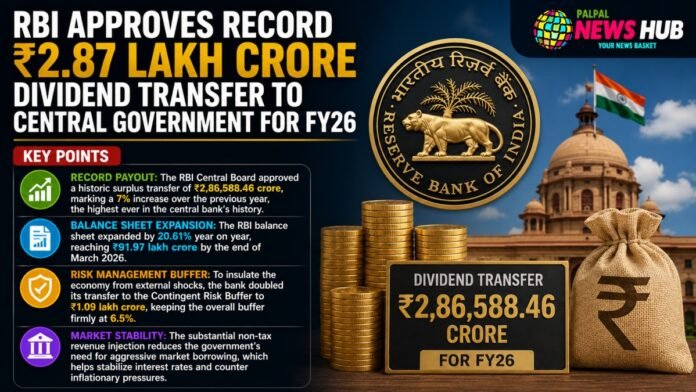
Key Points
- Record Payout: The RBI Central Board approved a historic surplus transfer of ₹2,86,588.46 crore, marking a 7% increase over the previous year, the highest ever in the central bank’s history.
- Balance Sheet Expansion: The RBI balance sheet expanded by 20.61% year on year, reaching ₹91.97 lakh crore by the end of March 2026.
- Risk Management Buffer: To insulate the economy from external shocks, the bank doubled its transfer to the Contingent Risk Buffer to ₹1.09 lakh crore, keeping the overall buffer firmly at 6.5%.
- Market Stability: The substantial non-tax revenue injection reduces the government’s need for aggressive market borrowing, which helps stabilise interest rates and counter inflationary pressures.
The Reserve Bank of India (RBI) announced a record-breaking dividend payout to the Central Government on Friday, providing a major financial cushion as the nation navigates volatile global markets. Meeting in Mumbai for its 623rd Central Board of Directors assembly, the RBI approved a surplus transfer of ₹2,86,588.46 crore for the accounting year 2025-26.
Presided over by RBI Governor Sanjay Malhotra, the board analysed prevailing domestic economic indicators alongside downside risks arising from prolonged geopolitical turbulence in West Asia. The unprecedented dividend payout acts as an immediate fiscal buffer, helping the government offset rising import costs and heavier state outlays for fertiliser and fuel subsidies without expanding its fiscal deficit target.
Income Surge Driven by Forex Operations and Global Yields
The central bank’s robust financial performance was underpinned by a 26.42% increase in gross income over the previous financial year. Concurrently, operational expenditure before risk provisions ticked upward by 27.60%. This translated to a net income of ₹3,95,972.10 crore before risk provisioning, a notable leap from the ₹3,13,455.77 crore recorded in the preceding fiscal year.
According to market analysts, the massive income surge was heavily driven by the RBI’s aggressive foreign exchange market interventions, where it conducted large-scale sales of US dollars to shield the Indian rupee from depreciation pressures. Additionally, elevated yields on foreign securities and overseas asset deployments significantly strengthened the bank’s bottom line, pushing its cumulative balance sheet size up by 20.61% to a staggering ₹91.97 lakh crore.
Strengthening Internal Buffers Against Global Volatility
While the dividend represents an immense windfall for the state treasury, the RBI balanced the transfer with prudent risk management. Under the revised Economic Capital Framework (ECF), the central bank is mandated to maintain its Contingent Risk Buffer (CRB) within a flexible range of 4.5% to 7.5% of its total balance sheet size.
Factoring in current macroeconomic uncertainties, the board elected to secure a substantial safety net by transferring ₹1,09,379.64 crore into the CRB, a major escalation from the ₹44,861.70 crore provisioned last year. This deployment keeps the defensive risk cushion pinned precisely at 6.5% of the total balance sheet. Economists note that the final surplus payout could have exceeded ₹3.5 lakh crore had the central bank not fortified its emergency reserves to deal with evolving domestic and global shocks.
Macroeconomic Ledger: RBI Financial Overview (FY25 vs FY26)
The comparative financial trajectory highlights the substantial growth in the central bank’s operational metrics over the past two financial cycles.
| Financial Indicator | FY 2024-25 | FY 2025-26 | Year-on-Year Change |
|---|---|---|---|
| Gross Income Growth | Base Year | — | +26.42% |
| Pre-Provision Net Income | ₹3,13,455.77 Crore | ₹3,95,972.10 Crore | +26.32% |
| Contingent Risk Buffer (CRB) Transfer | ₹44,861.70 Crore | ₹1,09,379.64 Crore | +143.81% |
| Total Balance Sheet Size | Base Year | ₹91.97 Lakh Crore | +20.61% |
| Final Surplus Transfer to Government | ₹2,68,590.00 Crore | ₹2,86,588.46 Crore | +6.70% |
Mitigating Market Borrowing and Taming Inflation
The ₹2.87 lakh crore capital injection aligns closely with the Union Government’s broader budgetary expectations, where it projected an estimated receipt of ₹3.16 lakh crore in dividends and surplus pools from the RBI, nationalised banking firms, and public financial bodies for the fiscal year 2026-27.
By securing this non-debt revenue, the government can effectively lower its planned market borrowing programs for the year. When state authorities are forced to rely heavily on debt to clear expenditure commitments, they crowd out private sector credit, causing domestic bank interest rates to climb and driving retail inflation upward. With this massive cash reserve safely in hand, liquidity balances will remain optimised, providing structural support to keep interest rates steady and consumer inflation well within targeted boundaries.