


































Key Points
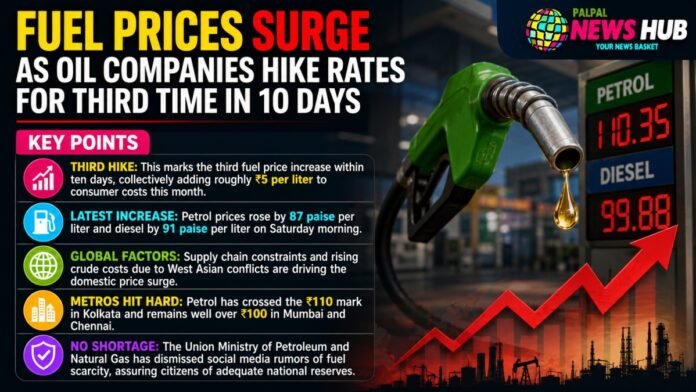
- Third Hike: This marks the third fuel price increase within ten days, collectively adding roughly ₹5 per liter to consumer costs this month.
- Latest Increase: Petrol prices rose by 87 paise per liter and diesel by 91 paise per liter on Saturday morning.
- Global Factors: Supply chain constraints and rising crude costs due to West Asian conflicts are driving the domestic price surge.
- Metros Hit Hard: Petrol has crossed the ₹110 mark in Kolkata and remains well over ₹100 in Mumbai and Chennai.
- No Shortage: The Union Ministry of Petroleum and Natural Gas has dismissed social media rumors of fuel scarcity, assuring citizens of adequate national reserves.
Citizens woke up to another wave of inflationary pressure on Saturday morning as domestic oil marketing companies implemented yet another steep hike in fuel prices. This latest adjustment marks the third major increase within the last ten days, forcing commuters and logistics operators to stretch their budgets even further.
On Saturday, a nationwide increase of 87 paise per liter for petrol and 91 paise per liter for diesel was recorded across India. This follows a substantial hike of nearly ₹3 on May 16, and a subsequent 90 paise increase on May 19. Cumulatively, the successive hikes have burdened consumers with an additional cost of approximately ₹5 per liter in less than two weeks.
Global Crude Pressures and the West Asia Crisis
The driving force behind the escalating domestic rates lies in the international crude market. Ongoing geopolitical turbulence and conflicts in West Asia have severely disrupted traditional oil supply routes, driving up global crude benchmarks.
Because India relies on imports for over 85% of its oil needs, domestic state-owned oil corporations are highly sensitive to these global market shocks. The sustained upward pressure on international Brent crude has left state retailers with little choice but to pass the escalating procurement costs onto the end consumer.
Retail Rates Across Major Metro Cities
Following the latest revision, retail fuel prices have reached new highs across major metropolitan hubs. In the national capital, Delhi, petrol rose to ₹99.51 per liter while diesel climbed to ₹92.49 per liter.
| City | Petrol (₹/liter) | Increase | Diesel (₹/liter) | Increase |
| Delhi | 99.51 | +0.87 | 92.49 | +0.91 |
| Kolkata | 110.64 | +0.87 | 97.02 | +0.91 |
| Mumbai | 108.49 | +0.87 | 95.02 | +0.91 |
| Chennai | 105.31 | +0.87 | 96.98 | +0.91 |
| Bhopal | 110.75 | +0.87 | 95.91 | +0.91 |
| Gurugram | 100.38 | +0.87 | 92.92 | +0.91 |
| Noida | 98.78 | +0.87 | 93.12 | +0.91 |
Other metropolitan areas continue to bear a heavier tax and freight burden, with prices in Kolkata retailing at ₹110.64 for petrol and ₹97.02 for diesel. In Mumbai, petrol reached ₹108.49 per liter, while Chennai saw petrol touch ₹105.31 per liter. Satellite cities like Noida and Gurugram also mirrored these upward trends, impacting thousands of daily corporate commuters.
Government Quells Shortage Rumors, Warns of Inflationary Ripple
As price anxiety grew, unverified rumors regarding fuel shortages and dry pumps began circulating widely on social media platforms. Addressing these concerns directly, the Union Ministry of Petroleum and Natural Gas issued an official statement assuring the public that India possesses robust and adequate reserves of both petrol and diesel.
The Ministry appealed to citizens to refrain from panic buying, acknowledging that while sudden surges in demand have caused minor, temporary pressure at select retail outlets, oil companies are actively managing supply lines.
Nevertheless, economic experts warn that the ripples of these fuel hikes will extend far beyond vehicle owners. Higher diesel rates directly elevate the cost of transporting essential goods, agricultural produce, and manufactured items, signaling a broader inflationary impact on the retail market in the coming weeks.