
































Key Points
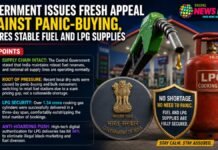
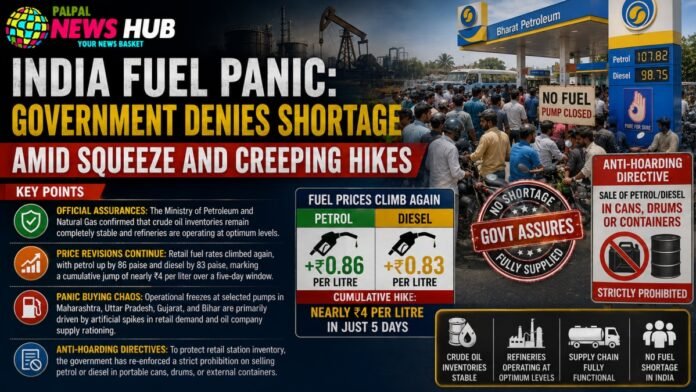
- Official Assurances: The Ministry of Petroleum and Natural Gas confirmed that crude oil inventories remain completely stable and refineries are operating at optimum levels.
- Price Revisions Continue: Retail fuel rates climbed again, with petrol up by 86 paise and diesel by 83 paise, marking a cumulative jump of nearly ₹4 per liter over a five-day window.
- Panic Buying Chaos: Operational freezes at selected pumps in Maharashtra, Uttar Pradesh, Gujarat, and Bihar are primarily driven by artificial spikes in retail demand and oil company supply rationing.
- Anti-Hoarding Directives: To protect retail station inventory, the government has reinforced a strict prohibition on selling petrol or diesel in portable cans, drums, or external containers.
Addressing a routine inter-ministerial briefing on the ripples of the West Asia crisis, Sujata Sharma, Joint Secretary at the Ministry of Petroleum and Natural Gas, firmly countered public anxieties regarding a potential fuel shortage. The Ministry clarified that India’s macro-level crude stockpiles are well-maintained, and state-owned refineries continue to process at full capacity. Government data shows that the vast majority of the nation’s retail points are operating normally, with no systemic “dry outs” or operational collapses reported at the institutional level.
However, the psychological impact of the ongoing geopolitical friction in West Asia, compounded by public appeals for energy conservation, has triggered severe logistical imbalances on the ground. Transporters and retail associations report that oil marketing companies (OMCs) have begun subtle supply adjustments and credit rationing to curb under recoveries. For instance, in tier 2 clusters and specific metropolitan pockets, companies are practicing targeted allocations, sometimes fulfilling only half of a dealer’s standard daily requisition order. This containment strategy has unintentionally amplified public anxiety, turning minor delivery delays into temporary closures.
Creeping Price Hikes and Retail Squeezes
The underlying friction is an aggressive price correction cycle forced by rising international crude costs. Following months of retail price stabilization, state, run oil marketing companies have executed back, to, back hikes within a single week to offset massive operational losses, which were estimated at nearly ₹1,000 crore daily before recent interventions.
  [ West Asia Geopolitical Volatility ]
                    │
                    ▼
  [ Brent Crude Surges Past $100/Barrel ]
                    │
                    ▼
  [ OMC Financial Squeeze / Under-Recoveries ]
                    │
   ┌────────────────┴────────────────┐
   ▼                                 ▼
[ Creeping Price Hikes ]    [ Targeted Supply Rationing ]
* Petrol up 86p, Diesel 83p  • Strict tanker cycles
* ~₹4 increase in 5 days     • Localized delivery delays
   │                                 │
   └────────────────┬────────────────┘
                    ▼
     [ Panic Buying at Retail Outlets ]
The fresh increase of 86 paise per liter for petrol and 83 paise for diesel pushes cumulative consumer costs up by roughly ₹4 over a short span. While these fiscal updates are aimed at stabilizing OMC balances, they have simultaneously sent panic signals down to retail consumers. In states like Maharashtra and Uttar Pradesh, consumer footfall surged by up to 50% over standard cycles, draining local station reservoirs faster than specialized tankers could complete their scheduled transit runs.
Strict Measures Against Retail Hoarding
Faced with massive queues and reports of verbal altercations at multiple urban fuel points, the Petroleum Ministry has instructed local district administrations to deploy strict inventory controls. While individual consumers retain the right to top up their vehicle fuel tanks to maximum capacity, a complete embargo has been reimposed on external storage sales.
Retail operators are legally barred from dispensing loose petrol or diesel into plastic jerrycans, industrial drums, or agricultural containers. This directive is designed to prevent black marketing and hoarding by commercial operators looking to exploit future price expectations. Additionally, public officials have requested corporate sectors to utilize work, from, home protocols where viable to naturally lower retail pressure on the distribution network while international supplies stabilize.