

































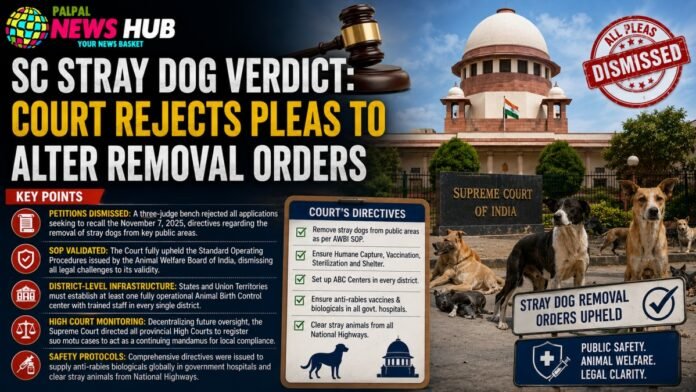
Key Points
- Petitions Dismissed: A three-judge bench rejected all applications seeking to recall the November 7, 2025, directives regarding the removal of stray dogs from key public areas.
- SOP Validated: The Court fully upheld the Standard Operating Procedures issued by the Animal Welfare Board of India, dismissing all legal challenges to its validity.
- District-Level Infrastructure: States and Union Territories must establish at least one fully operational Animal Birth Control center with trained staff in every single district.
- High Court Monitoring: Decentralizing future oversight, the Supreme Court directed all provincial High Courts to register suo motu cases to act as a continuing mandamus for local compliance.
- Safety Protocols: Comprehensive directives were issued to supply anti-rabies biologicals globally in government hospitals and clear stray animals from National Highways.
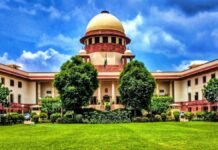
In a decisive judgment pronounced on May 19, 2026, the Supreme Court firmly prioritized the citizen’s right to safe public spaces. A three-judge bench comprising Justice Vikram Nath, Justice Sandeep Mehta, and Justice N.V. Anjaria dismissed a batch of review petitions and interlocutory applications filed by animal rights groups. These petitions sought to dilute or roll back the court’s previous November 7, 2025, directives, which mandated the systematic clearing of stray dogs from highly sensitive public locations, such as schools, hospitals, railway stations, and bus stands.
The apex court observed that the right to life and free movement under Article 21 of the Constitution cannot be compromised by the constant apprehension of physical mauling. The bench highlighted a deep, seated institutional failure since the introduction of the Animal Birth Control framework in 2001, labeling past state efforts as sporadic, underfunded, and profoundly lacking in planning. Citing alarming localized data, such as Rajasthan’s Sri Ganganagar recording over 1,000 dog bites in a single month and Tamil Nadu registering over two lakh cases early in the year, the court ruled that the human cost of administrative inaction had assumed deeply disturbing proportions.
Decentralized Enforcement and Euthanasia Clauses
To ensure the ruling translates into effective action rather than remaining on paper, the Supreme Court decentralized the long-term monitoring mechanism. Acknowledging that centralized supervision from New Delhi would be highly ineffective given the sheer geographical scale of the crisis, the bench commanded all regional High Courts across India to register independent, suo motu writ petitions. These high courts are now fully empowered to haul up local municipal commissioners, initiate immediate contempt proceedings, and penalize administrative lapses. Chief Secretaries of all states have been given a strict deadline of August 17, 2026, to file their first comprehensive compliance affidavits.
       [ Supreme Court Mandate (May 19, 2026) ]
                         │
                         ▼
        [ Suo Motu High Court Mandamus ]
                         │
        ┌────────────────┴────────────────┐
        ▼                                 ▼
[ District ABC Infrastructure ]  [ Highway Safety Framework ]
 • 1+ Center per District         • NHAI Relocation Drives
 • Standardized Vet Equipment     • High-Volume Vaccine Stocks
 • Euthanasia for Aggressive/Rabid Cases
The detailed guidelines also outline strict rules for animal handling and public health. Every administrative district across India is legally bound to set up at least one fully equipped Animal Birth Control center, backed by trained veterinary personnel and modern surgical tools. Striking a delicate balance on extreme cases, the judgment explicitly permits civic bodies to employ legally permissible measures, including euthanasia, strictly in line with statutory protocols for incurably ill, rabid, or demonstrably dangerous and aggressive dogs that pose a continued threat to human life.
Infrastructure Mandates for Highways and Healthcare
Beyond urban centers, the apex court extended its safety net to transit networks and primary healthcare facilities. The National Highways Authority of India, in direct coordination with respective state administrations, has been ordered to build a time-bound mechanism to clear stray animals from national highways and expressways, utilizing specialized transport vehicles for safe relocation to prevent catastrophic high-speed traffic accidents.
Concurrently, to address the immediate aftermath of animal encounters, the court directed a massive logistical upgrade for public health systems. All government medical centers and primary healthcare points are now legally required to maintain uninterrupted, adequate stocks of anti-rabies vaccines and immunoglobulin. To protect local municipal workers and veterinary officers from legal harassment while executing these mass relocation and sanitation drives, the Supreme Court granted them explicit protection, directing that no FIR or criminal proceeding shall be ordinarily initiated against public officials for bona fide actions undertaken to implement the court’s charter.