































Key Highlights
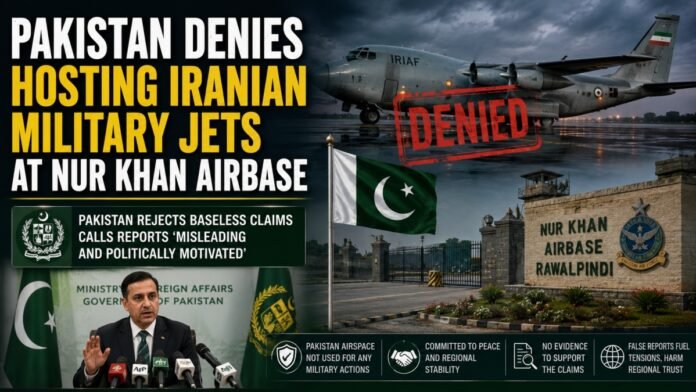
- Controversial Report: U.S. officials claim Iran parked an RC,130 reconnaissance plane at Pakistan’s Nur Khan base to avoid American strikes.
- Official Denial: Islamabad describes the reports as misleading, stating aircraft were only present to facilitate diplomatic peace talks.
- Mediator Under Scrutiny: Senator Lindsey Graham questions Pakistan’s neutrality, citing past statements regarding regional security.
- Afghanistan Connection: Reports emerge of an Iranian Mahan Air civilian plane being diverted to Kabul and Herat during the hostilities.
- Strategic Shift: Latest data reveals that 80% of Pakistan’s major weaponry is now supplied by China, complicating its regional balancing act.
A startling report from a U.S. news outlet has ignited a diplomatic firestorm, claiming that Pakistan quietly permitted Iranian military aircraft to be stationed at its airbases during the height of the recent U.S., Iran conflict. According to the report, which cites anonymous U.S. officials, the move was intended to safeguard Iranian aviation assets from direct American airstrikes. This development comes just weeks after a fragile ceasefire was brokered in April 2026, threatening to destabilize the ongoing peace negotiations in Islamabad.
The most sensational claim involves the Nur Khan Airbase in Rawalpindi. The report suggests that shortly after President Donald Trump announced the ceasefire on April 8, Tehran dispatched multiple military assets to the facility, including a specialized RC-130 reconnaissance and intelligence gathering aircraft.
Pakistan’s Categorical Rejection
A senior Pakistani government official has vehemently dismissed these allegations, calling them entirely false and baseless. The Foreign Ministry clarified that while Iranian and American aircraft were indeed present at Nur Khan, they were there solely to transport diplomatic personnel, security teams, and administrative staff involved in the first round of peace talks.
The official further noted that the Nur Khan base is located in a densely populated urban area, making it impossible to hide a fleet of foreign military aircraft from the public eye. Islamabad maintains that its role is strictly that of a neutral mediator and that such reports are designed to undermine regional stability.
Washington Reacts: Senator Lindsey Graham’s Warning
The report has triggered a sharp reaction in Washington DC. Prominent Republican Senator Lindsey Graham took to social media to express his skepticism regarding Pakistan’s role. Graham stated that if the reports are accurate, the United States must conduct a complete re-evaluation of Pakistan’s status as a mediator. He noted that, given previous statements by Pakistani defense officials regarding regional allies, he would “not be shocked” if the claims of military assistance to Tehran were true.
The Afghanistan Angle and Civilian Diversions
The scope of the report extends beyond Pakistan, claiming that Iran also moved civilian aircraft to neighboring Afghanistan to escape the conflict zone. An Afghan civil aviation official reportedly confirmed that a Mahan Air aircraft landed in Kabul just before the war began. Due to the closure of Iranian airspace, the plane was later moved to Herat Airport, situated near the border, after a period of operational uncertainty.
Growing Dependence on China
The controversy highlights Pakistan’s increasingly complex geopolitical position. While Islamabad attempts to maintain a balance between Washington and Tehran, its military leanings have shifted significantly toward Beijing. Recent studies from the Stockholm International Peace Research Institute (SIPRI) confirm that between 2020 and 2024, approximately 80% of Pakistan’s major arms imports originated from China. This strategic dependency adds a layer of difficulty to Pakistan’s efforts to appear as a neutral arbiter in West Asian conflicts.
Also Read: “Xi Jinping respects me,” Donald Trump made a bold claim ahead of his Beijing visit, while simultaneously issuing a surprising statement regarding the future of Taiwan.