



































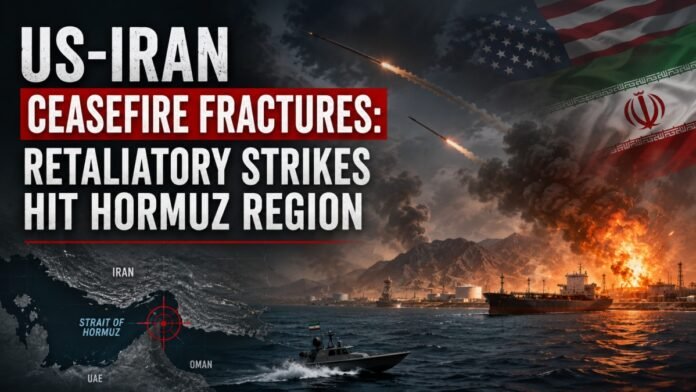
Key Points
- U.S. forces struck military and command centers in Bandar Abbas and Qeshm Island.
- The strikes were retaliation for an Iranian missile and drone assault on three U.S. destroyers.
- President Trump dismissed the escalation as a “love tap,” asserting the ceasefire remains intact.
- Iran’s Supreme Leader, Mojtaba Khamenei, has placed the nation’s air defense on high alert.
- Secretary of State Marco Rubio has fast-tracked a $25.8 billion arms package for Middle Eastern allies.
Despite a shaky ceasefire agreement, military tensions between Washington and Tehran reached a boiling point on May 7, 2026. Following a series of Iranian attacks targeting international shipping lanes, the United States military launched a wave of retaliatory strikes against key strategic assets in Iran, specifically targeting the Qeshm and Bandar Abbas regions. Reports indicate that U.S. forces successfully neutralized several military bases, launch sites, and command centers used to coordinate recent maritime assaults.
This offensive was prompted by a significant engagement on May 7, when Iranian forces launched a coordinated barrage of missiles and suicide drones at a trio of U.S. Navy guided-missile destroyers. The vessels were transiting toward the Gulf of Oman when they came under fire. While Iran claims the destroyers sustained “significant damage,” U.S. Central Command maintains that all incoming threats were intercepted with zero damage to American hardware.
“Love Taps” and Butterflies: The White House Response
President Donald Trump took to Truth Social to characterize the U.S. response as a “love tap,” reassuring the public that the broader ceasefire has not been officially abandoned. The President described the engagement in vivid terms, claiming that Iranian drones were “incinerated” in mid-air and “plummeted like dying butterflies.”
Trump further asserted that numerous Iranian small boats were sunk during the exchange. “They trifled with us today,” the President told reporters, “and we blew them away.” Despite the intensity of the kinetic exchange, the administration continues to push for a final diplomatic deal, even as it reinforces its “Wall of Steel” naval blockade.
Tehran Activates High-Level Air Defenses
In response to the U.S. strikes, Iran’s capital and southern provinces have transitioned to a state of high alert. The Iranian news agency Mehr reported explosions in the cities of Sirik and Minab, located in the Hormozgan province, as the nation’s advanced air defense systems were fully activated.
The Iranian military has lodged a fierce diplomatic protest, accusing the United States of a “gross violation” of the ceasefire by allegedly targeting civilian areas during the Qeshm offensive. Meanwhile, Iranian state media claimed their forces successfully retaliated by striking 228 U.S. military facilities, though these figures remain unverified by international observers. The situation is being closely monitored by Supreme Leader Mojtaba Khamenei, who has directed the military to prepare for a “crushing response” if further incursions occur.
A $25.8 Billion Strategic Shift
The military escalation has been accompanied by a massive surge in regional defense spending. Secretary of State Marco Rubio has officially approved an arms package valued at $25.8 billion, aimed at bolstering the defense capabilities of Middle Eastern partners. This move coincides with increased regional activity, including the activation of UAE air defense systems on May 8 to intercept stray missiles and drone threats originating from the conflict zone.
As U.S. Central Command releases imagery of combat flight operations from the USS George H.W. Bush, diplomatic observers fear that the window for a peaceful resolution is rapidly closing. While both sides claim to desire the maintenance of the April 8 ceasefire, the increasing scale of retaliatory “love taps” suggests a return to full-scale regional conflict may be imminent.