





























Key Highlights
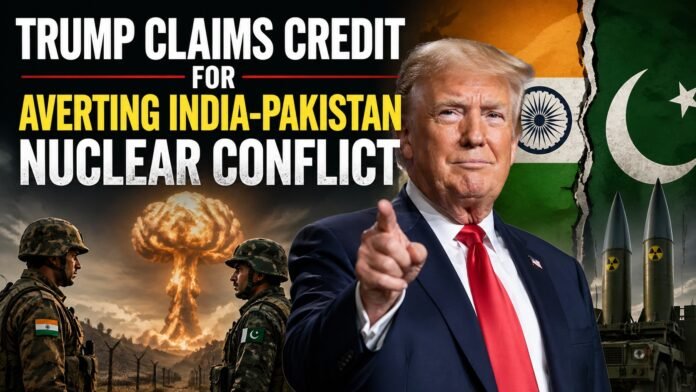
- Conflict Intervention: Trump claims to have stopped the 2025 Indo-Pak military clash from becoming a total war.
- The Sharif Conversation: Pakistan’s PM reportedly thanked Trump for saving “30 to 50 million lives.”
- Economic Pressure: The U.S. President cited threats of total trade termination and massive tariffs as his primary de-escalation tools.
- Nobel Aspirations: Trump stated he has resolved eight global conflicts during his second term, earning multiple Nobel Prize nominations.
- Military Toll: The President highlighted the 2025 air skirmishes, noting that 11 aircraft were shot down before his intervention.
In a press conference held at his New York headquarters on May 1, 2026, President Donald Trump reflected on what he termed a “historic streak of peacemaking” during his second term. Central to his address was the military standoff between India and Pakistan that occurred roughly one year ago. Trump contended that his intervention prevented the loss of millions of lives, describing the situation as the most dangerous nuclear flashpoint in modern history.
According to the President, this successful mediation is part of a broader pattern. He claimed to have personally halted eight potential or ongoing conflicts since January 2025, using a unique brand of “transactional diplomacy.” By leveraging the strength of the American economy, Trump argued he forced both New Delhi and Islamabad to the negotiating table by threatening to sever all trade ties and impose crippling 100% tariffs on their exports.
The Shehbaz Sharif Dialogue and the “50 Million” Figure
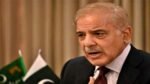
Trump provided specific details regarding a conversation with Pakistani Prime Minister Shehbaz Sharif following the ceasefire. According to the U.S. President, Sharif expressed deep gratitude, acknowledging that without the American ultimatum, the conflict would have escalated into a nuclear exchange.
The President quoted Sharif as saying that Trump’s actions saved between 30 and 50 million people, though Trump added that the “actual figure could have been even higher” given the population density of the region. He used this anecdote to contrast his administration’s “results-oriented” approach with the “endless wars” of previous decades, noting that several world leaders have submitted letters nominating him for the Nobel Peace Prize in response to these efforts.
Context of the 2025 Escalation
The conflict in question, which peaked in mid-2025, saw the most intense aerial combat between the two nuclear-armed neighbors in decades. Sparked by a “Pulwama-style” incident that led to immediate retaliatory strikes, the skirmishes resulted in the loss of 11 aircraft across both sides.
As the two nations moved heavy artillery to the Line of Control and mobilized their respective strike corps, the global community feared a full-scale invasion was imminent. Trump asserted that at the height of this tension, he made “the calls no one else could make,” informing both leaderships that their access to the American market would be permanently revoked within 24 hours if a truce was not signed.
A Shift in Global Diplomacy
The President’s latest statements come at a time when U.S. relations with traditional allies remain strained. As seen in recent months with the Iran conflict and the Greenland sovereignty dispute, the Trump administration has increasingly relied on bilateral pressure rather than multilateral alliances like NATO.
While some critics argue that “tariff-based diplomacy” risks long-term economic stability, Trump’s supporters point to the current absence of a full-scale war in South Asia as proof of the policy’s effectiveness. As of today, May 1, 2026, the ceasefire remains in place, though regional analysts warn that the underlying causes of the 2025 conflict remain unresolved.