



































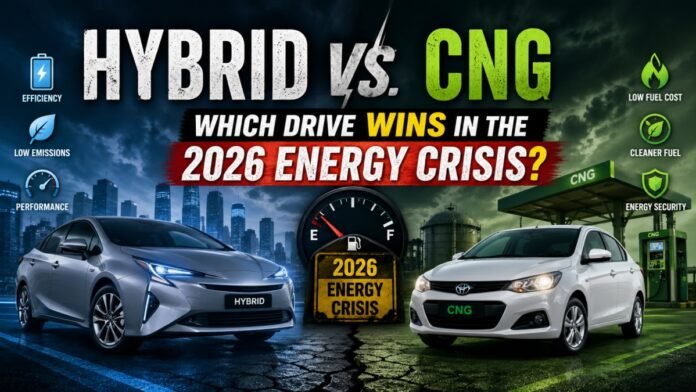
Key Highlights
- 2026 GST Reform: Small hybrids and CNG vehicles are now taxed at a uniform 18%, down from the previous 28% plus cess, significantly lowering entry costs.
- Energy Vulnerability: The March 2026 closure of the Strait of Hormuz has triggered a 30% surge in global gas prices, challenging the “low cost” dominance of CNG.
- Market Milestone: Alternative fuel vehicles, including Hybrids and CNG, captured nearly 30% of India’s 4.67 million passenger vehicle sales in FY2026.
- Infrastructure Shift: Hybrid and EV charging networks are expanding into highways, while CNG remains largely city-centric and prone to supply queues.
- Resale Value: Strong Hybrids are seeing higher resale premiums as they serve as the primary bridge to a fully electric future.
As of late April 2026, the global conversation around sustainable mobility has accelerated beyond environmental ethics into the realm of survival. With the Middle East conflict entering its second month and the Strait of Hormuz remaining blockaded, energy security has become the top priority for the modern driver. In this climate, both Compressed Natural Gas (CNG) and Hybrid Electric Vehicles (HEVs) have emerged as pragmatic alternatives to pure petrol, yet their long-term trajectories are diverging under the weight of current geopolitical realities.
The Case for Hybrids: The Bridge to Tomorrow
Hybrid cars, those that pair an internal combustion engine with an electric motor, have shed their image as niche products. In FY2026, the sector witnessed a 16% surge in wholesales, largely thanks to the government’s 18% GST mandate on small hybrid vehicles. This policy has brought the price of premium hybrids closer to conventional models, making them an attractive middle ground.
The primary advantage of hybrids in the current 2026 crisis is their “infrastructure independence.” Unlike EVs that require chargers or CNG cars that require filling stations, a strong hybrid harvests energy through regenerative braking. In India’s congested urban centers, where stop-and-start traffic is the norm, hybrids are delivering 30 to 50% better fuel efficiency than standard engines without the “range anxiety” often associated with pure electrification.
The Case for CNG: Economic Relief Under Pressure
CNG has long been the champion of the budget-conscious consumer, particularly for high-mileage fleet operators. By the end of March 2026, Tata Motors alone reported selling 1.7 lakh CNG units, emphasizing the fuel’s massive scale. Historically, CNG has offered running costs nearly 50% lower than petrol.
However, the “Hormuz factor” has introduced a new layer of risk. With natural gas exports from Qatar and the UAE currently stranded, domestic gas prices have spiked. This supply shock, combined with the 126% US duty on some energy imports, has made CNG pricing far less predictable than it was a year ago. Furthermore, while CNG burns 25% cleaner than petrol, it remains a fossil fuel subject to the same carbon tax pressures that are expected to intensify toward 2030.
Competitive Analysis: Hybrid vs. CNG (2026)
| Feature | Hybrid Electric (HEV) | Compressed Natural Gas (CNG) |
|---|---|---|
| Tax Rate (Small) | 18% GST (Reduced) | 18% GST (Stable) |
| Running Cost | Moderate (25-30 km/l) | Lowest (when gas supply is stable) |
| Infrastructure | Zero dependency | High (limited to urban gas grids) |
| Emissions | Very Low (CO2 and PM) | Low (CO2 reduction of 25%) |
| Market Share | Growing rapidly in private sector | Dominant in taxi and budget segments |
The Policy Landscape and the Road Ahead
The policy direction in New Delhi is unmistakably tilting toward electrification. While CNG is still supported as a transitional fuel, the 2026 “GST Reform 2.0” has explicitly incentivized small hybrids to help India meet its global climate commitments. Production, linked incentives for manufacturers like Maruti Suzuki and Toyota are already resulting in a wider selection of hybrid models reaching showrooms.
Looking at the decade ahead, experts suggest that CNG will maintain its grip on the commercial fleet market, where total cost of ownership is the sole metric. However, for the private car buyer, hybrids offer a more resilient path. As battery costs continue to decline and the 2026 energy crisis forces a rethink of fossil fuel dependency, the hybrid “bridge” is looking increasingly like the most stable route to a cleaner, more secure future.
Hybrids are better positioned for the long arc of the energy transition, offering a credible path toward full electrification without the infrastructure bottlenecks of CNG. While CNG remains a vital tool for cost-sensitive markets, its future is now inextricably tied to global gas stability, making the hybrid a smarter bet for those looking to future-proof their mobility.