Key Highlights
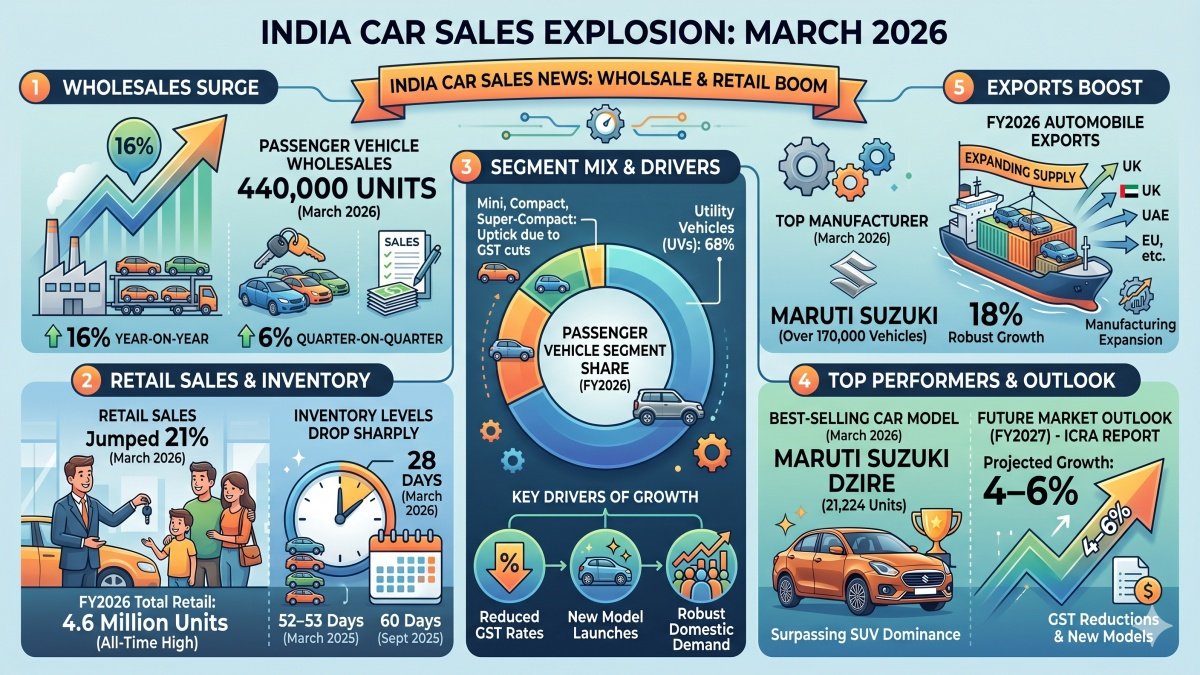
- Wholesale Record: Sales reached 440,000 units, marking a 16% year, on, year growth.
- Retail Boom: Retail sales jumped 21% in March 2026, driven by high consumer confidence.
- Inventory Efficiency: Dealer stock levels plummeted to 28 days, down from a high of 60 days in late 2025.
- Segment Trends: Utility Vehicles (UVs) dominate with a 68% market share, though compact cars are rebounding.
- Top Performer: Maruti Suzuki Dzire emerged as the nation’s best-selling model with 21,224 units.
The Indian automotive industry has reported a landmark performance for the month of March 2026. According to a report released on Monday, April 27, wholesale sales of passenger vehicles climbed to 440,000 units. This represents a substantial 16% increase compared to the same period last year and a steady 6% growth on a quarter, on, quarter basis.
Industry analysts attribute this surge to a combination of resilient domestic demand and a more favorable tax environment. An ICRA report released alongside these figures suggests that the momentum is likely to carry forward, with a projected growth of 4% to 6% for the fiscal year 2027.
The Impact of GST Reforms and Market Dynamics
The fiscal year 2026 served as a tale of two halves for the automotive sector. Following the implementation of revised Goods and Services Tax (GST) rates, the market initially saw a slight wholesale dip of 0.2% in the first half of the year. However, the second half witnessed a massive 17% recovery as consumers responded to lower price points.
Retail performance was even more striking. Total retail sales for the year reached an all-time high of 4.6 million units. This high sell-through rate had a significant impact on inventory management. Data from the Federation of Automobile Dealers Associations (FADA) indicates that inventory levels dropped to approximately 28 days by March 2026, a sharp decline from the 52 to 53 days recorded in March 2025 and the 60-day peak seen in September 2025. This lean inventory suggests that vehicles are moving off dealer lots almost as fast as they are being supplied.
Shifting Segment Preferences
While Utility Vehicles (UVs) continue to be the heavyweights of the Indian market, accounting for 68% of total sales in FY2026, the landscape is beginning to diversify. The recent GST reductions specifically benefited the mini, compact, and super compact segments, leading to a noticeable uptick in their sales volumes.
Key trends in the segments include:
- Utility Vehicles: Remain the primary driver of overall volume.
- Passenger Cars: Witnessing a resurgence as affordability improves due to tax cuts.
- Exports: Recorded a healthy 18% growth in FY2026, signaling that Indian manufacturers are successfully expanding their global supply footprint.
Maruti Suzuki Maintains Market Leadership
Maruti Suzuki solidified its position as India’s leading car manufacturer in March 2026, with total sales exceeding 170,000 units. In a surprising turn of events that challenged the recent market preference for SUVs, the Maruti Suzuki Dzire claimed the title of the country’s best-selling individual model. With 21,224 units sold in a single month, the sedan’s performance indicates that value-conscious consumers are returning to traditional segments when the pricing is right.
Looking ahead to FY2027, the industry is poised for steady expansion. The synergy of lower GST rates, a decrease in inventory carrying costs, and a consistent pipeline of new electric and internal combustion engine models is expected to keep the Indian automotive sector on a high growth trajectory.