
































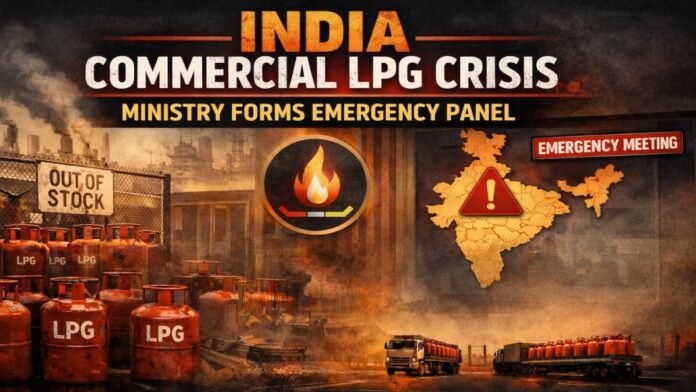
Key Highlights
- Emergency Committee: Three executive directors from top oil marketing companies will oversee supply restoration.
- Import Disruptions: Conflict in the Middle East and the closure of the Strait of Hormuz have impacted nearly 90% of India’s LPG imports.
- Production Shift: Refineries have been ordered to pivot from petrochemicals to LPG production to meet demand.
- Industrial Impact: Major hubs like Mumbai and Bengaluru report potential mass closures of eateries within days.
- Anti-Hoarding Measures: Domestic cylinder booking windows have been extended to 25 days to curb black marketing.
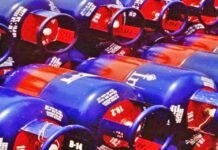
In response to a burgeoning energy crisis, the Ministry of Oil has officially formed a special task force to address the acute shortage of commercial LPG. The committee, comprised of three executive directors from state-run oil marketing companies, is tasked with stabilizing the supply chain for the hospitality sector, which has been pushed to the brink of a systemic shutdown.
The crisis stems from escalating instability in the Middle East, specifically the closure of the Strait of Hormuz, a critical maritime artery. India, which relies on imports for 62% of its total LPG demand, has seen 85% to 90% of its shipments from key suppliers like Saudi Arabia significantly delayed or diverted. With domestic kitchen supplies being the government’s primary priority, the commercial sector, which accounts for 13% of the nation’s 31.3 million-tonne annual consumption, has faced the brunt of the deficit.
Strategic Shifts in Production and Distribution
To counter the shortfall, the Ministry has issued a directive to national refineries to prioritize the production of Liquified Petroleum Gas over petrochemical derivatives. Furthermore, the government has introduced strict administrative controls to manage existing stocks. The mandatory gap between domestic cylinder bookings has been increased from 21 to 25 days, a move designed to prevent panic buying and the illegal diversion of domestic gas to commercial entities.
While the hospitality industry struggles, the government has designated hospitals and educational institutions as “essential non-domestic sectors,” ensuring they receive imported LPG on a priority basis.
Industry on High Alert: Thousands of Eateries Face Closure
The India Hotels and Restaurants Association (AHAR) has voiced grave concerns regarding the sustainability of the sector under current conditions. Reports indicate that the impact is most severe in Tier-1 cities. In Bengaluru and Mumbai alone, supply disruptions have reached a critical level. Vijay Shetty, President of AHAR, warned that without immediate intervention, the shortage could lead to the shuttering of thousands of establishments, a move that would impact both the economy and urban food security.
Already, unconfirmed reports suggest over 3,000 hotels have temporarily suspended operations in the Jaipur to Bengaluru corridor due to the exhaustion of fuel reserves.
Current LPG Market Rates (March 2026)
The following table reflects the current market prices across major metros, highlighting the high overhead costs for commercial operators.
| City | Commercial Cylinder (19 kg) | Domestic Cylinder (14.2 kg) |
|---|---|---|
| Delhi | ₹1883 | ₹913 |
| Mumbai | ₹1835* | ₹912.50 |
| Kolkata | ₹1990 | ₹939 |
| Chennai | ₹2043.50 | ₹928.50 |
Note: Based on current market trends, the commercial rate in Mumbai remains competitive but subject to high volatility due to local supply constraints.