































Key Points:
- Nitin Naveen filed nomination for BJP national president at party headquarters on Monday around 3 PM
- Union Ministers Amit Shah and Rajnath Singh proposed name, multiple CMs submitted support letters
- No other candidate filed nomination, ensuring Naveen’s unopposed election as 12th BJP president
- Election scheduled for Tuesday, January 20, 2026, with formal announcement at 6:30 PM Monday
- Present CMs included Yogi Adityanath (UP), Pushkar Singh Dhami (Uttarakhand), Pramod Sawant (Goa), Rekha Gupta (Delhi)
- At 12th president, Naveen will become youngest person to hold BJP’s top post
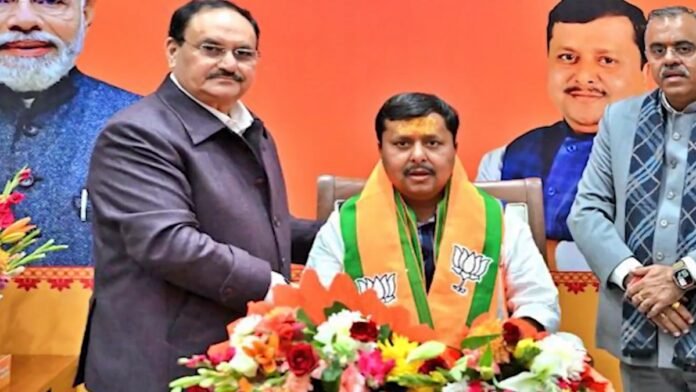
Nitin Naveen formally filed his nomination for the BJP national president post at the party headquarters on Monday afternoon, marking a significant step in the leadership transition of India’s ruling party. Union Home Minister Amit Shah, BJP President JP Nadda, and Defence Minister Rajnath Singh were present during the nomination process, demonstrating the high-level support for Naveen’s candidacy.
The nomination was filed around 3 PM, initiating the official election process for the BJP’s 12th national president. Following the submission, the party will conduct a scrutiny of nominations, after which candidates can withdraw their nominations between 5:00 PM and 6:00 PM. At 6:30 PM, the BJP’s National Election Officer will issue a press statement regarding the nomination process and election outcome.
Chief Ministers Rally Behind Naveen’s Candidacy
The nomination ceremony saw participation from chief ministers of several BJP-ruled states, who arrived in Delhi specifically to demonstrate their support. Defence Minister Rajnath Singh and Union Home Minister Amit Shah formally proposed Nitin Naveen’s name for the presidency.
Key leaders present included Uttar Pradesh Chief Minister Yogi Adityanath, Uttarakhand Chief Minister Pushkar Singh Dhami, Goa Chief Minister Pramod Sawant, and Delhi Chief Minister Rekha Gupta. All chief ministers submitted formal letters of support at the party headquarters, signaling broad consensus within the party’s state leadership for Naveen’s elevation.
Naveen Poised for Unopposed Election as Youngest BJP President
With no other candidate filing nomination for the BJP president post, Nitin Naveen’s election is virtually certain. The current acting president is fully prepared to assume full responsibility after filing his nomination, backed by Prime Minister Narendra Modi, Home Minister Amit Shah, and other top party leaders.
After the formal announcement on Tuesday, Naveen will become the youngest person to hold the position of BJP national president, marking a generational shift in the party’s leadership. His unopposed election reflects the party’s characteristic approach of building consensus around a chosen candidate rather than conducting contested elections for top posts.
BJP’s Presidential Election Process
The election of the BJP national president follows a structured constitutional process. The electoral college comprises representatives from the BJP’s National Council and State Councils, ensuring representation from across the party’s organizational structure.
According to the party constitution, a candidate must meet specific eligibility criteria, including nomination by at least 20 members of a state’s electoral college and a minimum of 15 years of party membership. These requirements ensure that presidential candidates have established track records within the party organization and broad-based support from state-level leadership.
The process emphasizes internal democracy while maintaining the party’s tradition of collective decision-making, with the National Election Officer overseeing the entire procedure to ensure transparency and adherence to constitutional provisions.