



































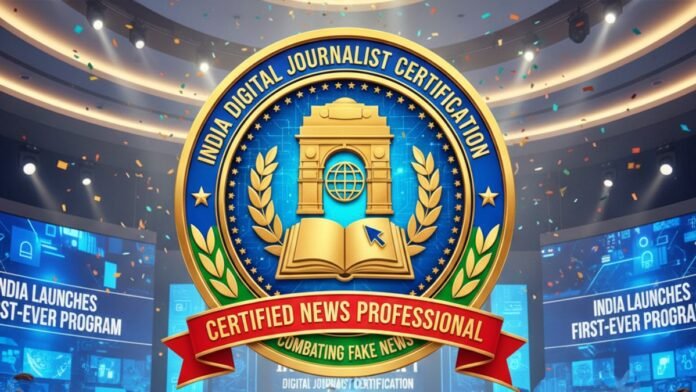
Key Points
- Erasmus Digital Media Council (EDMC) introduces India’s first comprehensive certification system for digital journalists and news platforms
- Certification covers individual journalists and institutional platforms across YouTube, Instagram, Facebook, LinkedIn, and X
- Applications accepted through official portal at newscertification.org with expert committee review process
- Annual certification aims to establish credibility standards amid rising misinformation concerns
- Three-phase implementation includes nationwide training programs and partnerships with journalism institutions
New Delhi: In a groundbreaking move to restore trust in India’s digital news landscape, the Erasmus Digital Media Council (EDMC) has unveiled the country’s first comprehensive certification program designed specifically for digital journalists and online media platforms. Registered under the Ministry of Corporate Affairs, Government of India, this non-profit organization aims to establish industry-wide standards for transparency, accountability, and ethical journalism in the rapidly evolving digital media space.
The certification program extends eligibility to both individual digital journalists and institutional media platforms, including online news websites, YouTube news channels, independent digital outlets, and content creators operating across major social media platforms such as Instagram, Facebook, LinkedIn, and X (formerly Twitter). This inclusive approach recognizes the diverse nature of modern digital journalism, where news dissemination no longer remains confined to traditional media organizations.
Addressing the Misinformation Challenge
The launch of this initiative comes at a critical juncture when India’s digital news ecosystem faces unprecedented challenges. With over 500 million internet users and growing smartphone penetration, the country has witnessed an exponential rise in digital content creation. However, this democratization of information has been accompanied by a parallel surge in fake news, misinformation campaigns, and manipulated narratives that threaten public discourse and democratic values.
The Council’s certification framework directly responds to this crisis by creating a structured system that distinguishes verified, responsible content creators from unregulated sources. By establishing clear benchmarks for ethical journalism, the program seeks to empower audiences to identify trustworthy information sources in an increasingly crowded digital space.
Streamlined Application Process
Interested applicants can access the certification program through the Council’s official website at www.newscertification.org. The application process has been designed for accessibility and transparency. After creating an account and logging in, journalists, content creators, and media organizations can submit applications either for individual certification or for their respective media platforms or channels.
The website provides comprehensive information regarding eligibility criteria, certification procedures, documentation requirements, and upcoming training opportunities. This centralized platform ensures that all applicants have equal access to information and support throughout the certification process.
Rigorous Evaluation Standards
Applications submitted through the portal undergo thorough evaluation by an expert committee comprising seasoned journalists, media ethics specialists, and digital content analysts. The review process assesses multiple dimensions of an applicant’s work, including content quality, adherence to journalistic principles, fact-checking practices, source verification methods, and overall compliance with professional standards.
Upon successful evaluation and approval, eligible journalists and media platforms receive an annual certification that officially recognizes their credibility and commitment to responsible digital journalism. This time-bound certification ensures ongoing compliance and encourages continuous improvement in professional practices.
Vision and Mission Framework
According to its founding vision document, the Erasmus Digital Media Council operates as a non-profit public trust with a clear mandate to combat misinformation, foster ethical journalism practices, and rebuild public confidence in digital media platforms. The organization’s mission centers on restoring integrity and accountability in digital journalism while simultaneously empowering audiences with the knowledge and tools to identify reliable and factual information sources.
The Council emphasizes that its approach transcends mere regulatory compliance. Instead, it seeks to cultivate a culture of voluntary accountability where journalists and content creators embrace ethical commitment and professional discipline as core values rather than external obligations.
Comprehensive Training and Capacity Building
Over the coming months, the Erasmus Digital Media Council will roll out an extensive program of nationwide workshops, webinars, and specialized training sessions. These educational initiatives will cover critical competencies, including advanced fact-checking methodologies, data verification techniques, media ethics frameworks, digital safety protocols, and the effective use of modern reporting tools and technologies.
The Council is actively establishing partnerships with journalism schools, established media houses, fact-checking organizations, and technology platforms to expand its reach and amplify its impact. These collaborations will ensure that training programs remain relevant, practical, and aligned with industry best practices.
Three-Phase Implementation Strategy
The Council’s implementation roadmap unfolds across three carefully designed phases. The first phase focuses on establishing the certification framework, including the development of evaluation criteria, application systems, and committee structures. The second phase involves rolling out a national audit and verification system that enables continuous monitoring of certified platforms and journalists.
The third phase emphasizes large-scale awareness campaigns and training programs designed to reach journalists, content creators, and media consumers across urban and rural India. Each phase builds upon the previous one to create a robust, sustainable ecosystem that nurtures ethical journalism and addresses misinformation at its source.
Beyond Certification: Building a Culture of Accountability
The Council maintains that enhancing digital journalism quality requires more than legislation or external regulation. While legal frameworks play an important role, lasting change demands voluntary accountability, ethical commitment, and professional self-discipline from practitioners themselves.
Therefore, the certification initiative extends beyond merely awarding credentials. It aims to foster a transformative culture where verification replaces rumor, truth overcomes manipulation, balanced reporting replaces sensationalism, and constructive dialogue supersedes polarizing rhetoric. Through regular audits, public feedback mechanisms, and ongoing compliance monitoring, the Council ensures that certified platforms maintain the highest ethical and professional standards.
Empowering Citizens Through Media Literacy
The initiative recognizes that combating misinformation requires a dual approach: improving content creator standards while simultaneously enhancing audience media literacy. By certifying credible sources, the program provides citizens with a reliable mechanism to distinguish factual journalism from misleading content.
This empowerment of news consumers represents a crucial element in strengthening democratic discourse. When audiences can confidently identify trustworthy sources, they become more resilient against manipulation and better equipped to participate meaningfully in public conversations.
Shaping the Future of Indian Digital Journalism
With this visionary initiative, the Erasmus Digital Media Council positions itself at the forefront of efforts to redefine digital journalism standards in India. The program not only elevates the professional stature of individual journalists and content creators but also establishes a framework for industry-wide transparency and credibility that could serve as a model for other nations facing similar challenges.
In an era where information travels at unprecedented speeds and reaches global audiences instantly, this initiative marks a pivotal shift toward responsible, transparent, and democratic digital journalism. By balancing freedom of expression with professional accountability, the Council’s certification program aims to shape a future where media integrity becomes the foundation of India’s digital information ecosystem.