



































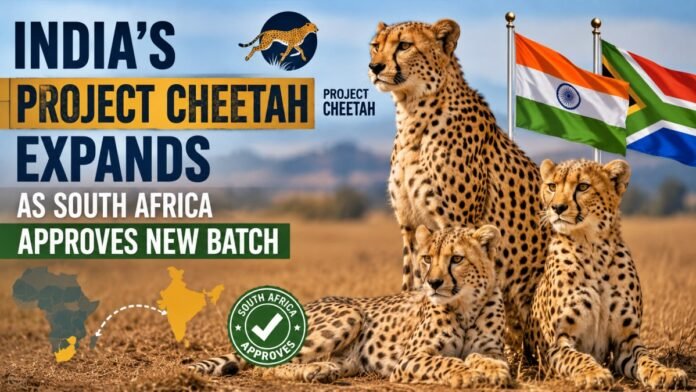
Key Highlights
- New Translocations: South Africa will supply six to eight more cheetahs following a fresh bilateral agreement.
- Current Population: India is now home to 53 cheetahs, thriving across Madhya Pradesh’s Kuno and Gandhi Sagar sanctuaries.
- New Habitats: Nauradehi Sanctuary is being finalized as India’s third cheetah home, with the first translocations expected by the end of 2026.
- Future Roadmap: Strategic plans are underway to expand the reintroduction program into Gujarat’s Banni Sanctuary and Rajasthan’s Sariska Sanctuary.
In a significant boost to India’s wildlife conservation efforts, South Africa has officially agreed to provide a new batch of cheetahs to the country. Following successful high-level discussions between India’s Ministry of Environment, Forest and Climate Change (MoEFCC) and South Africa’s top leadership, preparations are already underway to receive six to eight additional big cats.
Kuno National Park in Madhya Pradesh, which has served as the foundational launchpad for the world’s first intercontinental large carnivore translocation project, is upgrading its infrastructure to house the incoming batch. Officials confirm that the specialized enclosures and veterinary facilities at Kuno are being optimized to handle future international arrivals seamlessly.
Expanding the Footprint: Nauradehi and Beyond
While Kuno remains the central hub, India’s strategy has pivoted toward establishing multiple metadata populations to mitigate risks and ensure long-term genetic viability. Currently, the nation’s 53 cheetahs are distributed across Madhya Pradesh’s Kuno National Park and the Gandhi Sagar Sanctuary, where wildlife teams report that the animals are successfully roaming free, adapting to the terrain, and hunting wild prey independently.
The next major milestone for the project is the activation of the Nauradehi Sanctuary in Madhya Pradesh as the third official home for the species. Preparations at Nauradehi are in their final stages, and wildlife authorities anticipate shifting the first batch of cheetahs from Kuno to this new habitat by the end of 2026.
Looking further ahead, the MoEFCC has laid out a comprehensive roadmap for geographical diversification:
- Banni Grasslands (Gujarat): Highly anticipated as a unique arid ecosystem suited for cheetah conservation, with infrastructure layout plans moving forward.
- Sariska Tiger Reserve (Rajasthan): Recent high-level discussions presented a structured framework to assess habitat readiness and prey-base sustainability for future introductions.
Project Milestones at a Glance
- 2022: 8 cheetahs introduced from Namibia.
- 2023: 12 cheetahs introduced from South Africa.
- 2026: 9 cheetahs introduced from Botswana.
- Current Status: A thriving population of 53, significantly bolstered by a rising generation of Indian-born cubs growing to adulthood.
From Relocation to Self-Sustenance
The true success of Project Cheetah, wildlife experts note, lies in the transition from imported animals to an indigenous breeding population. The early phases faced steep learning curves, but the current phase highlights a stable ecosystem where Indian-born cubs have successfully matured. These cubs are demonstrating excellent survival instincts, signaling that the introduced species is firmly adapting to its ancestral home.