































Key Points
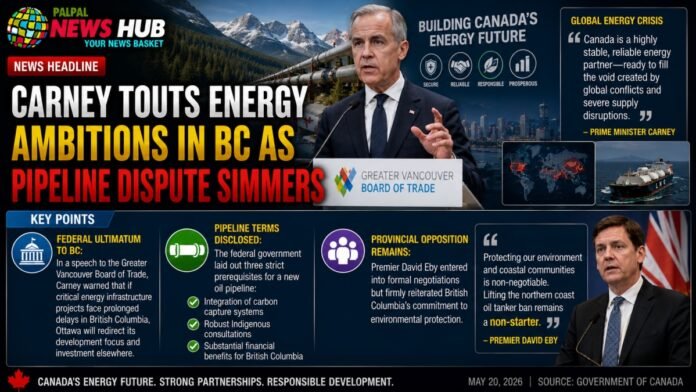
- Global Energy Crisis: Prime Minister Carney framed Canada as a highly stable, reliable energy partner capable of filling the resource void caused by escalating global conflicts and severe supply disruptions.
- Federal Ultimatum to BC: In a speech to the Greater Vancouver Board of Trade, Carney warned that if critical energy infrastructure projects face prolonged delays in British Columbia, Ottawa will redirect its development focus and investment elsewhere.
- Pipeline Terms Disclosed: The federal government laid out three strict prerequisites for a new oil pipeline, mandating the integration of carbon capture systems, robust Indigenous consultations, and substantial financial benefits for British Columbia.
- Provincial Opposition Remains: Premier David Eby entered into formal negotiations but firmly reiterated British Columbia’s commitment to environmental protection, explicitly maintaining that lifting the northern coast oil tanker ban remains a non-starter.
The world is currently grappling with several major challenges, including a severe energy crisis, rising consumer prices, and climate change. Amidst these difficult circumstances, Canadian Prime Minister Mark Carney has issued a highly significant statement. He asserted that Canada can play an active role in the global energy supply by leveraging its abundant natural resources. Mark Carney conveyed this crucial message to the business community during an event hosted by the Greater Vancouver Board of Trade in Vancouver.
Carney believes that recent global shocks, specifically the conflict in Iran that has driven up international fuel prices and taken significant Qatari gas supply offline, have severely disrupted energy availability in many nations. Consequently, Canada has the potential to emerge as a highly stable and reliable energy partner for the entire world in the future. He met with British Columbia Premier David Eby and engaged in extensive discussions regarding pipeline projects. The federal government is also working rapidly to expedite project approvals and implement necessary adjustments to clean energy policies, framing the resource push as a vital economic shield against ongoing trade disputes with the United States.
Environmental and Pipeline Disputes
British Columbia Premier David Eby is strongly opposing the proposed pipeline projects, expressing skepticism over rewarding separate regional resource demands at the cost of his province. His primary concerns are inextricably linked to their potential environmental impact and the vehement objections raised by Indigenous communities. He maintains that authorizing the transport of oil along the northern coast is a risky undertaking and is, therefore, unacceptable, emphasizing that a long-standing moratorium on oil tankers along the northern coast is non-negotiable.
Mark Carney has clarified that any new pipeline project would be subject to several critical conditions designed to avoid past litigation traps. These include the mandatory construction of the Pathways carbon capture and storage systems to reduce environmental emissions. Furthermore, proper consultation with Indigenous communities would be required under Section 35 of the Constitution, and the province must derive significant economic and financial benefits from the project. In a blunt warning to the Vancouver audience, Carney added that nearly one-third of the major infrastructure projects fast-tracked by Ottawa are located in British Columbia, stating, “If things get stalled here, we’re going to be spending more time elsewhere in the country.”
Opposition’s Sharp Reaction to Carney’s Statement
Regarding this entire matter, Conservative leader Pierre Poilievre has accused the federal government of acting too slowly to resolve the nation’s resource gridlock. He has demanded that energy projects be fast-tracked by eliminating the industrial carbon tax, following the federal government’s previous move to scrap the consumer portion of the tax. Poilievre cited the example of Germany, which rapidly constructed a new liquefied natural gas facility in the wake of a severe energy crisis, arguing Canada must mirror that speed.
This energy issue has significantly heightened political tensions between the federal and provincial governments in Canada. Carney is focusing his entire attention on transforming Canada into a major global energy supply hub, paired with a massive plan to double the nation’s clean electricity grid capacity by 2050. Meanwhile, the government of British Columbia is prioritizing environmental protection and its local interests above all else, though Eby has agreed to continue formal negotiations regarding shared federal investments in infrastructure and green residential incentives.