

































Key Points
- Offensive Caricature: Prominent Norwegian daily Aftenposten published a cartoon showing PM Modi as a snake charmer holding a fuel pipe, alongside a critical article titled “A Clever and Slightly Disturbing Man.”
- Colonial Stereotypes Slammed: Global netizens and media analysts have fiercely condemned the illustration, calling out the Western media’s refusal to outgrow regressive, colonial-era tropes of India.
- MEA Issues Sharp Response: Ministry of External Affairs Secretary Siby George strongly defended India’s democratic institutions, dismissing Western critics for relying on biased, ill-informed NGO reports.
- History of Media Bias: Critics point out the irony of the caricature, noting it follows a pattern of offensive Western media portrayals despite India’s global leadership in technology and digital infrastructure.
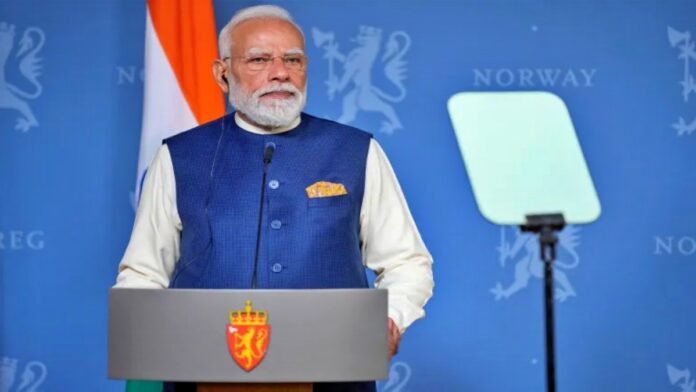
A diplomatic and social media firestorm has broken out during Prime Minister Narendra Modi’s official visit to Norway, the penultimate stop of his five-nation European tour. The controversy was triggered by Aftenposten, one of Norway’s most widely circulated newspapers, which published a highly offensive caricature of the Indian Prime Minister. The illustration portrays PM Modi as a traditional snake charmer, holding a fuel station pump nozzle modified to look like a cobra.
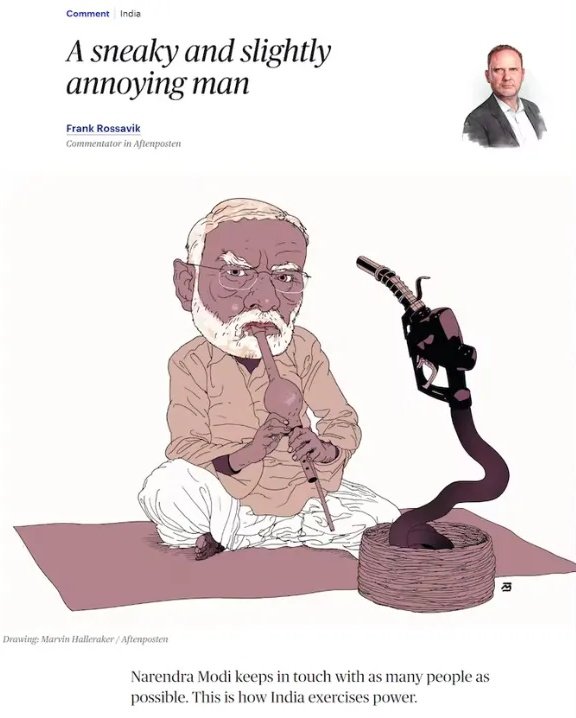
The caricature accompanied a highly critical op-ed titled “A Clever and Slightly Disturbing Man.” The controversy deepened after Norwegian journalist Helle Lyng publicly questioned the absence of a formal press conference and raised points regarding human rights in India. Following the circulation of the article and video clips of the media exchange, a massive international debate ignited online, with millions condemning the publication for relying on blatant, xenophobic tropes.
The Persistence of a Colonial Mindset
The publication has drawn severe backlash from digital rights activists, the Indian diaspora, and international observers who argue that the caricature unmasks a lingering colonial mindset within European media houses. Critics point out that portraying a global economic powerhouse through the regressive lens of “snake charmers” shows a deliberate ignorance of India’s modern reality.
“Europeans have yet to fully shed their old colonial fantasies and anxieties about a rising global South,” noted an international relations analyst on social media.
The incident stands in stark irony to PM Modi’s famous 2014 address in the United States, where he explicitly stated that India had transitioned from a land of “snake charmers” to a land of “mouse charmers,” driving the global digital and IT revolution. This is not an isolated incident in continental Europe, as recently as 2022, a prominent Spanish newspaper faced similar outrage for using a snake charmer motif to depict India’s booming economic growth.
MEA Rebuffs Western Criticism and Defends Democratic Fabric
India’s Ministry of External Affairs (MEA) stepped in to deliver a firm, uncompromising response to the European press. Siby George, Secretary at the MEA, strongly defended India’s democratic credentials and took a direct swipe at Western commentators who view India through a distorted lens.
Addressing the critique surrounding media freedom and press interactions, George highlighted the sheer scale, magnitude, and vibrance of the Indian press corps. He noted that New Delhi alone is home to over 200 independent television channels, broadcasting breaking news daily across dozens of languages, a feat unmatched by any Western nation.
The senior diplomat strongly criticized entities that form absolute opinions on India based on skewed, motivated data from select, ill-informed NGOs. He reiterated that the fundamental rights enshrined in the Constitution of India are non-negotiable, serving as absolute proof that India remains a completely independent, resilient, and sovereign democracy.