































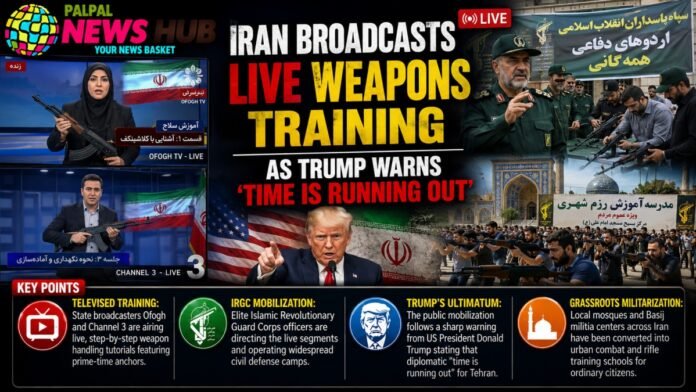
Key Points
- Televised Training: State broadcasters Ofogh and Channel 3 are airing live, step-by-step weapon handling tutorials featuring prime-time anchors.
- IRGC Mobilization: Elite Islamic Revolutionary Guard Corps officers are directing the live segments and operating widespread civil defense camps.
- Trump’s Ultimatum: The public mobilization follows a sharp warning from US President Donald Trump stating that diplomatic “time is running out” for Tehran.
- Grassroots Militarization: Local mosques and Basij militia centers across Iran have been converted into urban combat and rifle training schools for ordinary citizens.
In a striking manifestation of domestic anxiety, Iranian state television has transformed its public programming into an overt civil defense training platform. Over the past 48 hours, multiple state-run channels have integrated live, on-air firearms tutorials into their standard broadcast schedules. The radical programming shift aims to prepare the domestic population for potential urban warfare, following a series of high-stakes military standoffs and a devastating round of joint US, Israeli airstrikes earlier this spring.
Iran's Channel 3 female presenter just went on live TV holding a gun pic.twitter.com/ts2OctxvIv
— Alireza Akbari (@itsalireza_akb) May 17, 2026
Iranian TV continues firearms training segment, this time with a sniper rifle aimed at Trump. pic.twitter.com/rdf7nWS49p
— распад и неуважение (@VictorKvert2008) May 18, 2026
During a prime-time broadcast on the state-owned Ofogh network, prominent news anchor Hossein Hosseini was filmed dismantling, loading, and test-firing an automatic rifle inside a modified studio firing range. Standing directly beside him to guide the demonstration was a senior instructor from the Islamic Revolutionary Guard Corps (IRGC), who provided technical guidance on recoil management and tactical reloading. Concurrently, on Channel 3, anchor Mobina Nasiri delivered a monologue while holding an assault rifle, declaring her readiness to join frontline defense forces. These broadcasts are designed to demystify combat operations and foster a unified psychological front against external threats.
Mosques Transformed into Grassroots Combat Academies
Beyond television screens, the tactical training has rapidly expanded into neighborhood infrastructure across Tehran, Isfahan, and Mashhad. Under the coordination of the IRGC’s volunteer paramilitary wing, the Basij, hundreds of local mosques have been converted into neighborhood weapons centers. Independent journalists and regional monitors have documented a surge in local attendance, where citizens of all backgrounds, including shopkeepers, university students, and families, are being taught the mechanics of standard-issue infantry weapons like the AK,47.
The regime has categorized this mass mobilization as a fundamental pillar of national resilience. However, international human rights monitors have raised flags over regional photographs showing adolescents and young children participating in these live ammunition firearms drills at neighborhood centers. Government spokespersons have defended the inclusion of youth, framing it as an essential component of historical resistance and neighborhood security frameworks.
Rhetorical Escalation Fuels Urban Panic
This unprecedented militarization of public life is a direct reaction to the shifting rhetoric coming out of Washington. Although Gulf mediators recently managed to secure a temporary 72-hour pause in planned American airstrikes, President Donald Trump’s parallel public statements have kept domestic anxieties at an absolute peak. In his latest address to reporters, Trump explicitly warned Tehran that the current diplomatic window is an ultimate grace period, stating that “time is running out rapidly” and that the Pentagon’s target lists remain completely active.
This high-pressure strategy from the United States, intended to force Iranian negotiators into major nuclear concessions during back-channel talks in Islamabad, has instead triggered a siege mentality within Iran. Rather than driving the regime toward compliance, the threat of destruction has led state authorities to accelerate domestic defense protocols, transforming ordinary media personnel and civilian spaces into active cogs of the country’s military apparatus.