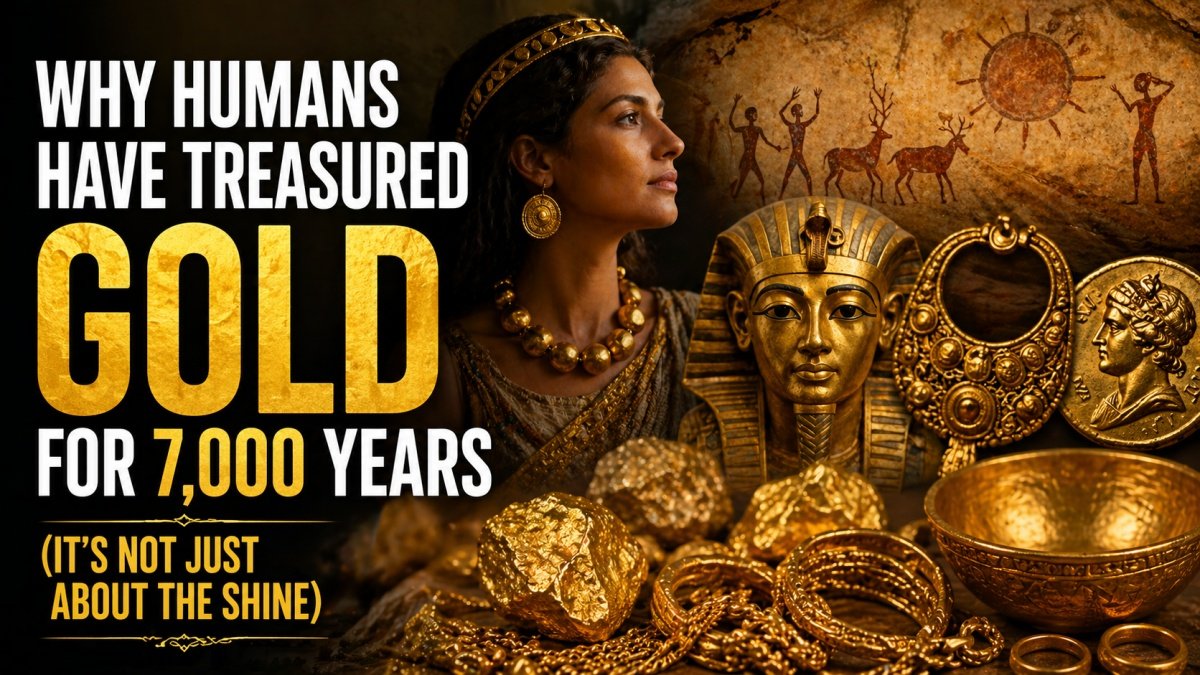
Gold is soft, heavy, and cannot even hold a sharp edge. Yet it has shaped human history for thousands of years. So what makes this metal so special?
The real answer lies in the brilliance of ancient craftsmen and how they turned a simple metal into a tool for power, religion, and trust.
1. Gold Didn’t Start in Egypt: It Started in Bulgaria
Most people assume gold working began in ancient Egypt or the Middle East. But the oldest known gold objects were actually found in Varna, Bulgaria, dating back to around 4,500 BCE.
The strangest discovery? Many graves at Varna contained no human bodies, just gold objects and clay masks. Gold wasn’t just decoration here. It stood in for a person’s spirit, acting as a gateway between the living world and the divine.
2. Ancient Indians Invented the Diamond Drill: 5,000 Years Ago
Craftsmen in the ancient Indus Valley (modern-day Pakistan and northwest India) weren’t just making pretty jewelry. They were solving engineering problems. They invented the diamond-tipped drill to bore perfectly centered holes through hard stones, a technology so precise that they later passed it on to the Romans.
This turned India into one of the world’s first mass manufacturing hubs for gold and bead ornaments.
3. South American Civilizations Faked Pure Gold and It Worked
The Inca and Moche civilizations used Tumbaga, a blend of gold, copper, and silver, instead of pure gold. To Western eyes, this might look like cutting corners. But these cultures chose the alloy deliberately: it melted at lower temperatures, and the varying metal ratios let them create bells tuned to specific musical notes.
To make it look like pure gold, they used a clever acid treatment that burned away the copper and silver from the surface, leaving a gleaming golden finish. The result? Enormous masks and ceremonial objects that appeared to be solid gold but were actually lightweight and affordable to produce.
4. The Sumerians Treated Gold Like Paint
Ancient Sumerian craftsmen in Mesopotamia (modern Iraq) mixed gold with silver and copper in precise ratios to achieve specific colors from pale green-gold to deep reddish tones. They also invented the loop-in-loop chain (still used in jewelry today) and mastered “granulation,” attaching tiny gold beads to surfaces to create a rich, velvety texture.
The gold they used even came from as far away as Afghanistan, showing how seriously they took their craft.
5. Ancient Egypt Made “Budget Gold” for the Poor
In Egypt, gold was literally considered the skin of the sun god Ra. Only pharaohs could wear it, think of Tutankhamun’s famous golden death mask. But ordinary Egyptians wanted that same divine protection too.
So Egyptians invented faience, a glazed ceramic material made to mimic gold’s yellow color. The logic was straightforward: if the color yellow represented the sun, then a yellow ceramic bead offered the same spiritual protection as real gold. The symbol mattered as much as the material.
6. Medieval England Created the World’s First Consumer Protection Law For Gold
As gold became a global currency, fraud became a serious problem. In 1300 CE, England’s King Edward I introduced the hallmarking system requiring every gold item to be tested and stamped for quality by official “Guardians of the Craft.” By 1363, goldsmiths were also required to stamp their own maker’s mark on every piece, so buyers could track down who made it if something went wrong.
This was essentially the world’s first product quality guarantee born entirely out of gold trading.
So Why Does Gold Still Matter?
From ancient Bulgaria to medieval England, gold was never just a shiny rock. It was a spiritual symbol, an engineering challenge, a design medium, and a foundation of public trust all at once.
As we move into a world of cryptocurrencies and digital assets, it’s worth asking: will any of our modern forms of value ever carry the same meaning as an object that has survived 7,000 years? History suggests our hunger for beauty, security, and something that lasts is as enduring as gold itself.