Key Highlights
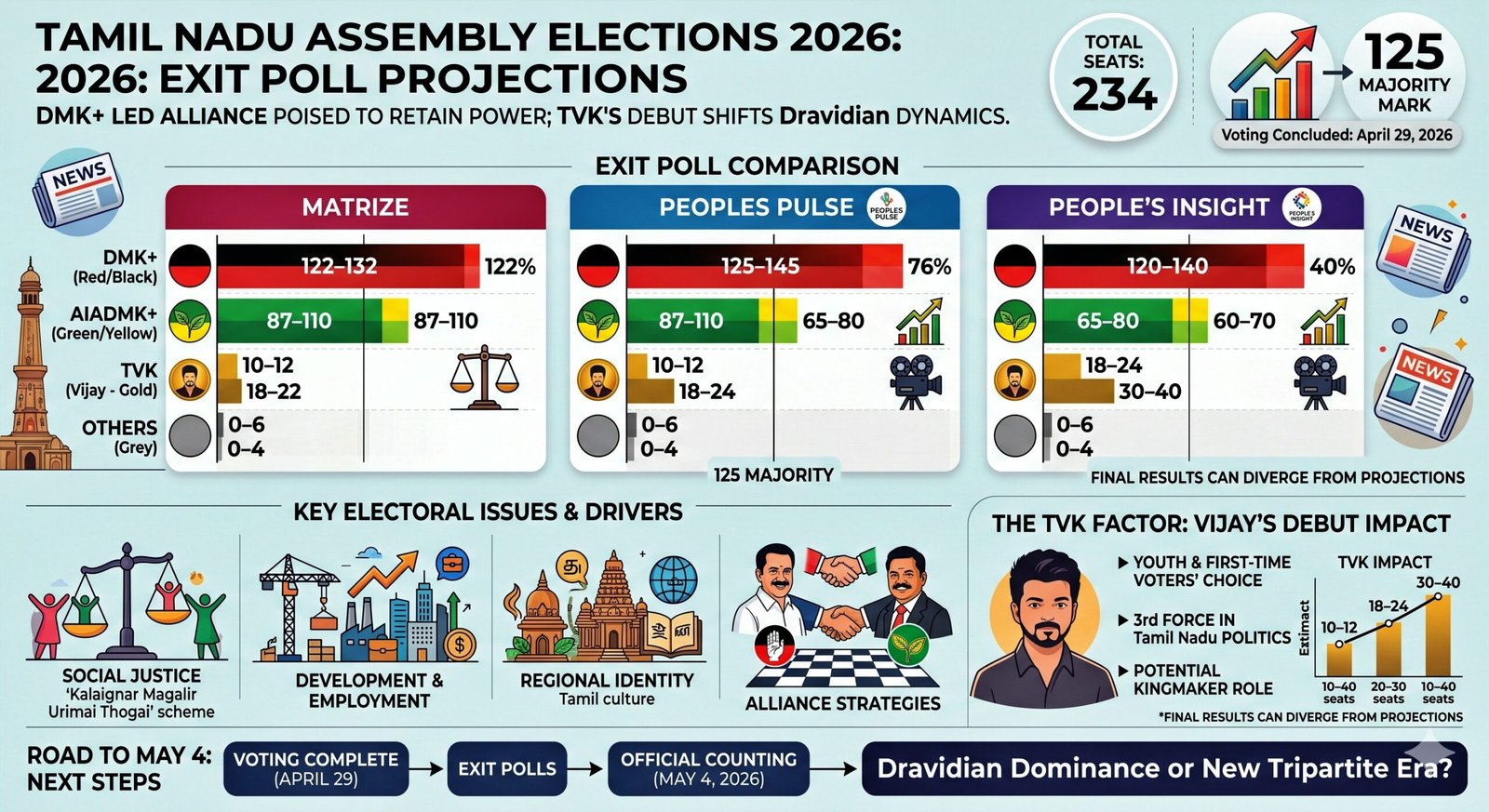
- DMK+ Lead: Most major agencies project the DMK-led alliance to surpass the majority mark of 125 seats.
- AIADMK+ Gains: The opposition AIADMK+ is expected to improve its 2021 performance, but likely fall short of forming a government.
- The TVK Factor: Vijay’s TVK is projected to make a significant entry, with estimates ranging from 10 to 40 seats.
- Voter Turnout: High participation was recorded across the state, particularly in rural belts, signaling strong engagement with local issues.
- Result Date: Official counting of votes is scheduled for May 4, 2026, which will confirm if the “Dravidian Model” has secured a second consecutive term.
As the final curtains fell on the 2026 Tamil Nadu Legislative Assembly elections today, April 29, the state’s political landscape appears to be on the cusp of a significant shift. For decades, Tamil Nadu has been a battleground for the two Dravidian giants, the DMK and AIADMK. However, this election cycle introduced a powerful third variable: actor-turned-politician Vijay and his party, Tamilaga Vettri Kazhagam (TVK).
Early exit poll data released after polling ended suggest that while Chief Minister M.K. Stalin’s DMK-led alliance maintains a dominant position, the TVK has successfully carved out a niche, potentially acting as a kingmaker or a formidable third force in several constituencies.
Detailed Exit Poll Projections
The projections from various agencies show a consensus on a DMK+ lead, but they differ on the impact of the TVK’s debut.
| Agency | DMK+ (Ruling) | AIADMK+ (Opposition) | TVK (New Entrant) | Others |
|---|---|---|---|---|
| Peoples Pulse | 125,145 | 65,80 | 18,24 | 2,6 |
| People’s Insight | 120,140 | 60,70 | 30,40 | 0,4 |
| Matrize | 122,132 | 87,110 | 10,12 | 0,6 |
Matrize offers the most conservative estimate for the DMK, suggesting a tighter race where the AIADMK could reach triple digits. Conversely, People’s Insight highlights a massive surge for the TVK, projecting they could secure up to 40 seats, largely at the expense of the two traditional powerhouses.
Core Issues: Social Justice and Regional Identity
The 2026 campaign was defined by a blend of welfare politics and ideological battles. The DMK campaigned heavily on its “Dravidian Model,” emphasizing social justice, women’s rights through the “Kalaignar Magalir Urimai Thogai” scheme, and its opposition to perceived central overreach.
The AIADMK, led by Edappadi K. Palaniswami, focused its attack on law and order issues, drug menace allegations, and infrastructure delays. Meanwhile, the TVK’s platform of “secular social justice” and its critique of both the ruling party and the central government appears to have resonated deeply with the youth and first-time voters, a demographic that played a pivotal role in this election.
The Road to May 4
The high stakes of this election cannot be overstated. For the DMK, a win would validate M.K. Stalin’s leadership as a successor to M. Karunanidhi. For the AIADMK, it is a battle for relevance after a decade of fluctuating fortunes. For Vijay and the TVK, these results will determine whether the party can sustain itself as a legitimate alternative to the status quo.
Direct contests were particularly fierce in the Kongu region (an AIADMK stronghold) and the northern belts, where alliances with parties like the PMK and VCK influenced the arithmetic. While these exit polls offer a snapshot of the public mood, Tamil Nadu’s electorate has a history of delivering decisive, sometimes surprising mandates. All eyes now move to the counting centers on May 4, 2026, to see if the state continues its tradition of Dravidian dominance or pivots toward a new tripartite future.