





























Key Highlights
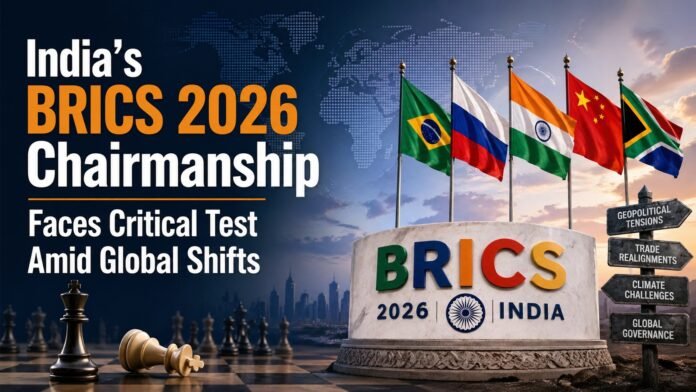
- Leadership Role: India chairs BRICS in 2026, hosting the Foreign Ministers’ meeting in June and the Heads of State Summit in September.
- 11-Member Friction: Growing discord among the expanded bloc, particularly regarding Iran’s stance against Western policies.
- Pakistan’s Entry: China continues to push for Pakistan’s inclusion, a move India strongly opposes to prevent “SAARC-style” stagnation.
- Quad Uncertainty: The 2025 Quad Summit’s failure to materialize has cooled India’s enthusiasm, further complicated by volatile US trade tariffs.
- Diplomatic Balancing: India seeks to prevent BRICS from becoming an “Anti-West” bloc while navigating new 126% US duties on solar imports.
The geopolitical landscape of 2026 has placed India at a historic crossroads. As the rotating Chair of BRICS, New Delhi unveiled its theme, “Building for Resilience, Innovation, Cooperation and Sustainability,” earlier this year. However, the expansion of the bloc to 11 members, including new entrants like Indonesia and Iran, has introduced a volatile set of internal contradictions. With the Foreign Ministers’ meeting scheduled for June 14, 15, India’s primary challenge is preventing the platform from devolving into a purely reactionary anti-Western alliance.
The Iran Dilemma and the Shadow of the West
The most immediate crisis involves Iran, which is seeking a formal BRICS condemnation of Western economic policies and US military positioning. This comes at a time when US President Donald Trump has threatened a 25 percent tariff on any country conducting business with Tehran. India, aiming to maintain its strategic autonomy, finds itself sandwiched between Russia and China, which favor a harder stance against the West, and its own need to maintain a “non-bloc” identity for BRICS. If a consensus is not reached during the June meetings, the September summit could face an unprecedented deadlock.
Resistance to Pakistan’s Inclusion
Mirroring the collapse of the South Asian Association for Regional Cooperation (SAARC), India is currently battling a renewed push by China to grant Pakistan full membership. New Delhi’s stance remains firm; officials believe that Islamabad’s entry would introduce bilateral obstructionism into BRICS, effectively paralyzing the organization’s economic agenda. India argues that Pakistan’s history of utilizing regional forums for parochial political agendas makes it a liability rather than an asset to the “Greater BRICS” framework.
The Quad on the Back Burner
While BRICS dominates the headlines, India’s relationship with the Quad (comprising the US, Japan, and Australia) has significantly cooled. The failure of the 2025 Quad Summit to take place in India marked a turning point in New Delhi’s diplomatic priorities.
The cooling of ties is largely attributed to erratic trade relations with Washington. Although a February 2026 deal initially reduced general tariffs on Indian goods from 50 percent to 18 percent, the sudden imposition of a 126 percent countervailing duty on Indian solar imports in late February has caused deep resentment. New Delhi increasingly views the Quad as a vehicle for US interests in the Indo-Pacific that offers diminishing economic returns for India.
A Strategy for Global Stability
India’s 2026 chairmanship is not merely about hosting meetings; it is a survival test for multilateralism. By attempting to bridge the gap between the Global South and the West, India is positioning itself as the “Vishwa Mitra” (Global Friend). However, the success of this strategy depends on whether New Delhi can leverage its $20 billion foreign investment targets and its growing economic clout to keep the BRICS nations focused on development rather than ideology. As the world watches, the outcome of the 2026 September Summit will likely determine whether BRICS remains a viable economic engine or becomes another relic of geopolitical fragmentation.