


































Key Points of the Escalation
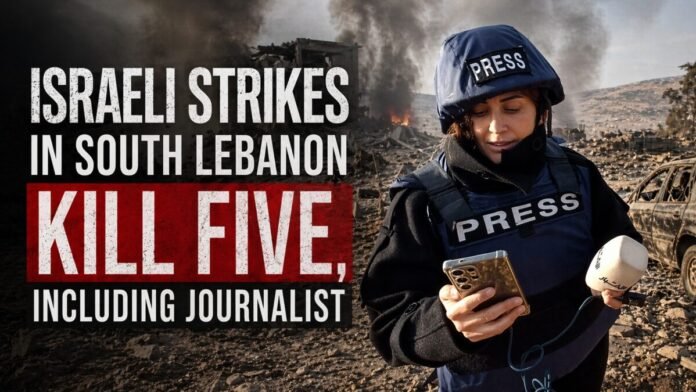
- Fatalities Confirmed: Five people were killed in separate strikes, including Amal Khalil, a veteran journalist for the Lebanese daily Al-Akhbar.
- Strike Locations: Aerial attacks focused on a vehicle in At-Tiri and a residential building where rescue operations were reportedly underway.
- IDF Justification: The Israeli military claims the strikes targeted Hezbollah operatives who breached the “forward defense line” in the Saluki region.
- Media Targeted: Lebanon’s Ministry of Information has accused Israel of intentionally targeting journalists covering the initial aftermath of the strikes.
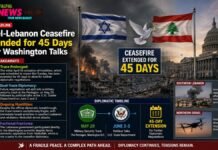
- Ceasefire Status: Diplomatic monitors warn that the lack of a robust buffer zone is leading to daily “tactical violations” from both sides.
The flare-up began early Thursday morning when an Israeli drone targeted a vehicle traveling through the village of At-Tiri. According to local reports, the strike killed two occupants instantly. As emergency responders and members of the press arrived to document the wreckage and assist potential survivors, a second strike hit a nearby structure.
The second wave proved particularly lethal, as the building collapsed onto those gathered below. Among those trapped in the rubble was Amal Khalil, a prominent female journalist affiliated with the pro-Resistance newspaper Al-Akhbar. Her death has ignited a wave of mourning and outrage within the Lebanese media community, which has faced a high casualty rate throughout the recent conflict.
IDF Cites Ceasefire Violations
The Israel Defense Forces (IDF) issued a formal statement shortly after the operation, asserting that the strikes were defensive in nature. According to military intelligence, two Hezbollah members were identified crossing the designated “forward defense line” in the rugged Saluki region of southern Lebanon.
The IDF maintains that these individuals posed an “immediate threat” to Israeli troops stationed near the border. Military officials stated that they tracked the operatives as they departed from a known Hezbollah infrastructure site and utilized vehicles to approach the defense line, prompting the decision to neutralize the threat from the air. Under the terms of the current ceasefire, Hezbollah is prohibited from maintaining an armed presence south of the Litani River, a point Israel claims is being systematically ignored.
Lebanese Condemnation and International Context
Lebanese officials have presented a starkly different narrative, characterizing the strikes as a blatant violation of international law and the truce agreement. Lebanon’s Minister of Information, Paul Morcos, used social media to condemn the “assassination” of Amal Khalil, arguing that Israel is targeting the press to obscure its violations on the ground.
“The targeting of journalists performing their professional duties is a war crime,” Morcos stated, calling on the United Nations and the international community to hold Israel accountable for the safety of non-combatants.
The situation remains highly volatile as the tripartite monitoring committee, led by international mediators, struggles to verify claims from both sides. With the IDF declaring that operations in the region are “ongoing to maintain control,” the prospects for a long-term cessation of hostilities appear increasingly dim. Analysts suggest that unless a more permanent security arrangement is enforced in the border districts, these sporadic but lethal exchanges could trigger a return to full-scale combat.