Key Highlights of the 2026 Elections
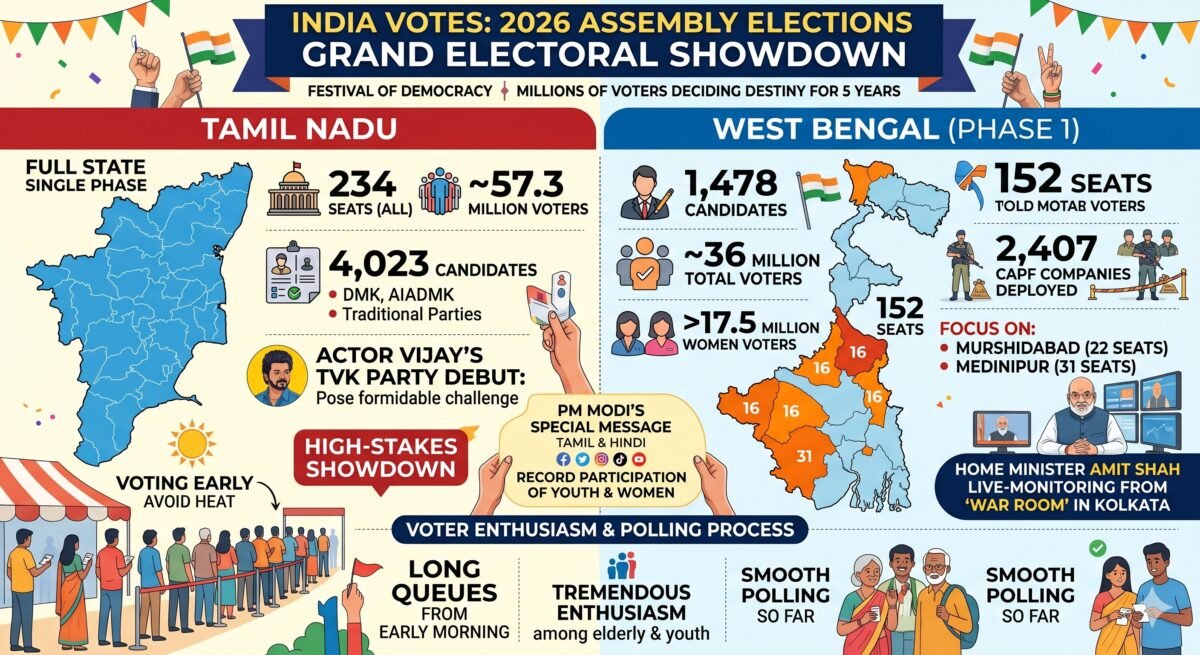
- Tamil Nadu Turnout: Single-phase polling is underway for all 234 Assembly seats, with over 57.3 million registered voters.
- West Bengal Phase 1: Voting has commenced for 152 seats across 16 districts, marking a massive start to the state’s multi-phase election.
- Political Debuts: Actor-turned-politician Vijay’s party, TVK (Tamilaga Vettri Kazhagam), makes its electoral debut, challenging the traditional DMK and AIADMK dominance.
- Prime Ministerial Appeal: PM Narendra Modi issued a bilingual message in Tamil and Hindi, urging record participation from youth and women.
- Security Blanket: Over 2,400 companies of the Central Armed Police Forces (CAPF) are deployed in West Bengal to ensure a peaceful process.
As the doors to polling stations opened at 7:00 AM, long queues formed across the urban and rural landscapes of both states. In Tamil Nadu, the early morning hours saw a significant turnout as residents looked to beat the rising summer heat. Similarly, across the plains and hills of West Bengal, a palpable sense of excitement was evident, particularly among first-time voters and the elderly.
Election Commission officials reported that the process has remained largely smooth, with technical support teams quickly addressing minor Electronic Voting Machine (EVM) glitches. The atmosphere remains charged with hope, as citizens view their single vote as a definitive tool for regional transformation.
The Battle for Tamil Nadu: A Three-Way Contest
In a departure from the historical two-party rivalry, the 2026 Tamil Nadu elections have transitioned into a complex three-way battle. While the ruling DMK and the opposition AIADMK remain the primary titans, the entry of actor Vijay’s TVK has disrupted traditional calculations. With 4,023 candidates in the fray, the political future of the state is being sealed in EVMs across the coastal and inland districts.
Prime Minister Narendra Modi’s special message, shared early Thursday morning, specifically highlighted the “sacred democratic duty” of the electorate. By reaching out in both regional and national languages, the PM aimed to galvanize a high turnout in a state known for its politically conscious population.
West Bengal: A Fortress for Phase 1
The first phase of the West Bengal elections is unusually large, covering 152 seats and involving approximately 36 million voters. The geographical spread is vast, stretching from the northern reaches of Darjeeling, Kalimpong, and Jalpaiguri to the southern strongholds of Murshidabad and Medinipur.
To prevent the violence that has historically marred Bengal polls, the security measures are unprecedented. Union Home Minister Amit Shah is reportedly monitoring the situation in real-time from a ‘War Room’ in Kolkata, ensuring immediate coordination between state authorities and the 2,407 CAPF companies stationed on the ground. Particular attention is being paid to the 31 seats in Medinipur, a region that remains a critical flashpoint for both the TMC and the BJP.
Candidate and Voter Statistics at a Glance
| Feature | Tamil Nadu | West Bengal (Phase 1) |
|---|---|---|
| Total Seats Voting | 234 | 152 |
| Eligible Voters | ~57.3 Million | ~36 Million |
| Number of Candidates | 4,023 | 1,478 |
| Key Districts | Chennai, Coimbatore, Madurai | Darjeeling, Medinipur, Murshidabad |
| Security Status | High (State & Central Police) | Maximum (2,400+ CAPF Companies) |
As the day progresses, the focus remains on the “red alert” constituencies where voter intimidation has been a concern in the past. With the Election Commission’s strict surveillance and the public’s enthusiastic participation, the 2026 Assembly elections are shaping up to be a landmark event in Indian democratic history.