


































Key Highlights
- Station Unrest: Police resorted to a mild lathi-charge at Udhna Station after crowds broke queues for UP-bound trains.
- Energy Crisis: West Asia tensions have pushed LPG prices to ₹500 per kg, making daily survival impossible for laborers.
- Industrial Impact: Nearly 300,000 textile workers have reportedly fled Surat as factories face shutdowns and demand slumps.
- Mass Departure: Railway officials confirmed that over 21,000 passengers were dispatched on Sunday alone across six special trains.
- Extreme Conditions: Thousands waited in 40°C heat, with queues stretching over three kilometers outside the station.
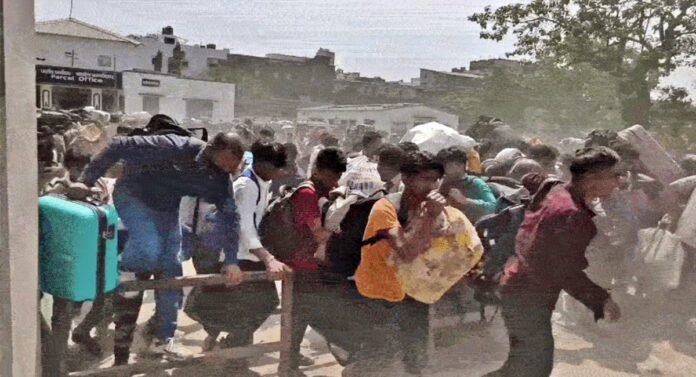
The Udhna Railway Station in Surat became a scene of desperation on Sunday as thousands of migrant workers attempted to flee the city. The situation reached a breaking point around 11:30 AM when passengers, waiting for the Udhna-Hasanpur special train, broke through security ranks to secure seats. To prevent a stampede and restore order, Surat Police and the Railway Protection Force (RPF) were forced to use a mild lathi-charge. Viral footage from the scene shows panicked travelers leaping over iron barricades to escape the police action and reach the platforms.
Railway Official Anubhav Saxena confirmed that by Sunday afternoon, approximately 21,000 passengers had departed on six different trains. Despite the deployment of extra services, the sheer volume of travelers, many of whom had waited for over 16 hours in sweltering 40°C temperatures, overwhelmed the station’s infrastructure.
🚨 Chaos at Surat’s Udhna Railway Station!
— Public News X (@PublicNewsX) April 19, 2026
Over 7,000 migrant workers rushed for limited trains, causing massive overcrowding & long queues.
Police resorted to mild lathi-charge; several travelers fainted amid extreme heat & poor facilities.
Recurring issue in textile hub.… pic.twitter.com/70Kk9pfQhD
Chaos at Udhna Railway station in Surat due to migrant workers; official says situation under control. pic.twitter.com/9RvFTG4GEQ
— News Arena India (@NewsArenaIndia) April 19, 2026
The Root Cause: West Asia Conflict and the LPG Shortage
The primary driver of this mass migration is a crippling shortage of Liquefied Petroleum Gas (LPG), a direct consequence of the escalating conflict in West Asia. Following the start of hostilities on February 28, 2026, global energy supply chains have been severely disrupted. India, which imports roughly 60% of its LPG, has seen domestic supplies plummet.
In Surat’s industrial clusters, the impact is devastating. Migrant workers, who typically live in shared accommodations, report that LPG is being sold on the black market for as much as ₹500 per kg, or up to ₹4,000 for a standard cylinder. Many laborers, unable to afford fuel to cook or find work in stalling factories, are choosing to return to their home states of Uttar Pradesh and Bihar.
Textile Industry on the Brink
Surat’s world-renowned textile industry is bearing the brunt of this energy-driven economic slowdown. Industry experts estimate that 30% of the city’s workforce, totaling approximately 300,000 people, has already participated in this “reverse migration.”
Factory owners have noted a significant drop in demand and an inability to sustain operations under current energy costs. For many workers, the combination of no work and the inability to afford basic meals has made staying in the city untenable. This marks the first time in Surat’s history that an energy crisis, rather than a health or political event, has triggered a labor exodus of this magnitude.
A Convergence of Pressures
Adding to the complexity, the seasonal summer vacation rush and the ongoing wedding season (Akshaya Tritiya) have coincided with the industrial flight. This has created a “perfect storm” at transportation hubs. While the Western Railway has introduced several special “Amrit Bharat” and “Antyodaya” trains to manage the surge, the demand continues to outstrip the available capacity.
As the West Asia conflict shows no signs of immediate resolution, the pressure on India’s industrial hubs and railway systems is expected to persist. Local authorities are urging passengers to maintain order, while industry leaders are calling for urgent government intervention to stabilize fuel prices and prevent a total collapse of the textile labor market.