


































Key Points:
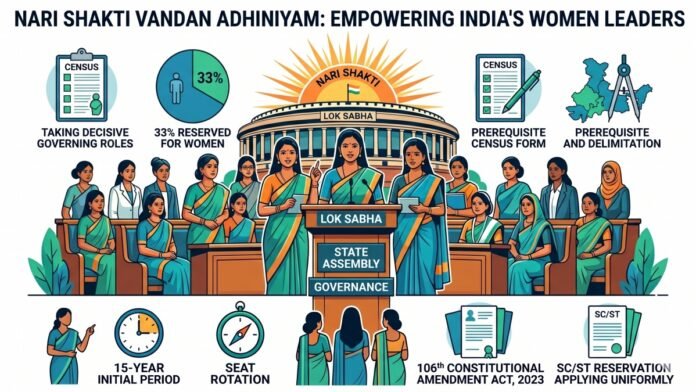
- Technically, the 106th Constitutional Amendment Act, 2023, it mandates a 33% reservation for women.
- The reservation applies uniformly to all seats, including those for Scheduled Castes (SCs) and Scheduled Tribes (STs).
- It introduces a system of seat rotation after every delimitation exercise to ensure equitable representation.
- The framework is initially set for a period of 15 years, with the possibility of extension by Parliament.
- Implementation is conditional on a new census being published and a fresh delimitation of constituencies being completed.
- The government has proposed increasing Lok Sabha seats to 816 to accommodate the reservation without reducing seats for men.
The Nari Shakti Vandan Adhiniyam (Women’s Empowerment Act) is being hailed as a milestone in India’s democratic journey. This legislation is not merely a component of electoral politics; rather, it represents a robust endeavor to integrate the country’s female population, comprising half of its total inhabitants, into the mainstream of governance and policymaking. This long-pending bill, after multiple attempts in parliament over several decades, finally received parliamentary approval and presidential assent in 2023, and the process of implementing it on the ground has now gained momentum.
The primary objective of this law is to establish women not merely as voters, but as decisive leaders. Currently, women’s representation in the Lok Sabha stands at approximately 14 percent, a figure considered low for a robust democracy. This legislation is deemed essential to rectify this disparity.
What is the Nari Shakti Vandan Adhiniyam and What Are Its Provisions?
Technically known as the 106th Constitutional Amendment Act, 2023, the Nari Shakti Vandan Adhiniyam mandates that 33 percent, or one-third of the total seats in the Lok Sabha, State Legislative Assemblies, and the Legislative Assembly of Delhi shall be reserved for women. This reservation will apply uniformly not only to general seats but also to seats reserved for Scheduled Castes (SCs) and Scheduled Tribes (STs). In practical terms, this legislation signifies that every third member of the country’s Parliament and State Assemblies will be a woman in the future.
Women’s Reservation and the System of Seat Rotation
Another significant feature of this Act is the provision for the rotation of reserved seats. According to this mechanism, seats reserved for women will be rotated across different constituencies following every delimitation exercise. This ensures that all regions within a state receive equitable representation and that women’s leadership extends to every corner of the territory.
This entire reservation framework is initially being implemented for a period of 15 years. However, taking into account the evolving needs and prevailing circumstances of the nation, Parliament retains the authority to extend this duration. This system of rotation is expected to provide opportunities for new leadership to emerge within the realm of electoral politics.
The Process of Implementation Following Delimitation and Census
Although this legislation has been passed by Parliament and has received the assent of President Murmu, a specific procedure has been established for its implementation. According to the provisions of the Act, women’s reservation will become effective only after the data from the new census has been published and, based on that data, the fresh delimitation of constituencies has been completed.
The timeline for implementation is complex. Due to the 84th Constitutional Amendment (2001), constituency boundaries were frozen until the first census after 2026. This means that a standard 2031 Census will be the trigger for a full delimitation process. Consequently, the earliest the women’s reservation is expected to be implemented is for the 2034 general elections, unless a special, quicker census is undertaken after 2026. This nuance means that while the act is law, its application is a future-dated event.
In light of recent developments, the Central Government has initiated preparations to deliberate on bills related to delimitation in 2026. A significant proposal put forth by the government is to increase the total number of seats in the Lok Sabha from 543 to 816, thereby enabling women to receive their rightful share of representation without reducing the number of seats currently held by men.
The long-term objective of this Act is to realize the vision of a ‘Developed India’ (Viksit Bharat), a vision for which ‘Nari Shakti’ (Women’s Power) is considered the fundamental pillar. The government firmly believes that the true upliftment of society can be achieved only when women assume roles in policy-making and leadership. However, the Opposition has raised certain questions regarding the timing of the census and has also demanded the inclusion of a quota for Other Backward Classes (OBCs), expressing concern that without it, the benefits of reservation may not reach marginalized women within the general population. The link between census publication and implementation has also led to accusations by some opposition members that the act is more symbolic than immediately effective.