



































Key Points
- Port Paralysis: Container movement at JNPT and Mundra has reached a near-complete halt following the escalation of the US, Israel, and Iran conflict.
- Stranded Exports: Approximately 400,000 tons of Basmati rice and thousands of containers of perishable fruits are stuck, unable to reach critical Gulf markets.
- Energy Emergency: The Indian government has invoked emergency powers, directing domestic refiners to maximize LPG production to offset disruptions in Middle Eastern imports.
- Price Volatility: A “reverse-flow crisis” has caused local wholesale prices for export-quality bananas and onions to crash by nearly 40% due to an oversupplied domestic market.
- Soaring Costs: Exporters are battling daily storage and electricity charges of roughly ₹8,000 per refrigerated container for cargo that cannot be moved.
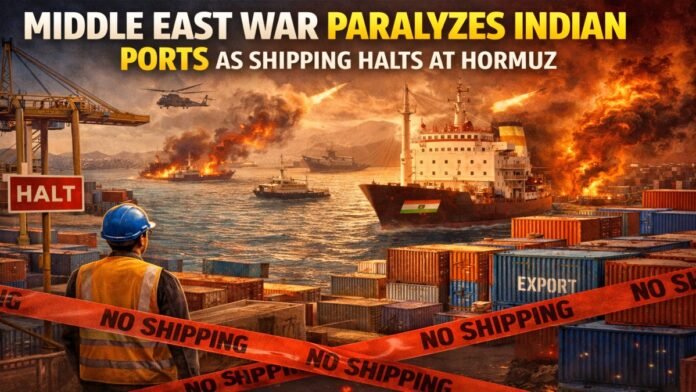
The escalating military conflict in the Middle East, marked by direct strikes between the US, Israel, and Iran, has effectively severed India’s primary maritime trade route through the Strait of Hormuz. As of March 7, 2026, the global shipping industry has declared the strait a high-risk zone, with major carriers such as Maersk and MSC suspending all bookings to the Persian Gulf. This blockade has created a massive logistical bottleneck at India’s western gateway ports, specifically Jawaharlal Nehru Port (JNPT) in Navi Mumbai and Mundra Port in Gujarat, where an estimated 3,000 containers are currently immobilized.
The agricultural sector is bearing the brunt of this disruption. Industry data indicates that 400,000 metric tons of Basmati rice, valued at over ₹6,000 crore, is currently stranded either at ports or in transit. Perishable goods are in an even more precarious state, with over 300 containers of fresh grapes and 5,400 tons of onions stuck at JNPT. Because these goods require constant refrigeration, exporters are facing unsustainable daily costs of ₹8,000 per unit, with many now forced to offload products into domestic markets to avoid total loss. This has led to a sharp decline in local prices; for instance, premium bananas that previously fetched ₹25/kg have dropped to ₹15/kg in wholesale markets like the Vashi APMC.
On the energy front, the situation is critical. With roughly 95% of Middle Eastern LPG and 55% of LNG imports typically passing through the now-blocked Hormuz chokepoint, India’s energy security is under immediate pressure. In response, the Ministry of Petroleum and Natural Gas has invoked emergency provisions, instructing all domestic refineries to step up LPG, propane, and butane output. While Union Minister Hardeep Singh Puri has assured the public that current stocks of petrol and diesel remain adequate, the redirection of gas carriers and force majeure declarations at key facilities like Saudi Arabia’s Ras Tanura have already begun to inflate global fuel benchmarks.
Logistical pressures are compounding the economic strain. Shipping companies have begun rerouting vessels around the Cape of Good Hope, a move that adds three to four weeks to transit times and more than doubles freight rates. For Indian traders, the financial impact is dual-edged: they must pay exorbitant “war-risk surcharges” while their capital remains locked in stranded inventory. Government officials are currently holding daily emergency meetings with the Indian Rice Exporters Federation and port authorities to assess the feasibility of alternative trade corridors, though no immediate replacement for the high-volume Gulf route has been identified.
The long-term impact on the Indian economy remains tied to the duration of the conflict. If the hostilities between Iran and the US-Israel coalition persist, the disruption to 80% of India’s trade routes to Europe and the Middle East could lead to widespread industrial slowdowns and sustained inflationary pressure on domestic energy costs.
Impact of the Middle East War on Indian Agricultural Trade
| Commodity | Volume Stuck / At Risk | Estimated Financial Loss | Domestic Wholesale Price Impact |
|---|---|---|---|
| Basmati Rice | 400,000 Tonnes | ₹4,000 – ₹7,500 Crore | Dropped 6–10% in 72 hours; trading at premium lows. |
| Fresh Bananas | 1,000+ Reefer Units | ₹150+ Crore | Crashed 40% (from ₹25/kg down to ₹15/kg). |
| Onions | 5,400 Tonnes (Nashik) | ₹85 Crore | Dropped 25%; Modal price at Vashi APMC: ₹9.50 – ₹11.50/kg. |
| Fresh Grapes | 300+ Containers | ₹120 Crore | Softened 15% due to local oversupply of export-quality fruit. |
| Buffalo Meat | 300+ Perishable Units | ₹200+ Crore | Stagnant; storage costs exceeding profit margins. |
| Pomegranates | Hundreds of Tonnes | ₹45 Crore | Dropped 20%; localized glut in Maharashtra markets. |
Key Logistical & Economic Indicators
- Freight Rate Surge: Container costs on the India-West Asia route have skyrocketed from $1,500 to nearly $4,500 per container.
- Daily Surcharges: Exporters of perishable goods are paying approximately ₹8,000–₹8,500 per day in electricity and port demurrage charges for grounded reefers.
- Insurance Crisis: Most marine insurers have suspended new “War Risk” policies for the Persian Gulf, leaving ₹20,000 crore worth of total transit cargo currently uninsured.
- “Reverse Flow” Effect: Export-grade produce is being diverted to local mandis (markets) like Vashi and Azadpur, leading to a surplus of high-quality goods at significantly lower prices for Indian consumers.