Key Points
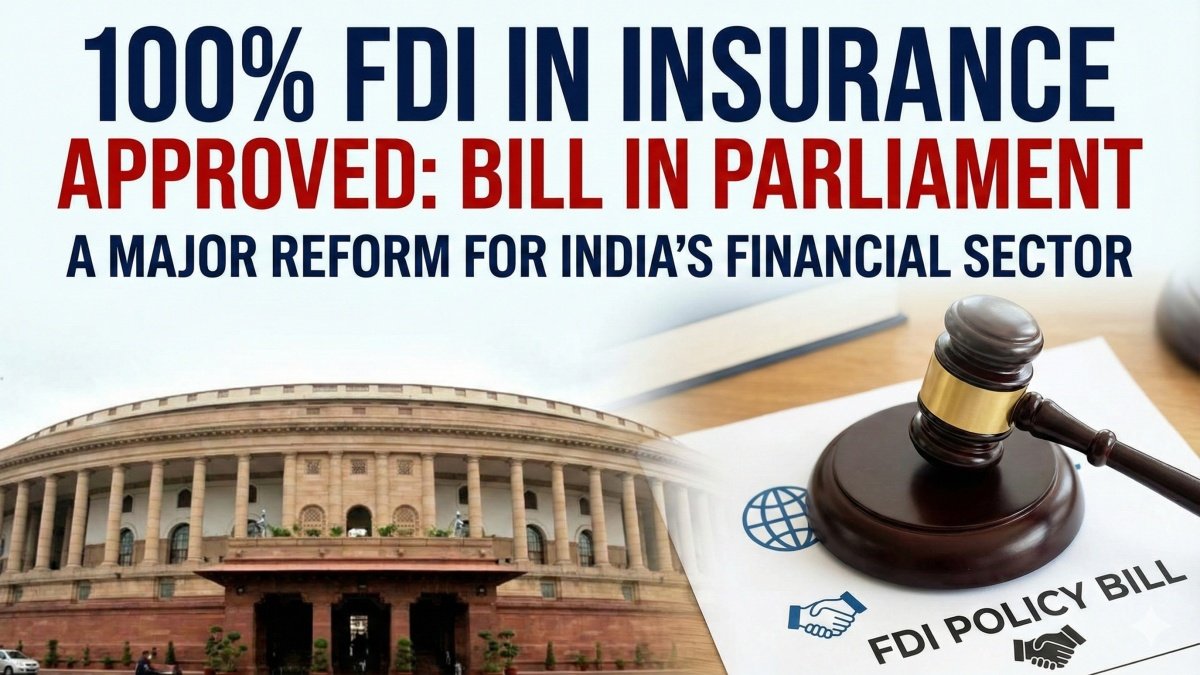
- 100% FDI approved in insurance sector, up from previous 74% limit
- Insurance Laws (Amendment) Bill, 2025 listed for winter session discussion
- ₹82,000 crore FDI received so far; government expects major capital influx
- Industry leaders welcome move for global innovation and digital capabilities
- Additional reforms include reduced paid-up capital requirements and comprehensive licensing system
- LIC to receive greater operational powers for branch expansion and recruitment
- Policyholders to benefit from better products, faster claim settlements, improved service
- Amendments proposed to Insurance Act 1938 and IRDAI Act 1999 to support reforms
The Union Cabinet made a major change to insurance regulations on Friday, approving complete foreign ownership in insurance companies. The objective of this decision is to bring more capital into the insurance sector, increase competition, and further strengthen customer service. It is expected that the approval of 100% FDI will bring about several transformative changes in the insurance sector, which currently manages assets worth over ₹60 lakh crore and serves more than 50 crore policyholders across life and non-life segments.
The Insurance Laws (Amendment) Bill, 2025 is now expected to be introduced in the current winter session of Parliament. It has been listed for discussion in a Lok Sabha bulletin, indicating the government’s urgency to push through these reforms. Prior to this bill, Finance Minister Nirmala Sitharaman had proposed increasing the foreign investment limit from 74% to 100% as part of comprehensive reforms in the financial sector during her budget speech earlier this year.
Foreign Investment Impact and Industry Response
So far, the Indian insurance industry has received approximately ₹82,000 crore in foreign direct investment from global players like AIG, Allianz, AXA, and Prudential. With this new rule, the government expects a surge in global capital, potentially attracting an additional ₹50,000 to ₹75,000 crore in the next three to five years. This influx will provide companies with more opportunities to expand into tier-2 and tier-3 cities, develop new products for emerging risks like cyber threats and climate change, and offer better digital services to tech-savvy customers.
Industry Welcomes Government’s Decision. According to Kamlesh Rao, MD and CEO of Aditya Birla Sun Life Insurance, opening the sector to 100% FDI is certainly a welcome and progressive step. Increased foreign participation can bring in new ideas, global product innovation, digital capabilities, and new service models, which will enhance the last-mile customer experience. Other industry leaders, including HDFC Life’s Vibha Padalkar and ICICI Prudential’s Anup Bagchi, have also praised the move, highlighting potential improvements in claim processing times and product customisation.
Comprehensive Reform Package
The Finance Ministry has proposed several significant changes to modernise the insurance sector. These include increasing the limit for Foreign Direct Investment (FDI) to 100%, reducing paid-up capital requirements from the current ₹100 crore to ₹50 crore for new companies to help new players enter the market, and creating a comprehensive licensing system so that insurers can offer multiple products under one roof. Currently, companies need separate licenses for life, general, and health insurance, but the new system will allow composite licensing.
The government also plans to grant the LIC board greater operational powers, particularly in areas such as opening new branches without prior IRDAI approval for each location and recruiting employees at competitive market salaries. This will help India’s largest insurer compete more effectively with private players who have been gaining market share. LIC currently holds about 60% of the life insurance market but has been losing ground to more agile private insurers.
Alongside this, amendments to the Insurance Act of 1938 and the IRDAI Act of 1999 have been suggested to support the comprehensive reform package. These amendments will streamline regulatory processes, reduce compliance burdens, and align Indian insurance regulations with global standards set by the International Association of Insurance Supervisors (IAIS).
Policyholder Benefits and Market Expansion
The government says these changes are being made to provide better protection to policyholders and to encourage more companies to enter the market. This could lead to better products with more comprehensive coverage, faster claim settlements through AI-powered processing systems, and improved customer service with 24/7 digital support. Increased competition is also expected to boost employment, potentially creating 2-3 lakh new jobs in sales, underwriting, claims processing, and technology roles over the next five years.
Policyholders can expect to see innovative products like usage-based motor insurance, parametric crop insurance with satellite monitoring, and personalised health plans based on wearable device data. The reforms also aim to improve insurance penetration, which currently stands at just 3.2% of GDP compared to the global average of 7.2%. With more capital and competition, insurers can develop affordable micro-insurance products for India’s rural population, where penetration remains below 1%.
The IRDAI has also been directed to fast-track approvals for new products and simplify the claims dispute resolution process, setting a target of settling 90% of claims within 30 days by 2027. This will be supported by a new digital infrastructure platform that will connect insurers, hospitals, and vehicle service centres for real-time claim processing.