Key Highlights
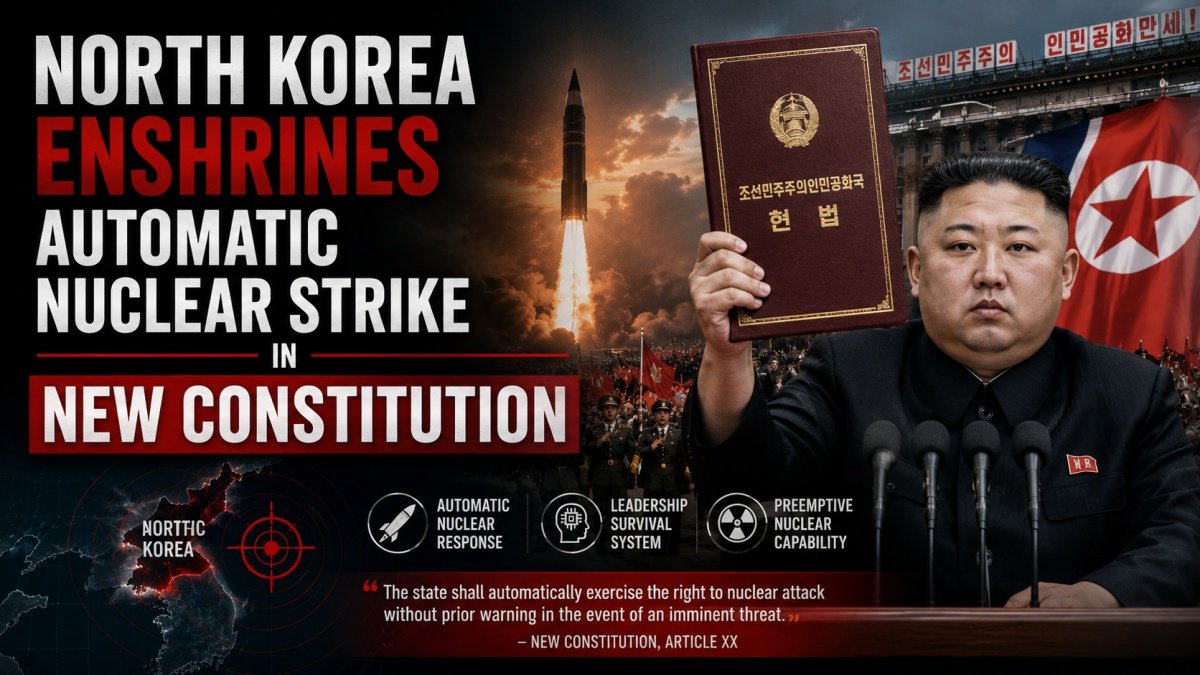
- Constitutional Mandate: The 15th Supreme People’s Assembly officially codified the “automatic strike” protocol into Article 3 and Article 89 of the revised constitution.
- Decapitation Deterrent: The military is now legally required to launch nuclear weapons without manual orders if the supreme command system is targeted by hostile forces.
- Middle East Influence: Intelligence reports suggest the policy shift was accelerated by recent U.S. and Israeli military actions against the Iranian leadership.
- Delegation of Power: For the first time, the Constitution allows the delegation of nuclear launch authority to the National Nuclear Forces Command.
- Global Security Crisis: International observers warn that the “Doomsday” protocol significantly lowers the threshold for nuclear conflict.
In a move that has sent shockwaves through the international community, North Korea has officially amended its constitution to ensure its nuclear arsenal remains operational even if its supreme leader is killed. According to a briefing from South Korea’s National Intelligence Service (NIS) on May 7, 2026, the 15th Supreme People’s Assembly finalized these revisions during its recent sessions in Pyongyang. The new legislation effectively places the nation’s nuclear retaliatory capabilities on “automatic” mode, removing the need for a direct order from Kim Jong Un in the event of his incapacitation.
The core of this change lies in the revised Article 3 of the nuclear policy law, which stipulates that if the state’s nuclear command and control system is placed in danger by hostile attacks, a nuclear strike shall be launched immediately. This provision is specifically designed to deter “decapitation strikes,” a military strategy aimed at removing a country’s top leadership to paralyze its command structure.
Lessons from the Middle East
Geopolitical analysts indicate that Kim Jong Un’s decision to automate nuclear retaliation is a direct response to the volatile situation in the Middle East. Following the reported U.S. and Israeli operations targeting Iranian military commanders and the supreme leadership earlier this month, Pyongyang has become increasingly wary of its own security. The “Doomsday” protocol is intended to signal to the United States, South Korea, and Japan that any attempt to target the North Korean leadership would result in an unavoidable and catastrophic nuclear response.
While the 2022 nuclear forces law previously hinted at these measures, the 2026 constitutional revision elevates this authority to the highest legal level. Article 89 now explicitly states that command authority over nuclear forces belongs to the President of the State Affairs Commission, while also establishing the legal framework for delegating this authority to a specialized nuclear command organization.
Escalating Global Risks
The timing of this announcement coincides with a period of extreme global instability. As of May 8, 2026, regional tensions remain at a breaking point following clashes in the Strait of Hormuz. By constitutionally enshrining an automatic strike policy, North Korea has eliminated any ambiguity regarding its nuclear intentions.
Critics argue that this policy creates a “hair-trigger” environment where technical malfunctions, false alarms, or minor skirmishes could lead to an unintended nuclear exchange. Despite international condemnation, the North Korean state media has characterized the move as a necessary measure to “permanently fix” the country’s status as a nuclear-armed state and ensure the survival of the regime against what it terms “hostile imperialist aggression.”