

































Key Highlights
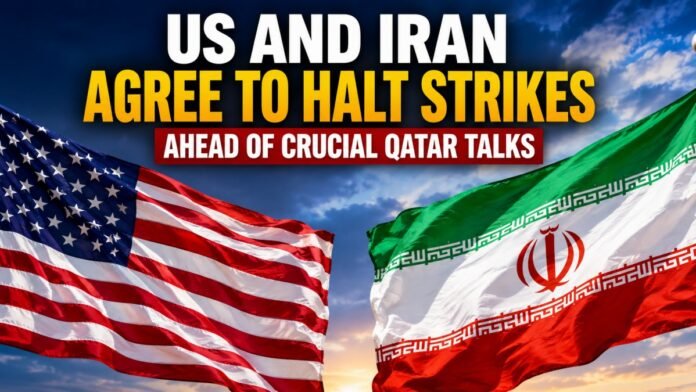
- Kinetic Activity Paused: Senior US officials confirmed both nations agreed to suspend direct military strikes to protect a fragile interim peace deal.
- Hormuz Waterway Dispute: Tomorrow’s high-stakes meeting in Doha, Qatar, aims to settle clashing interpretations over maritime traffic control in the vital energy corridor.
- High-Stakes Brinkmanship: The pause follows intense tit-for-tat strikes and severe warnings from US President Donald Trump, who threatened to restart full-scale warfare if compliance failed.
The United States and Iran have reached a critical understanding to completely halt all “kinetic activity,” a military term denoting active strikes and aggressive maneuvers, following a perilous 24 hour window of renewed hostilities. According to senior US administrative sources, the sudden stand-down is intended to preserve a fragile peace framework and clear a diplomatic path for upcoming bilateral discussions.
The sudden halt comes directly after both sides traded missile and drone strikes over the weekend, threatening to collapse a hard-won memorandum of understanding signed on June 17, 2026. That agreement, which temporarily halted a wider conflict that erupted in late February, had seen Washington agree to ease its naval blockades on Iranian ports in exchange for Tehran guaranteeing safe passage for commercial shipping. The weekend’s violations underscored the extreme volatility of the truce, pushing both capitals back to the negotiating table.
Strategic Doha Meeting to Target Strait of Hormuz Dispute
Delegations from Washington and Tehran are scheduled to convene on Tuesday in Doha, the capital of Qatar, to address the core source of the recent military friction, control and administration of the Strait of Hormuz. The strategic waterway serves as a global economic lifeline, routing approximately one-fifth of the world’s petroleum and liquid natural gas supplies.
The renewed hostilities stemmed from clashing interpretations of the June 17 agreement. Iranian Foreign Minister Abbas Araghchi asserted that the deal grants Tehran the exclusive right to manage maritime traffic, requiring commercial vessels to follow specific corridors along the Iranian coastline. The US, conversely, maintains that the memorandum ensures completely unimpeded navigation in international waters. Tensions boiled over when Iranian forces targeted a commercial vessel attempting to cross the strait by hugging the coast of Oman, prompting immediate US military retaliation.
While recent talks in Switzerland led by US Vice President JD Vance successfully established a direct military hotline between the US Armed Forces and the Islamic Revolutionary Guard Corps, the communication channel was not yet fully operational when the latest clashes broke out. The Doha summit, which was originally slated to cover nuclear negotiations, has been re-routed to focus entirely on preventing a permanent maritime breakdown.
Rhetorical Escalation and Shipping Relief
Prior to the agreement to stand down, US President Donald Trump adopted a highly aggressive posture, warning that the US military was prepared to restart the war and finish the job if Iran continued to disrupt regional waters. Trump openly declared that continued non-compliance would face devastating, overwhelming force, while Iranian diplomatic channels counter-warned that any unilateral violation of the ceasefire by Washington would permanently shut down all future avenues for dialogue.
Despite the heavy rhetoric, US officials report that maritime traffic through the Strait of Hormuz is currently moving without hindrance, as both nations seek to foster a viable atmosphere for the Qatari-mediated talks. While Washington has publicly detailed the stand-down agreement, Tehran has yet to issue an official state confirmation, keeping regional observers and global energy markets on high alert as the technical delegations arrive in Doha.