



































Key Points
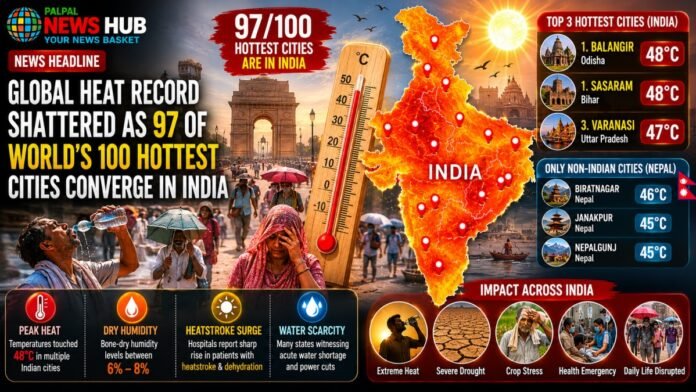
- Global Dominance: According to real-time tracking by AQI.in, an overwhelming 97 out of the world’s 100 hottest locations on Friday afternoon were inside India.
- Peak Temperatures: Balangir in Odisha and Sasaram in Bihar tied for the hottest spots on Earth at a blistering 48°C, closely followed by Varanasi in Uttar Pradesh at 47°C.
- Regional Outliers: The only non-Indian cities to make the global top 100 list were three locations in neighboring Nepal, where temperatures hovered around 45°C to 46°C.
- Public Health Emergency: Extreme heat coupled with bone-dry humidity levels between 6% and 8% has triggered a surge in heatstroke, dehydration, and severe water scarcity across multiple states.
Large swathes of India are grappling with an extraordinary environmental crisis as a severe heatwave effectively monopolizes the global list of extreme temperatures. In a shocking data release on Friday afternoon, real-time climate monitoring platform AQI.in confirmed that 97 of the world’s 100 hottest municipalities were located simultaneously within Indian borders, underscoring a historic atmospheric anomaly gripping the subcontinent.
Driven by dry, persistent winds, clear skies, and a distinct lack of stabilizing western disturbances, daytime temperatures easily breached the 45°C threshold across northern, central, and eastern India by midday. Compounding the distress, bone-dry humidity levels dropping to between 6% and 8% in the worst-hit zones have created an “extreme hot” thermal environment, turning routine outdoor exposure dangerous.
Mapping the Global Heat Leaders
The global top 100 list reveals an intense concentration of heat across several major Indian states, with Uttar Pradesh, Bihar, Odisha, and Chhattisgarh bearing the brunt of the pre-monsoon furnace.
Balangir in Odisha officially registered as the hottest city on Earth, clocking a lethal 48°C at 2:50 PM IST. It was immediately matched by Sasaram in Bihar at 48°C, while the historic city of Varanasi in Uttar Pradesh secured the third spot globally at 47°C. This intense spike follows a similarly brutal reading earlier in the week in Banda, Uttar Pradesh, which also touched 48°C.
| Rank | City, Country | Temperature | Condition |
|---|---|---|---|
| 1 | Balangir, India | 48°C | Extreme Hot |
| 2 | Sasaram, India | 48°C | Extreme Hot |
| 3 | Varanasi, India | 47°C | Extreme Hot |
| 23 | Dhangadhi, Nepal | 46°C | Extreme Hot |
| 26 | Muzaffarnagar, India | 46°C | Extreme Hot |
| 32 | Ayodhya, India | 46°C | Extreme Hot |
| 34 | Nepalgunj, Nepal | 46°C | Extreme Hot |
| 42 | Patiala, India | 46°C | Extreme Hot |
| 55 | Warangal, India | 46°C | Extreme Hot |
| 56 | Haridwar, India | 46°C | Extreme Hot |
| 62 | Sri Ganganagar, India | 45°C | Extreme Hot |
| 76 | Lumbini Sanskritik, Nepal | 45°C | Extreme Hot |
(Data Source: AQI.in real-time afternoon metrics)
The geographic scale of the synchronised heat across India is historically unprecedented. Aside from the 97 Indian municipalities, the only other global outliers to pierce the top 100 chart were three cities located in Nepal: Dhangadhi, Nepalgunj, and Lumbini Sanskritik, where thermometers peaked between 45°C and 46°C.
Hospitalizations Soar Amid Infrastructure Strain
The human toll of the extreme weather is mounting rapidly. State health departments have logged hundreds of suspected heatstroke casualties, with Andhra Pradesh alone reporting 325 cases. Local hospitals across the Indo-Gangetic plains are overwhelmed by long queues of citizens suffering from acute dehydration, heat exhaustion, and gastroenteritis.
Medical experts warn that heatstroke constitutes an absolute emergency. When environmental temperatures cross 40°C in the plains, or 30°C in hilly terrains, it attacks the human body’s regulatory mechanisms, causing confusion, dizziness, seizures, and eventual multi-organ failure if left unaddressed.
Simultaneously, the heatwave is pushing public infrastructure to its absolute limit. Severe water shortages have sparked localized crises, with news agency ANI broadcasting stark visuals of citizens queuing for basic water rations in rural and urban parts of Gujarat. Furthermore, power grids are facing historic load stress as electricity demand for air cooling hits unprecedented peaks nationwide.
Strict Advisories Issued as Red Alerts Loom
The India Meteorological Department (IMD) has issued formal “heatwave to severe heatwave” warnings, projecting these punishing conditions will persist through May 27. The weather office enforces a heatwave classification when localized temperatures depart 4.5°C to 6.4°C above seasonal baselines.
In response to the data, state administrative bodies have issued strict public safety mandates, urging citizens to observe voluntary self-lockdowns and completely avoid outdoor activities between 11:00 AM and 4:00 PM, when solar radiation and thermal loading reach their peak.