


























Key Points
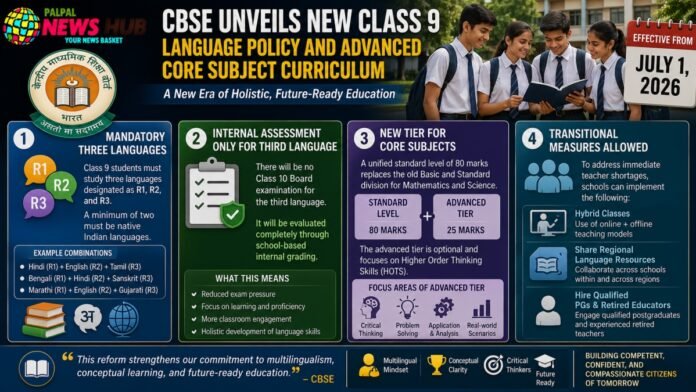
- Mandatory Three Languages: Starting July 1, 2026, Class 9 students must study three languages, designated as R1, R2, and R3, with a minimum of two being native Indian languages.
- Internal Assessment Only: There will be no Class 10 Board examination for the third language, as it will be evaluated completely through school-based internal grading.
- New Tier for Core Subjects: A unified standard level of 80 marks replaces the old Basic and Standard division for Mathematics and Science, introducing an optional 25-mark advanced tier focused on Higher Order Thinking Skills, or HOTS.
- Transitional Measures Allowed: To address immediate teacher shortages, schools can implement hybrid classes, share regional language resources, or hire qualified postgraduates and retired educators.
NEW DELHI, In a major structural shift aligned with the National Education Policy, or NEP 2020, and the National Curriculum Framework for School Education, or NCF-SE 2023, the Central Board of Secondary Education, or CBSE, released an official notification on May 15, 2026. The circular establishes that beginning July 1, 2026, all Class 9 students enrolled across CBSE-affiliated schools must compulsorily study three distinct languages.
The primary regulatory update dictates that out of the three selected languages, categorized sequentially as R1, R2, and R3, at least two must be native Indian languages. While students retain the flexibility to select a foreign language, they may only do so as their third language option, or alternatively, as a non-compulsory fourth subject. To alleviate academic pressure, the Board clarified that no formal external Class 10 Board examination will be administered for the third language, ensuring the tracking metric remains strictly confined to internal, school-based assessments.
Overcoming Operational Constraints
Because this transition applies directly to the ongoing 2026-2027 academic session, schools have been granted permission to adopt a transitional blueprint. For instance, Class 9 students starting their third language this year will temporarily utilize Class 6 textbooks until the National Council of Educational Research and Training, or NCERT, formally develops secondary-level specialized material.
Furthermore, to combat acute shortages of qualified native Indian language teachers in specific regions, CBSE has authorized flexible, interim solutions. School administrations are encouraged to establish cross-school resource sharing agreements, deploy virtual or hybrid classrooms, and hire qualified postgraduates or retired teachers. Schools must update their specific language tracks on the institutional OASIS portal before June 30, 2026, though individual relaxations will be granted for schools located outside India, foreign nationals, and Children with Special Needs, or CwSN.
Structural Updates to Mathematics and Science
In tandem with the language overhaul, CBSE is restructuring the evaluation architecture for core STEM fields. Starting in the 2026-2027 academic session for Class 9, and expanding to Class 10 by 2027-2028, the Board is permanently dissolving the old segregation between ‘Basic’ and ‘Standard’ Mathematics. Instead, a singular, uniform curriculum will be administered to all students, tested via a compulsory, three-hour annual examination worth 80 marks.
To cater to students demonstrating advanced aptitude, CBSE is introducing an optional, independent advanced tier for both Mathematics and Science. This optional paper consists of a separate one-hour examination carrying 25 marks, explicitly curated to test Higher Order Thinking Skills, or HOTS. Crucially, these advanced scores will not affect a student’s overall aggregate percentage. If a candidate achieves 50% or higher on the optional module, their official marksheet will feature a special validation note highlighting successful completion of the advanced level. The inaugural Class 10 Board examinations utilizing this unified standard and advanced blueprint will take place in early 2028.