



































Key Points
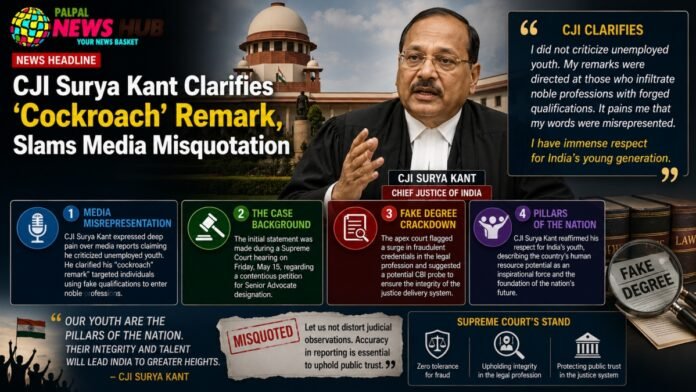
- Media Misrepresentation: CJI Surya Kant expressed deep pain over reports claiming he criticized unemployed youth, clarifying his remarks targeted individuals infiltrating noble professions via forged qualifications.
- The Case Background: The initial statement occurred during a Supreme Court hearing on Friday, May 15, regarding a contentious petition for Senior Advocate designation.
- Fake Degree Crackdown: The apex court flagged a surge in fraudulent credentials within the legal sphere, suggesting a potential Central Bureau of Investigation, or CBI, probe.
- Pillars of the Nation: Reaffirming his respect for India’s young generation, the Chief Justice described the country’s human resource potential as an inspirational global force.
Chief Justice of India Surya Kant issued a comprehensive clarification on Saturday, May 16, 2026, asserting that a section of the media had completely misquoted and misrepresented oral observations he made during a court session a day prior. Expressing profound disappointment over the narrative circulating online, the Chief Justice clarified that his remarks were never intended as a critique of India’s unemployed youth or junior lawyers struggling within the profession.
Instead, the Chief Justice emphasized that his verbal reprimand was specifically directed at individuals who use fake, bogus degrees to sneak into respected fields such as law, journalism, and social media activism, subsequently using their positions to systematically undermine the judiciary. Describing these fraudulent actors as parasites on the system, the CJI reaffirmed his utmost regard for India’s young generation, characterizing them as the essential pillars of a developed India.
The Courtroom Context: Frivolous Litigation and Professional Conduct
The controversy stems from a Friday session where a Supreme Court bench, comprising CJI Surya Kant and Justice Joymalya Bagchi, was hearing a contempt petition filed by advocate Sanjay Dubey. The petitioner was seeking judicial action against the Registrar General of the Delhi High Court over perceived delays in implementing revised guidelines for conferring the highly coveted “Senior Advocate” designation.
During the tense exchange, the bench raised serious objections to the petitioner’s aggressive pursuit of the title, reminding him that a senior designation is a merit-based honor conferred by the courts rather than a status symbol to be actively chased through repetitive litigation. The bench took severe exception to the language and confrontational statements the petitioner had previously deployed on digital platforms like Facebook. It was within this specific framework, while admonishing individuals who use public platforms to launch unprovoked attacks on judicial institutions, that the term “cockroach” was utilized, an observation that was subsequently separated from its context and amplified across social media networks.
Courtroom Exchange Highlights:
- Justice Joymalya Bagchi: “Is a senior advocate tag a status symbol which is ornamental to be kept, or for your active participation in the justice system?”
- CJI Surya Kant: “If you people do not have any respect, do you expect outsiders to give you respect? There are already parasites in society who attack the system.”
A Firm Directive on Fake Qualifications and BCI Politics
The Supreme Court expanded on the broader issue of institutional decay during the proceedings, identifying a systemic crisis regarding the authenticity of professional credentials. The Chief Justice expressed grave concern over the increasing number of individuals practicing law without legitimate educational backgrounds, noting that thousands of fraudulent operators are currently wearing black robes while holding highly questionable degrees.
To address this integrity breach, the CJI indicated that the Supreme Court is strongly considering referring the entire matter to the Central Bureau of Investigation, or CBI, to carry out a comprehensive verification check on degrees held by practicing advocates. Furthermore, the bench pointedly questioned the regulatory oversight of the Bar Council of India, or BCI, observing that the council frequently fails to initiate strict, timely disciplinary actions against fraudulent practitioners due to internal vote-bank politics.
Restoring Trust in India’s Human Resource Potential
Concluding his official statement, Chief Justice Surya Kant sought to completely dispel any perceptions of anti-youth sentiment within the apex court. He reiterated that the allegations suggesting he targeted the nation’s struggling young demographic are entirely baseless, noting that the country’s vast human resource capacity remains a formidable, highly respected global force. Following the sharp reprimand from the bench, the petitioner’s lawyer tendered an unconditional apology to the court for his social media conduct and formally withdrew his plea, drawing the controversial legal battle to a close.