






























Key Points
- New Tax Era: The 65-year-old Income Tax Act of 1961 is officially replaced by the streamlined Income Tax Act, 2025.
- Higher Exemptions: Salaried individuals earning up to ₹12.75 lakh (including the ₹75,000 standard deduction) will pay zero tax under the new regime.
- GST Relief: Health and life insurance premiums, 33 life-saving drugs, and unpackaged dairy are now tax-exempt.
- Inflationary Pressure: Domestic LPG prices rise to ₹913 in Delhi, and over 900 essential medicines will see a 1.74% price hike.
- Compliance Shift: Aadhaar is no longer valid as age proof for new PAN applications, requiring a birth or Class 10 certificate instead.
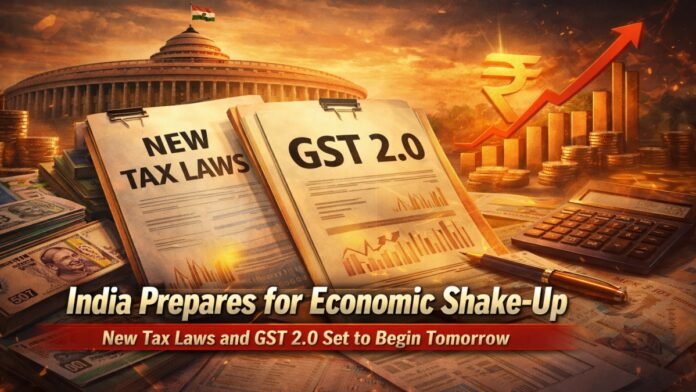
India stands on the brink of a historic economic pivot. At midnight on April 1, 2026, the nation will repeal the 1961 Income Tax Act in favour of the “Income Tax Act, 2025.” This transition, paired with the rollout of “GST 2.0,” represents a comprehensive restructuring of India’s fiscal landscape. The new laws are designed to simplify compliance and increase disposable income for the middle class, though they arrive alongside significant price adjustments for energy and healthcare.
Under the new regime, the effective tax-free limit has been aggressively raised. Any citizen with a net annual income of up to ₹12 lakh will have their tax liability reduced to zero through a ₹60,000 rebate under Section 87A. For salaried employees, this limit effectively stretches to ₹12.75 lakh when the ₹75,000 standard deduction is applied. For those remaining in the old tax regime, the government has addressed long-standing inflation concerns by increasing the children’s education allowance from ₹100 to ₹3,000 per month, and the hostel allowance from ₹300 to ₹9,000.
GST 2.0, Insurance Relief and Luxury “Sin Taxes”
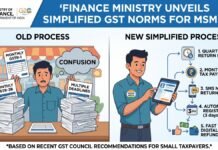
The implementation of GST 2.0 brings structural changes to the indirect tax system. In a major win for social security, individual health and life insurance premiums have been moved to the 0% bracket, down from 18%. This shift is expected to significantly lower the cost of coverage for millions of families. Additionally, 33 life-saving drugs and unpackaged dairy products have been made tax-free to support public health and nutrition.
The tax slabs for consumer durables have also been re-aligned. Small cars, air conditioners, and televisions have seen their GST rates slashed from 28% to 18%, potentially triggering a wave of summer demand. Conversely, the government has tightened the “Sin Tax” on tobacco, luxury vehicles, and online gaming, all of which will now attract the maximum GST rate of 40%.
Global Volatility Hits LPG and Healthcare Costs
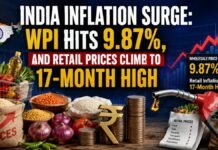
While tax breaks offer relief, geopolitical instability in the Middle East, particularly following the recent military strikes in Isfahan, has impacted energy prices. In Delhi, domestic LPG cylinder prices have climbed to ₹913, while commercial cylinders are now priced at ₹1,884.50. This energy inflation is joined by a sanctioned 1.74% price hike for over 900 essential medicines. Patients will likely see immediate price increases for daily necessities, including paracetamol and common antibiotics.
Stricter Rules for Banking and Identity
Administrative rules are also seeing a tightening of screws. HDFC Bank has announced that UPI-based cardless ATM withdrawals will now count toward the monthly limit of five free transactions, with subsequent withdrawals costing ₹23 each.
Furthermore, the process for obtaining a PAN card has been modernised, yet made more rigorous. From tomorrow, an Aadhaar card will no longer be accepted as a valid proof of age; applicants must provide either a birth certificate or a Class 10th matriculation certificate. Finally, Indian Railways has revamped its refund policy to improve seat availability, decreeing that no refunds will be issued for tickets cancelled less than eight hours before the scheduled departure.