



































Key Highlights
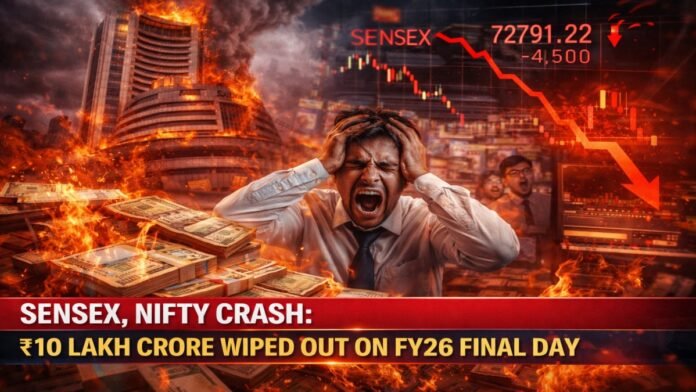
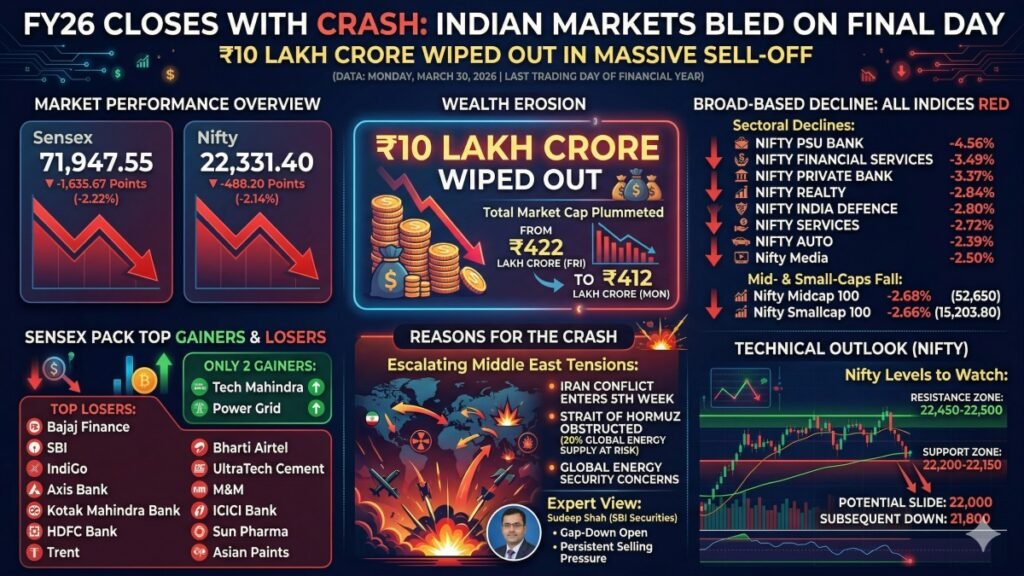
- Market Crash: Sensex plunged 1,635 points, while Nifty crashed below the 22,350 mark.
- Wealth Erosion: The total market capitalization of BSE,listed firms dropped from ₹422 lakh crore to ₹412 lakh crore.
- Sectoral Pain: PSU Banks and Financial Services were the hardest hit, falling over 3%.
- Geopolitical Trigger: Escalating conflict between the U.S., Israel, and Iran remains the primary driver of global market volatility.
- Closing Standings: Only two Sensex stocks, Tech Mahindra and Power Grid, managed to finish in positive territory.
The Indian stock market witnessed a brutal “Black Monday” during the final trading session of the 2025,26 financial year. Investor sentiment was crushed by a wave of global panic, leading to a broad, based sell, off across all sectors. By the closing bell, the BSE Sensex stood at 71,947.55, down a staggering 1,635.67 points or 2.22 per cent. Simultaneously, the NSE Nifty 50 shed 488.20 points, closing at 22,331.40.
The magnitude of the decline was visible in the mid-cap and small-cap segments as well. The Nifty Midcap 100 index fell by 2.68 per cent to close at 52,650, while the Nifty Smallcap 100 dropped 2.66 per cent to 15,203.80, indicating that the panic was not limited to blue-chip stocks but permeated the entire market ecosystem.
The Iran Conflict and Global Uncertainty
The primary catalyst for this dramatic downturn is the worsening geopolitical crisis in the Middle East. With the conflict involving Iran now entering its fifth week, and recent claims of “regime change” from Washington, the threat to global energy security has reached a critical level. The ongoing obstruction of the Strait of Hormuz, which handles 20% of the world’s oil and gas, has kept crude prices volatile, directly impacting India’s trade deficit and inflationary outlook.
Retailers and institutional investors alike moved toward safe-haven assets as the “fog of war” obscured any immediate signs of resolution. This uncertainty led to the erosion of approximately ₹10 lakh crore in market capitalisation in just six hours of trading.
Sectoral Breakdown and Top Losers
The carnage was led by the banking and financial sectors. The Nifty PSU Bank index was the worst performer, crashing 4.56 per cent, followed closely by Financial Services (down 3.49%) and Private Banks (down 3.37%).
Top Losers included:
- Financials: Bajaj Finance, SBI, Axis Bank, HDFC Bank, and ICICI Bank.
- Consumer/Others: IndiGo, Trent, Bharti Airtel, UltraTech Cement, and M&M.
In a rare show of resilience, Tech Mahindra and Power Grid were the only two stocks among the Sensex 30 to buck the trend and close with marginal gains.
Expert Technical Outlook for April 2026
Sudeep Shah, Head of Technicals and Derivatives at SBI Securities, noted that the market opened with a significant “gap down” on this final day of FY26. Despite a brief attempt at a mid-session recovery, persistent selling pressure from institutional desks exacerbated the decline.
According to technical analysts, the Nifty has now entered a precarious zone. While a support level is identified between 22,200 and 22,150, a breach of this range could see the index slide toward 22,000 or even 21,800 in the opening week of the new fiscal year. On the upside, the 22,450 to 22,500 range now serves as a formidable resistance level that the bulls must reclaim to restore confidence.