


































Key Points
- Silver surges 158% in 2025, outpacing gold, equities, and cryptocurrencies
- Record supply deficit of 430 million ounces as industrial demand jumps 12%
- Solar and EV sectors consume 65% of total silver output, up from 50% five years ago
- Experts predict $100/ounce by 2026, up from current $73, Indian prices could hit ₹240,000-250,000/kg
- Physical silver shortage prompts shift from paper contracts, COMEX inventories at 7-year low
- Investment advisors recommend SIPs and ETFs for retail participation amid extreme volatility
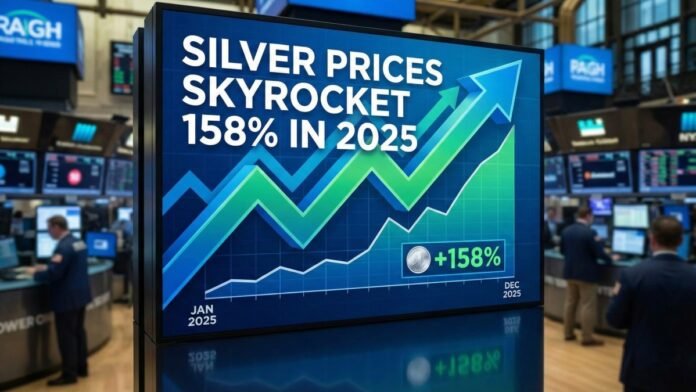
Silver has emerged as the standout performer across all asset classes in 2025, delivering staggering returns of 158% year-to-date. The white metal’s meteoric rise from approximately $28 per ounce in January to current levels around $73 has caught even seasoned bullion traders off guard, making it one of the highest-returning investments globally. The rally accelerated dramatically in the second half as supply constraints became acute and industrial consumption reached record levels. Unlike the speculative spike of 1979-80, this surge rests on solid fundamentals, structural supply shortages, and a fundamental shift in silver’s role from precious metal to critical industrial commodity. The London Bullion Market Association reports that daily trading volumes have doubled to $50 billion, indicating massive institutional participation.
Supply Crisis Deepens as Industrial Demand Explodes
The core driver behind silver’s parabolic move is a persistent supply deficit that has plagued the market for five consecutive years. Approximately 75% of silver production comes as a by-product of lead, zinc, and copper mining, creating a structural limitation where miners cannot quickly ramp up output even when prices surge. The Silver Institute’s latest report indicates that global mine supply fell 3% in 2025 to 820 million ounces, while total demand jumped 12% to 1.25 billion ounces, creating a record deficit of 430 million ounces. This gap exceeds the combined annual production of the world’s top three primary silver mines.
Industrial consumption now accounts for 65% of total silver demand, up from 50% just five years ago. The solar photovoltaic industry alone consumed 210 million ounces in 2025, a 25% increase from last year, as governments worldwide accelerate renewable energy deployment. Electric vehicle manufacturers used another 85 million ounces for electrical contacts, battery management systems, and charging infrastructure. The electronics sector, including 5G infrastructure and AI data centers, absorbed 180 million ounces. The International Energy Agency projects solar installations will grow another 30% in 2026, while the EV revolution shows no signs of slowing, with major automakers committing $500 billion to electrification through 2030.
$100/Ounce Target Gains Credibility Among Analysts
The once-outlandish prediction of silver hitting $100 per ounce now commands serious attention from major financial institutions. JPMorgan Chase has revised its 2026 target to $95 per ounce, citing inelastic supply response and accelerating industrial adoption. Goldman Sachs’ commodities team believes the $100 level is achievable by the fourth quarter of 2026 if current deficit conditions persist. The India Bullion and Jewellers Association confirms that trading desks are positioning for a potential breakout above the psychological $100 barrier, which would represent uncharted territory.
The shift from paper silver to physical holdings has intensified this rally. Major ETFs like iShares Silver Trust have seen inventories deplete by 120 million ounces in 2025 as investors demand physical delivery rather than synthetic exposure. COMEX warehouse stocks have fallen to a 7-year low of 280 million ounces, raising concerns about potential delivery squeezes during contract expiries. The London Metals Exchange has responded by increasing margin requirements by 30% to manage volatility, though this has done little to cool the rally.
Indian Market Poised for Historic Price Levels
Indian silver prices on the Multi-Commodity Exchange have tracked the global rally, touching lifetime highs of ₹224,000 per kilogram in December 2025. If international prices reach the projected $100 per ounce level, domestic prices could surge to between ₹240,000 and ₹250,000 per kilogram, factoring in rupee depreciation and import duties. The landed cost includes 10% basic customs duty, 3% GST, and other charges, which amplify international price movements.
The price surge has triggered a curious phenomenon in the Indian market: retail demand for physical silver has collapsed by 40% due to affordability issues, while investment demand through ETFs and futures has exploded. The National Stock Exchange’s Silver ETF assets under management have grown 300% to ₹18,000 crore in 2025. Jewellers report that consumers are exchanging old silverware for cash rather than buying new items, creating a secondary supply that partially offsets industrial demand. The Reserve Bank of India has not commented on whether it plans to add silver to its reserves, though central bank buying could provide another demand catalyst. Indian solar panel manufacturers are facing a cost crisis, with silver accounting for 15% of total production costs, up from 8% last year.
Investment Strategy and Market Outlook
Market veterans advise retail investors to approach silver with caution despite the bullish long-term outlook. The 158% rally has left prices vulnerable to sharp corrections, with technical analysts warning that a drop to $60-65 per ounce is possible if industrial demand shows any weakness. However, the structural deficit suggests that any dip would be a buying opportunity for long-term investors. Financial planners recommend systematic investment plans in silver ETFs to average out volatility, rather than lump-sum investments at current elevated levels.
The India Bullion and Jewellers Association suggests allocating 5-10% of investment portfolios to silver, viewing it as both an industrial commodity and a monetary metal. They caution against leveraged positions in futures markets due to extreme volatility. Recent intraday swings of 8-10% have triggered margin calls for many traders. For those seeking physical exposure, government-minted silver coins and bars from accredited refiners offer the best liquidity, though premiums have widened to 15% over spot prices due to supply shortages. The next two years could prove to be a “golden period” for silver investors, but only those who can stomach the volatility.