


































Key Highlights
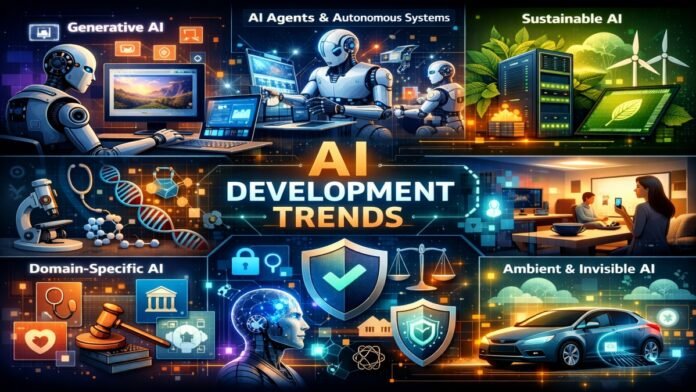
- The Agentic Shift: AI has moved toward Multiagent Systems (MAS), where specialized agents collaborate to manage end, to, end business workflows without constant human prompts.
- Scientific Breakthroughs: AI-enabled drug discovery is seeing its first major Phase III clinical results, with early discovery timelines compressed by up to 40%.
- Sovereign Infrastructure: The IndiaAI Mission has expanded its common compute cluster to over 38,000 GPUs, offering subsidized access to startups at ₹65 per hour.
- Global Governance: In March 2026, the first legally binding international treaty on AI governance was endorsed, establishing a global baseline for rights, respecting deployment.
- Frugal AI: A new focus on “energy-efficient” or “frugal” AI is rising to mitigate the environmental impact of massive data centers.
Artificial Intelligence is currently undergoing its most transformative phase since the initial generative boom. By early 2026, the industry will have shifted its focus from single large models to Multiagent Systems (MAS). These systems function like a digital orchestra, where different specialized agents handle modular tasks, such as risk assessment, document generation, and final decision-making, within a unified framework.
This shift marks the transition from “AI as an assistant” to “AI as an organizational intelligence.” Instead of users needing to micromanage every prompt, these autonomous agents can independently plan and execute complex processes, such as managing a complete loan application or coordinating patient care in healthcare settings.
Scientific Discovery and the Clinical Inflection Point
AI is no longer just a laboratory curiosity; it is now a primary engine for scientific discovery. In the pharmaceutical sector, 2026 is being hailed as the “Year of Clinical Validation.” Molecules discovered entirely through AI workflows are now entering late-stage Phase III trials, the definitive test of whether AI can deliver drugs that actually work at scale.
Beyond drug discovery, AI is being utilized as a “lab assistant” in materials science and climate modeling. By integrating multi-omics data and utilizing reinforcement learning with verifiable rewards, scientific agents are now capable of performing autonomous multi-step research tasks that were previously impossible for human researchers to complete in such short timeframes.
Sovereign AI and the Infrastructure Revolution
Governments worldwide are increasingly treating AI computing as a critical public utility. A prime example is the IndiaAI Mission 2.0, which was recently launched to focus on deep research and indigenous model development. India’s common compute cluster has already onboarded more than 38,000 high-end GPUs, providing the hardware necessary for local startups to compete on a global scale.
This “common compute” model, which offers high-performance resources at significantly lower costs, is intended to democratize technology and ensure that AI leadership is not confined to a few massive corporations.
Sustainability and the Rise of Frugal AI
As the energy demands of massive data centers continue to climb, 2026 has seen the emergence of Frugal AI. This movement prioritizes “right-sizing” models, using smaller, task-specific architectures that require a fraction of the power of their general-purpose predecessors.
Organizations are also increasingly moving AI workloads to lower-carbon grids and utilizing renewables, which now represent over 40% of global electricity generation. The goal is to ensure that the AI boom remains compatible with global climate commitments, turning AI’s energy appetite into a catalyst for the green energy transition.
Trust, Safety, and Global Treaties
The rapid expansion of AI has necessitated a new era of global cooperation. In March 2026, several world powers endorsed the first legally binding international treaty on AI governance. This framework addresses the risks AI poses to fundamental democratic values and establishes strict standards for transparency, auditability, and human oversight.
Furthermore, the high-risk provisions of the EU AI Act are set to take effect in August 2026, creating a more regulated and predictable environment for enterprise AI deployment. These guardrails are seen as essential for building public trust as AI becomes an “invisible” but integral layer of everyday life.