

































Key Points
- Salary-Based Selection: Selection odds are now weighted by wage level, with senior-level (Level 4) applicants receiving four times the entries of entry-level (Level 1) candidates.
- Mandatory Form I-129: A new, detailed edition of Form I-129 becomes mandatory on April 1, 2026, requiring specific data on job duties and education to verify wage levels.
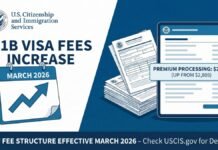
- Staggering Fee Increase: A $100,000 annual supplemental fee now applies to new H-1B petitions for workers outside the U.S., a massive jump from previous rates.
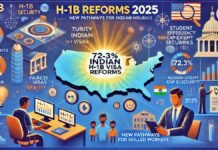
- Impact on Indian Talent: Indian professionals, who traditionally secure 70% of H-1B visas, are seeing a sharp decline in filings as entry-level roles become economically unsustainable for many firms.
The landscape of skilled immigration to the United States has undergone its most dramatic transformation in decades. Moving away from the long-standing random lottery, the U.S. government has implemented a merit-based system that prioritizes high-earning professionals. Under the new guidelines, the probability of obtaining an H-1B visa is now directly proportional to the salary offered, signaling a clear move to favor senior experts over entry-level talent.
Effective February 27, 2026, the Department of Homeland Security (DHS) began using a weighted selection process for the Fiscal Year 2027 cap season. In this system, applicants are categorized into four wage levels based on their profession and geographic location. A Level 4 candidate (the highest expertise) is granted four entries into the selection pool, while a Level 1 candidate (entry-level) receives only one. This structural change is projected to reduce the selection rate for entry-level positions by nearly 50%, while doubling the odds for those at the top tier.
Form I-129 and the Crackdown on Wage Discrepancies
To enforce this new logic, the U.S. Citizenship and Immigration Services (USCIS) has released an updated edition of Form I-129, dated February 27, 2026. This form becomes the only accepted version starting April 1, 2026. Employers must now provide exhaustive details, including the minimum educational requirements, specific fields of study, required years of experience, and whether the role involves supervisory duties.
This level of detail is designed to prevent “wage level inflation,” where a company might claim a higher wage level to increase lottery odds while describing a job that only requires basic skills. USCIS now cross-references these details with Department of Labor data, and any inconsistency between the claimed wage level and the actual job description is likely to trigger a Request for Evidence (RFE) or an outright denial.
The $100,000 Fee: A “Perfect Storm” for Global Hiring
Perhaps the most controversial update is the introduction of a $100,000 supplemental fee for new H-1B petitions. Signed into effect via a presidential proclamation in late 2025, this fee applies to most workers being hired from abroad. While the administration argues this ensures that “only the most valuable talent” enters the country, critics and industry experts have described the move as “lawless” and “economic sabotage” for certain sectors.
As of early March 2026, H-1B filings are reportedly down by as much as 50% compared to previous years. For major Indian IT outsourcing firms like TCS, Infosys, and Wipro, the high-volume model of bringing in entry-level engineers is becoming financially unfeasible. The fee, which must be paid by the employer, effectively makes a foreign hire significantly more expensive than an American counterpart in many regions.
Trump’s Evolving Immigration Stance
These policies reflect the broader “America First” agenda, though President Trump’s recent rhetoric has shown a degree of inconsistency. While his administration has raised fees to historic levels and tightened restrictions, Trump recently remarked that the U.S. “needs talent,” suggesting that the door remains open for those at the very top of their fields. The current proclamation is set to expire in September 2026, but observers expect it to be extended or codified into more permanent regulation.
For Indian professionals, who have historically dominated the H-1B pool, the path forward is increasingly complex. While the visa still offers a route to a Green Card after a six-year stay, the initial barrier to entry has never been higher. Master’s degree holders from U.S. universities may find a slight advantage, as they often enter at higher wage levels, but for the thousands of undergraduate applicants from India, the “American Dream” is now tethered more tightly than ever to a premium paycheck.