



































Key Points:
- Birth Crisis: China recorded only 9.54 million births in 2024, down 49% from 18.8 million a decade ago after the one-child policy ended.
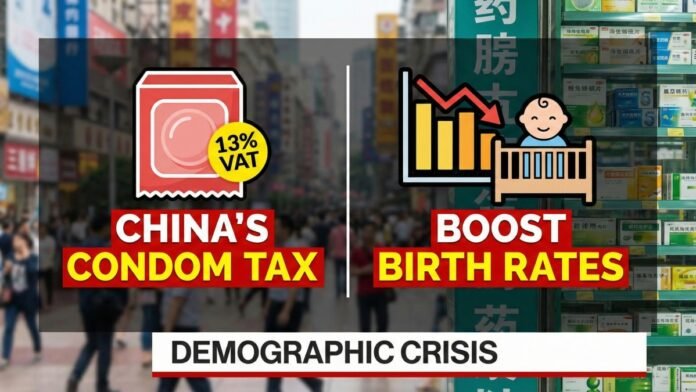
- Condom Tax: China imposed a 13% value-added tax (VAT) on condoms and contraceptive pills for the first time in 32 years, effective immediately.
- Cost Barrier: Raising a child to age 18 costs over 538,000 yuan (approximately Rs 6,294,600), deterring young people from parenthood.
- Policy Evolution: China shifted from one-child (1979), to two-child (2016), to three-child (2021) policies as demographic pressures intensified.
- HIV Concern: HIV cases surged from 0.37 to 8.41 per 100,000 people between 2002-2021, mainly from unprotected sexual contact.
In a dramatic policy reversal, China has imposed a 13% value-added tax (VAT) on condoms and contraceptive pills for the first time in 32 years, marking a stark departure from decades of birth control promotion. The taxation, implemented as part of broader tax reform and family planning policy restructuring, aims to artificially inflate the cost of contraception to discourage their use and encourage childbearing. These products remained tax-exempt since 1993, when they were incentivized during the enforcement of the one-child policy. The move reflects Beijing’s escalating anxiety over an imploding birth rate that threatens the nation’s economic sustainability and workforce stability.
The Collapse of China’s Birth Rate
China’s demographic trajectory has become increasingly alarming. In 2024, merely 9.54 million children were born, representing a catastrophic 49% decline from the 18.8 million births recorded a decade earlier when the one-child policy was abolished. This free fall has prompted the government to pivot dramatically, implementing successive policy liberalizations, first allowing two children in 2016 and later permitting three children in 2021. Despite these permissive measures, birth rates continue their downward spiral, exposing the limitations of policy adjustments alone in reversing deeply entrenched demographic decline.
Economic Barriers Overshadow Government Incentives
A fundamental disconnect exists between government encouragement and young Chinese citizens’ ability to afford parenthood. According to the YuWa Population Research Institute’s 2024 report, raising a single child to age 18 costs approximately 538,000 yuan (roughly Rs 6,294,600), an astronomical sum for a generation facing sluggish wage growth and intensifying job market competition. Compounding these pressures, China’s slowing economic growth (below 5% in recent quarters), stagnant wages in key sectors, and evolving social expectations around career advancement have made parenthood economically unfeasible for millions of young adults.
Government initiatives, including cash rewards for births, subsidized childcare facilities, and extended maternity and paternity leave, have proven insufficient to overcome these structural economic barriers. Guidelines encouraging the reduction of medically unnecessary abortions similarly lack enforcement mechanisms or financial incentives strong enough to shift behavior patterns.
Tax Exemptions Expand for Family-Related Services
Partially offsetting the contraceptive tax burden, the Chinese government has exempted childcare and family-support services from VAT, effective January 2026. These exemptions cover nurseries, kindergartens, elderly care facilities, disability services, and wedding services, reducing costs for these essential social services. The selective exemption strategy aims to lower the financial burden of child-rearing while simultaneously increasing contraceptive costs, attempting to manipulate economic incentives toward higher fertility.
HIV Crisis Compounds Public Health Challenges
Amid the population crisis, China faces an escalating HIV epidemic that contradicts global trends. Reported HIV and AIDS cases surged dramatically from 0.37 per 100,000 people in 2002 to 8.41 per 100,000 by 2021, according to the National Center for Disease Control and Prevention. This sharp increase diverges sharply from worldwide declining HIV rates, with unprotected sexual contact identified as the primary transmission vector. The combination of demographic collapse and disease proliferation compounds healthcare and social welfare challenges facing Chinese policymakers.