Key Points
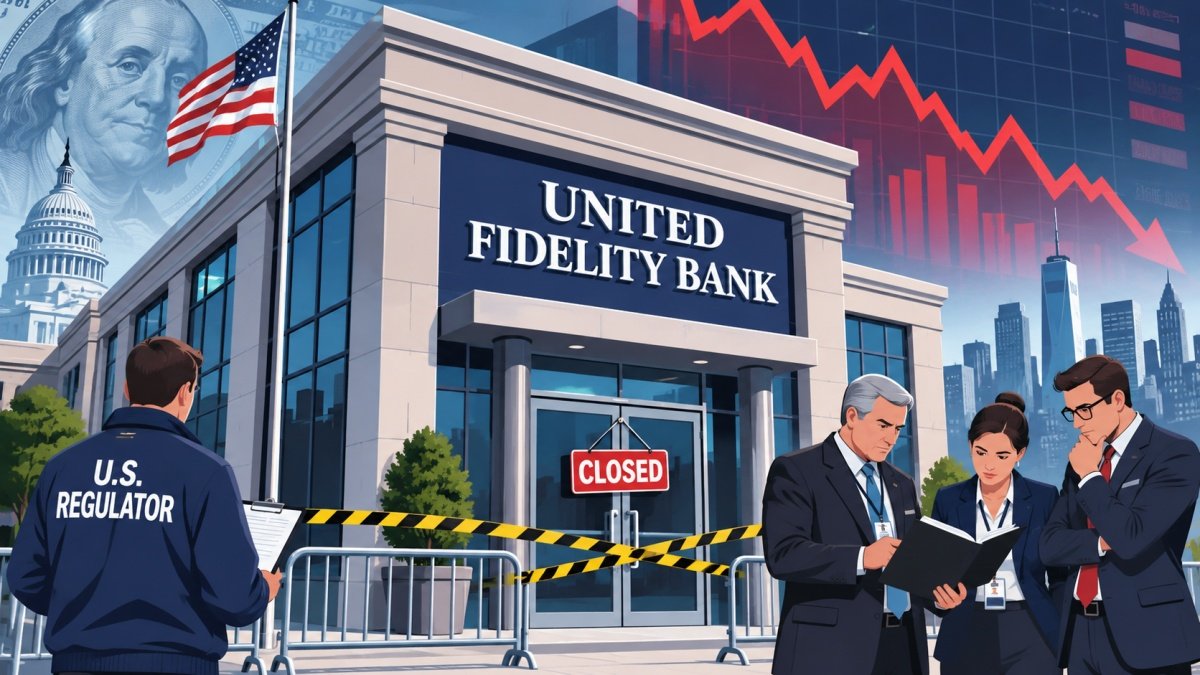
- Regulator Action: The Office of the Comptroller of the Currency (OCC) closed Evansville-based United Fidelity Bank on November 27, 2026, appointing the FDIC as receiver.
- Deposits Protected: First-Citizens Bank & Trust Company assumed all deposits and assets, ensuring no depositor lost money.
- Seamless Transition: All 22 branches across four U.S. states and the U.S. Virgin Islands are reopening as First Citizens locations by Monday, November 30.
- Cost to Insurance Fund: The failure is projected to cost the FDIC’s Deposit Insurance Fund approximately $1.83 billion.
- Broader Context: This marks the seventh U.S. bank failure in 2026, the highest annual total since 2017, and the largest since Republic First Bank collapsed in April 2024.
On the night of Black Friday, November 27, 2026, U.S. banking regulators abruptly shut down United Fidelity Bank, FSB, sending ripples through the American financial sector. Established in 1914 and headquartered in Evansville, Indiana, the lender held approximately $5.9 billion in total assets and $5.4 billion in total deposits as of September 30, 2026. Despite the sudden seizure, federal intervention ensured that customers retained uninterrupted access to their funds.
Why Regulators Closed United Fidelity Bank
The Office of the Comptroller of the Currency (OCC) moved to close the institution after determining that its financial health had severely deteriorated. According to regulatory findings, the bank was no longer able to meet its financial obligations and faced the risk of being unable to fulfill customer withdrawal demands. Earlier financial disclosures showed that United Fidelity had posted a $250 million loss across the first three quarters of 2026.
Following the closure, the OCC appointed the Federal Deposit Insurance Corporation (FDIC) as receiver. The bank’s holding company, Evansville-based Fidelity Federal Bancorp, was not included in the closure or the resulting receivership.
What Happened to Customer Deposits and Accounts
To prevent disruption and safeguard savers, the FDIC struck an agreement with Raleigh, North Carolina-based First-Citizens Bank & Trust Company to assume substantially all of United Fidelity’s deposits and purchase substantially all of its assets.
Because of the takeover, no depositors lost money, regardless of their account balance. Checking, savings, money market, certificate of deposit, and retirement accounts were transferred automatically to First Citizens without requiring customers to open new accounts or submit applications.
Customers can continue using their existing checks, ATM cards, debit cards, and current account and routing numbers until notified otherwise in writing. Regular direct deposits, including paychecks and Social Security benefits, will continue without interruption, and interest accrued through November 27 will be paid at existing rates. United Fidelity’s 22 branches, spanning Indiana, Illinois, Florida, Colorado, and two locations in the U.S. Virgin Islands, began reopening as First Citizens branches on Saturday, with all remaining locations opening on Monday.
Impact on Borrowers and the FDIC Insurance Fund
The transition does not alter existing loan agreements. Customers holding mortgages, home loans, or other credit lines with United Fidelity must continue making their scheduled payments and installments as usual. In cases where the FDIC retains specific loans, affected borrowers receive direct notification and support through the agency.
The FDIC estimates that resolving United Fidelity Bank will cost its Deposit Insurance Fund roughly $1.83 billion. This figure represents the financial burden absorbed by the industry-funded insurance reserve rather than any loss to individual bank customers.
Latest Updates and Industry Context
United Fidelity’s collapse is the largest U.S. bank failure in more than two years, trailing only the April 2024 failure of Philadelphia-based Republic First Bank, which held $6 billion in assets. It also brings the 2026 tally to seven failed U.S. banks, the highest number in a single year since 2017.
For First Citizens Bank, the deal adds to its track record of stepping in during banking crises, most notably its 2023 acquisition of Silicon Valley Bank. Calling the acquisition “financially and strategically compelling,” First Citizens Chairman and CEO Frank B. Holding Jr. stated that the bank looks forward to welcoming its new customers and earning their trust.
Meanwhile, lawmakers are already seeking answers regarding the sudden collapse. On Saturday, Indiana Senator Jim Banks, who serves on the Senate Banking Committee, announced that he is scheduled to receive a formal briefing on United Fidelity Bank’s failure on Monday.