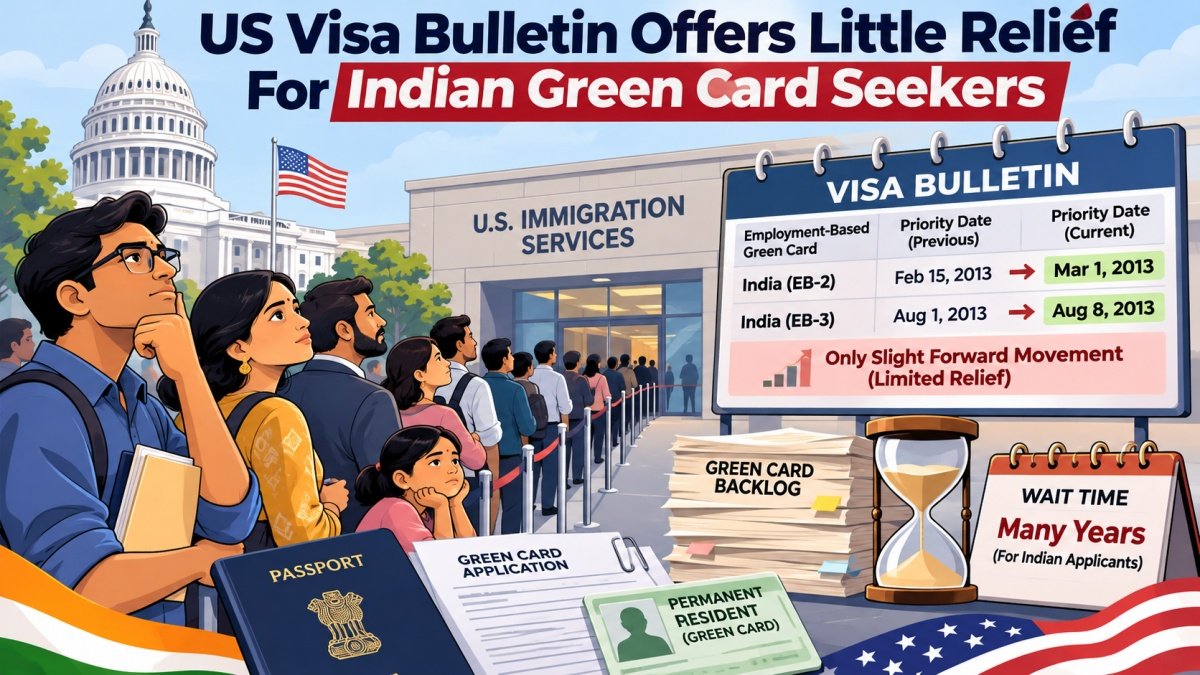
The December 2026 US Visa Bulletin shows no movement in final action dates for Indian employment-based Green Card categories, leaving many professionals facing long delays.
Key Points
- Unchanged Dates: Final Action Dates for EB-1, EB-2, and EB-3 categories remain stagnant for Indian applicants.
- Filing Window: The Dates for Filing chart allows some applicants to submit Form I-485 early.
- Category Status: EB-2 remains at November 1, 2013, while EB-3 stands at January 22, 2014.
- Retrogression Risk: The US Department of State warned that dates could move backward to stay within annual limits.
Stagnant Progress For Employment Categories
NEW DELHI: The US Department of State has released the December 2026 Visa Bulletin, which provides the latest cut-off dates for Indian nationals seeking employment-based Green Cards. For many Indian professionals, the update offers minimal relief as the Final Action Dates for the EB-1, EB-2, and EB-3 categories have remained unchanged from the previous month.
The Final Action Date for the EB-2 category continues to sit at November 1, 2013, while the EB-3 category remains at January 22, 2014. For those in the EB-1 category, which covers priority workers such as individuals with extraordinary abilities or outstanding researchers, the date remains fixed at February 1, 2023.
Understanding Filing Dates Versus Final Action
The bulletin distinguishes between the Dates for Filing and the Final Action Dates, a distinction that is crucial for applicants. For the December 2026 cycle, the US Citizenship and Immigration Services (USCIS) has designated the Dates for Filing chart for employment-based adjustment-of-status applications. These dates stand at July 1, 2024, for EB-1, and January 15, 2015, for both EB-2 and EB-3.
While meeting the Dates for Filing allows an applicant to submit Form I-485 and lock in their place in the system, it does not guarantee the issuance of a Green Card. Applicants who meet the filing criteria can still apply for a work permit (EAD) and travel documents (advance parole), but the actual approval is only granted when the Final Action Date moves past their specific priority date.
Reasons For The Persistent Backlog
The prolonged waiting period for Indian applicants is primarily due to the annual caps on Green Cards. The US immigration system limits any single country to 7 per cent of the total employment-based visas available each year. Because demand from India significantly exceeds this allocated share, a substantial backlog has formed, creating a queue that spans several years.
The US Department of State has cautioned that these dates are subject to change and may even move backward, a process known as retrogression. This measure is used to ensure that the total number of issuances stays within the established annual limits. Consequently, being able to file an application today does not provide a definitive timeline for when the final approval will be granted.
Category Breakdown For Indian Applicants
The US immigration system categorizes employment-based Green Cards based on professional qualifications. EB-1 is reserved for priority workers, including multinational executives, managers, and professors with extraordinary abilities. EB-2 is designated for individuals with advanced academic degrees or those possessing exceptional abilities.
The EB-3 category is broader, encompassing skilled workers, professionals, and other workers. Given the high volume of applicants in these categories from India, the current bulletin suggests that the trend of long waiting periods is likely to persist for the foreseeable future.