Key Points
- Quake Details: The 5.0-magnitude tremor hit at 9:30 a.m. PT on Saturday, originating offshore about 5 to 6 km southwest of Manhattan Beach at a depth of roughly 12 to 13 km.
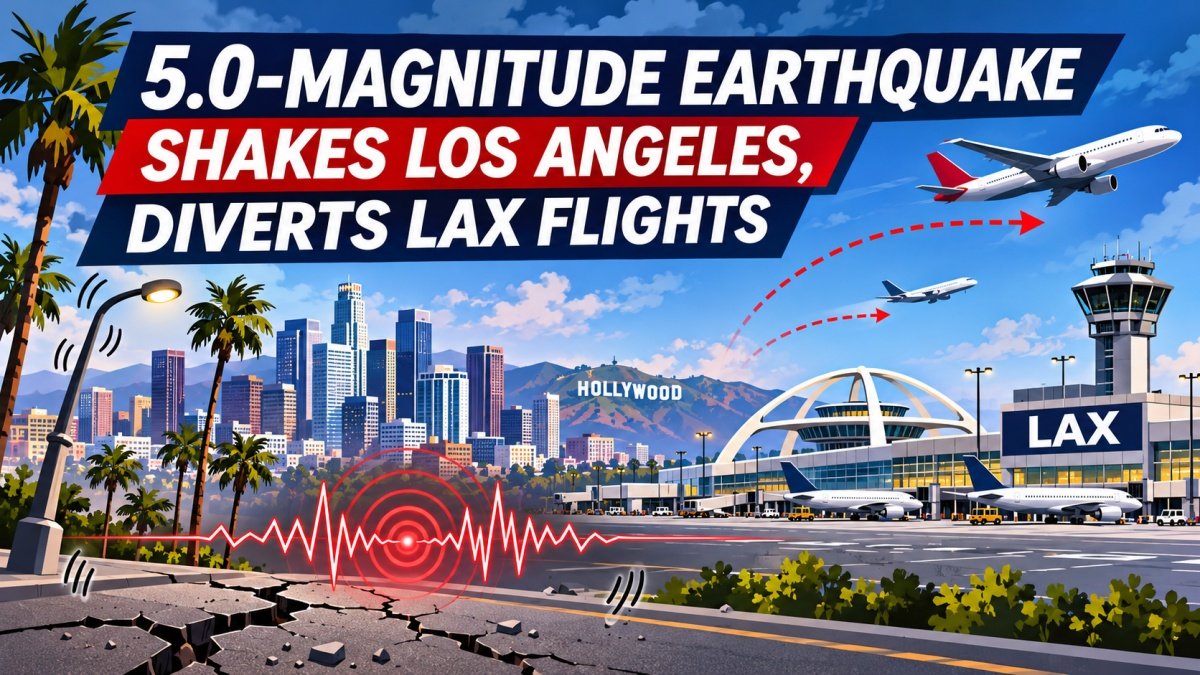
- Airport Disruptions: Incoming flights at Los Angeles International Airport (LAX) aborted landings or were diverted, while shaking knocked down ceiling tiles in a terminal.
- Refinery Flares: Flames spotted at Chevron’s El Segundo refinery and the Torrance Refinery were caused by automated safety flaring, not structural earthquake damage.
- No Major Injuries: The Los Angeles Fire Department found no major structural damage or injuries across the city, and the U.S. National Tsunami Warning Center confirmed there is no tsunami threat.
- Ongoing Aftershocks: Caltech seismologists recorded at least 40 aftershocks following the main quake, with officials warning residents to stay alert for more tremors.
A moderate 5.0-magnitude earthquake jolted the Los Angeles metropolitan area on Saturday morning, November 28, 2026, rattling buildings, toppling merchandise from store shelves, and briefly disrupting air travel. According to the United States Geological Survey (USGS) and Caltech, the quake struck at 9:30 a.m. local time, centered offshore roughly 5 to 6 km southwest of Manhattan Beach at a depth of about 12 to 13 km. Tremors were felt across Southern California, reaching as far inland as Pasadena, approximately 43 km from the epicenter.
Flight Diversions and Minor Damage at LAX
The sudden jolt caused immediate disruptions at Los Angeles International Airport (LAX). Incoming aircraft, including a Delta flight whose tense cockpit audio was captured during the tremor, were forced to abort landings or divert as the ground shook. Inside the airport, the shaking caused ceiling tiles to fall in one of the terminals and shattered glass, while car alarms sounded across surrounding neighborhoods.
Across coastal communities near the epicenter, including Hermosa Beach, local businesses reported merchandise tumbling from shelves, leaving aisles cluttered with broken goods.
Flames at Chevron’s El Segundo Refinery Explained
Shortly after the earthquake, large flames rose from Chevron’s El Segundo refinery, located just south of LAX, sparking concern among nearby residents. However, both Chevron and City of El Segundo officials quickly clarified that the flames were not the result of earthquake damage.
When seismic activity occurs, the refinery’s automated safety systems shut down equipment and activate “safety flaring,” a standard, controlled procedure used to burn off excess gas safely during operational interruptions. Chevron notified the South Coast Air Quality Management District along with city leaders in El Segundo and Manhattan Beach, confirming that the flaring posed no safety risk to the public. Unplanned safety flaring was also reported at the nearby Torrance Refinery, with no offsite impact.
The El Segundo facility is a critical energy hub, supplying fuel for roughly 20% of Southern California’s vehicles and 40% of the region’s jet fuel. Because the plant previously experienced a fire in October 2025, officials moved quickly to reassure the public that Saturday’s flames were strictly a controlled safety measure.
Latest Updates, Aftershocks, and Official Response
Immediately following the tremor, the Los Angeles Fire Department (LAFD) entered “earthquake mode,” deploying crews from 106 neighborhood fire stations to inspect critical infrastructure across the city. Following the citywide sweep, fire officials confirmed there were no reports of major structural damage or injuries. The U.S. National Tsunami Warning Center also issued an alert confirming there was no tsunami danger.
Los Angeles Mayor Karen Bass acknowledged that while earthquakes are common in the region, Saturday’s tremor was “more significant and closer to Los Angeles,” though she assured residents there was no reason to halt normal activities.
Seismic activity continued well after the initial shock. At least 19 aftershocks rattled the coastline within the first 45 minutes, including a magnitude 3.7 tremor, and Caltech seismologists later tallied at least 40 aftershocks in total. With the USGS estimating a 30% chance of an aftershock reaching magnitude 4.0 or greater, the California Governor’s Office of Emergency Services (Cal OES) and local authorities have urged residents to remain prepared for additional shaking in the coming days.