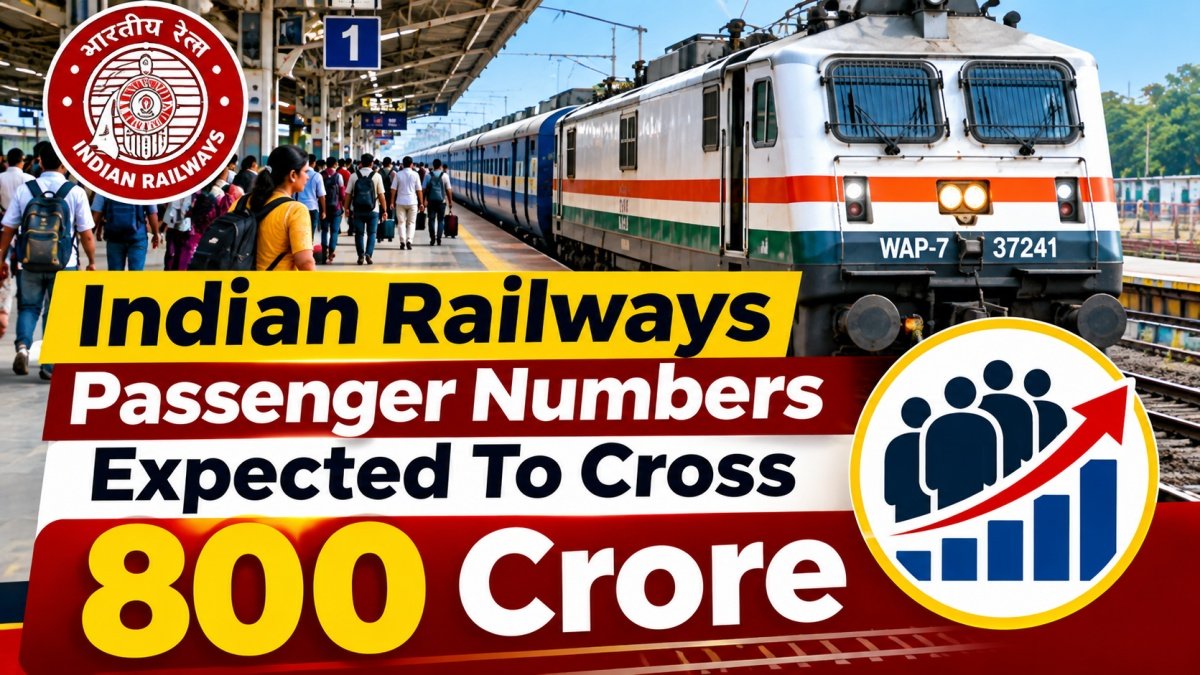
Indian Railways expects the total number of passengers to exceed 800 crore in the 2026-27 financial year, reflecting a steady recovery post-pandemic.
Key Points
- Growth Forecast: Passenger numbers are projected to rise by 8 percent to cross 800 crore this fiscal year.
- Festive Surge: Approximately 20 crore passengers traveled during the peak 26-day festive period in 2026.
- Capacity Expansion: The railways have introduced over 2,500 new train services in the last five to six years.
- City Traffic: Daily passenger movement in major hubs like Delhi and Mumbai saw significant spikes during festivals.
- Tech Adoption: Artificial Intelligence is being deployed for crowd monitoring and coach inspections.
Projected Growth in Rail Traffic
NEW DELHI: Indian Railways is preparing for a significant surge in passenger movement, with estimates suggesting that the number of travelers could surpass 800 crore in the 2026-27 financial year. This represents a projected increase of approximately 8 percent compared to the 740 crore passengers recorded in the 2025-26 fiscal year. While this growth signals a robust recovery, the figures remain below the record high of 844 crore passengers seen during the 2018-19 period.
The railway network has seen a dramatic turnaround since the COVID-19 pandemic, which caused a sharp decline in traffic. In the 2020-21 financial year, passenger numbers plummeted to 125 crore. However, the sector has experienced rapid improvement since then, reaching 350 crore in 2021-22 and climbing to 730 crore in 2024-25. Railway Minister Ashwini Vaishnaw noted that the continuous rise in demand necessitates the operation of more trains to accommodate the growing public.
To meet these demands, the railways have initiated several infrastructure projects over the last five to six years. These include the addition of more than 2,500 new train services and significant upgrades to track capacity, station facilities, and the overall train fleet.
Festive Season Logistics and Demand
During the 60-day festive period spanning October and November 2026, the railways operated approximately 18,000 additional train services. Data shows that 20 crore passengers traveled during the 26 busiest days of the season, which included Durga Puja, Diwali, and Chhath. This volume was 8 percent higher than the same period in the previous year.
Specific holiday peaks showed notable increases in daily travel. During Durga Puja, 76 lakh passengers traveled compared to the usual average of 70 lakh. Diwali saw a rise from 71 lakh to 74 lakh, while Chhath recorded a jump from 75 lakh to 82 lakh. To manage these sudden influxes, 145 unreserved trains were deployed at key locations, and dedicated holding areas with passenger amenities were established at major hubs like New Delhi, Anand Vihar, Udhna, and Ayodhya.
Major metropolitan stations reported substantial spikes in daily footfall. In Delhi, daily movement at stations such as New Delhi, Old Delhi, and Hazrat Nizamuddin rose from 5 lakh to 8 lakh during festivals. Similarly, Mumbai stations like Bandra and Chhatrapati Shivaji Maharaj Terminus saw numbers climb from 4 lakh to 5 lakh, while Hyderabad and Bengaluru hubs also reported significant increases in passenger volume.
Technological Integration and Modernization
Beyond expanding capacity, Indian Railways is integrating advanced technology to enhance operational efficiency and passenger experience. The ministry has begun using specialized machines to clean the first compartments of bio-toilets in trains. Furthermore, a new system has been introduced for construction organizations to ensure all necessary preparations are completed before projects receive official approval.
The railways are also adopting Artificial Intelligence to monitor crowds and inspect both freight wagons and passenger coaches. These technological strides are part of a broader effort to modernize the passenger reservation system and improve overall safety. According to reports from ThePrint, these initiatives are aimed at helping the railway network reach pre-pandemic levels by 2027.