Key Points:
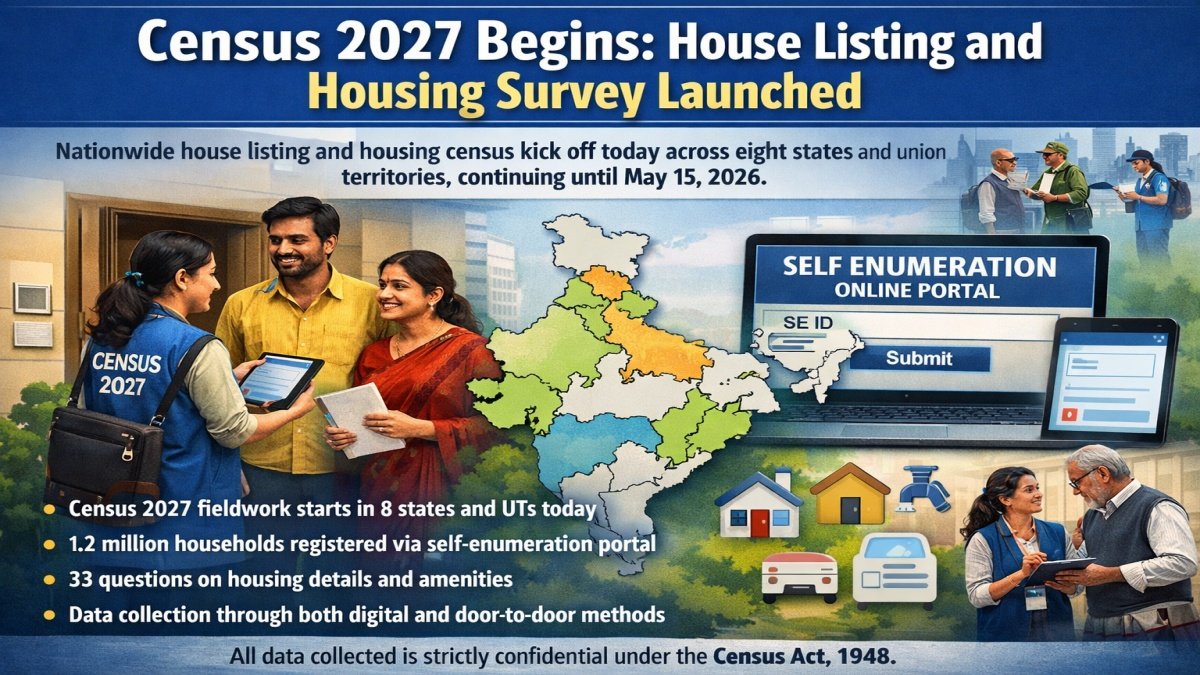
- Phase 1 of the decennial Census 2027 has officially commenced with the start of house-listing fieldwork.
- The initial rollout covers eight states and Union Territories, including Karnataka, Goa, and Mizoram, as well as parts of Delhi.
- For the first time, a digital-first approach enables self-enumeration via an online portal, alongside traditional door-to-door surveys.
- Over 1.2 million households have already utilized the self-enumeration option.
- Enumerators will ask 33 questions concerning housing conditions, amenities, and assets.
- All information collected is strictly confidential and protected under the Census Act, 1948.
The massive exercise of conducting India’s decennial census has officially begun today, Thursday, marking a significant milestone in the country’s administrative and developmental planning. The fieldwork for the first phase, which encompasses house-listing and the housing census, is now underway across eight specific states and Union Territories. This crucial phase lays the groundwork for the main population enumeration scheduled for later.
The initial phase of the field exercise has been launched in Andhra Pradesh, Arunachal Pradesh, Haryana, Chandigarh, Madhya Pradesh, Chhattisgarh, and parts of the national capital. This includes areas under the jurisdiction of the New Delhi Municipal Council (NDMC) and the Delhi Cantonment Board. This nationwide operation is scheduled to continue diligently until May 15, 2026.
Embracing Digital Modernization and Self-Enumeration
A defining feature of Census 2027 is its significant pivot towards digital technology, aimed at improving efficiency, data accuracy, and processing speed. This census marks the first time that data will be collected primarily through a mobile application, reducing reliance on paper forms.
Alongside the traditional door-to-door method, the government has introduced a convenient self-enumeration facility. This allows citizens to fill out their details securely via an online portal. According to official data, approximately 1.2 million households have already proactively registered and submitted their information through this digital channel.
Citizens who have completed self-enumeration must securely retain their unique Self-Enumeration (SE) ID. When the census enumerator visits their residence, presenting this ID will allow the official to quickly sync the data, finalizing the process for that household without needing to ask all questions again. For households that do not use the online portal, data collection will proceed via the traditional method of door-to-door visits by trained enumerators using tablets or smartphones.
A Comprehensive Data Collection Exercise
During the house-listing phase, enumerators will be tasked with gathering information through a set of 33 comprehensive questions. These questions are meticulously designed to assess various aspects of living standards and infrastructure, covering details such as:
Housing Characteristics: The condition of the structure, materials used for roofing and walls.
Household Amenities: Access to drinking water, sanitation facilities, a source of lighting, and cooking fuel.
Asset Ownership: Possession of certain specified assets like communication devices or vehicles.
It is important to note that the objective of this phase is to update the National Population Register (NPR) and list houses, not to collect data on sensitive personal information such as caste, religion, or income, which are typically addressed in the subsequent population enumeration phase.
Staggered Rollout and Legal Safeguards
The self-enumeration process follows a staggered timeline across different regions. While it has begun today for several states, including Madhya Pradesh, Andhra Pradesh, and Chhattisgarh (running until April 30, 2026), it will start slightly later in Bihar, scheduled from April 17 to May 1, 2026. The actual house-listing fieldwork in these regions will follow immediately after the completion of their respective self-enumeration windows.
The government reiterates that all information provided during the census operations is completely secure and strictly confidential under the provisions of the Census Act, 1948. The data collected cannot be used as evidence in a court of law and is utilized exclusively for statistical analysis, formulating government schemes, and planning developmental initiatives.
All residents in the notified states and UTs are strongly encouraged to cooperate with the visiting enumerators and participate actively in this essential national campaign, which is critical for shaping India’s future planning.