



































Key Points
- Jio launched CNAP in Haryana, West Bengal, Rajasthan, Kerala, Bihar, Jharkhand, and Odisha
- Airtel activated the service in Jammu and Kashmir, Madhya Pradesh, Gujarat, and West Bengal
- Vodafone Idea started rollout in parts of Maharashtra and Tamil Nadu
- BSNL is testing CNAP in West Bengal with plans for nationwide expansion
- The feature displays the name registered with the SIM card at purchase
- Users can deactivate CNAP if they prefer not to use it
- TRAI and Department of Telecommunications mandated the implementation
- Service is expected to significantly reduce fake bank calls, lottery scams, and digital arrest frauds
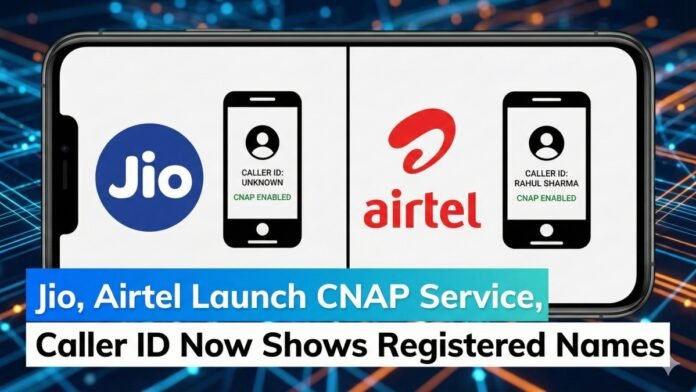
The Caller Name Presentation (CNAP) service is a network-level feature that displays the registered name of the caller on the recipient’s phone screen, even for unknown numbers. Unlike third-party apps like Truecaller that rely on crowdsourced data, CNAP pulls information directly from the telecom operator’s database, which contains the name provided during SIM card registration with a valid ID proof.
When a call comes in, the network transmits the registered name along with the phone number, which appears on the screen before the user answers. This means that instead of seeing “Unknown Number” or a potentially fake saved contact name, users see the actual identity of the caller as per official records. The feature works on both smartphones and feature phones, making it accessible to users across all device types.
State-Wise Implementation Status and Rollout Timeline
According to official sources and media reports, the phased rollout is progressing faster than initially planned. Reliance Jio has emerged as the frontrunner, launching CNAP in seven states simultaneously. The company’s network teams confirmed that Haryana, West Bengal, Rajasthan, Kerala, Bihar, Jharkhand, and Odisha are now fully covered. Jio users in these states started seeing caller names from December 18, 2025.
Bharti Airtel has taken a more measured approach, activating the feature in Jammu and Kashmir, Madhya Pradesh, Gujarat, and West Bengal. Airtel’s Chief Technology Officer stated that network integration is complete in these states, and users should see the feature within 48 hours. The company plans to add Punjab, Uttar Pradesh, and Tamil Nadu by December 25, 2025.
Vodafone Idea, despite financial constraints, has initiated the service in select areas of Maharashtra (Mumbai, Pune, Nagpur) and Tamil Nadu (Chennai, Coimbatore). The company is leveraging its existing network infrastructure and expects full state coverage by January 15, 2026.
BSNL, the state-owned telecom operator, is currently conducting pilot tests in West Bengal, particularly in Kolkata and its surrounding areas. BSNL Chairman confirmed that the technical trials are successful, and a nationwide rollout will begin in the first week of January 2026, covering all 22 telecom circles.
How CNAP Will Curb Fraud Calls and Cybercrime
Cybersecurity experts and law enforcement agencies have welcomed the CNAP implementation as a major breakthrough in combating telecom fraud. According to the National Cybercrime Reporting Portal, India recorded 1.2 million fraud calls in 2025, resulting in financial losses exceeding ₹1,500 crore. The most common scams include fake bank KYC verification calls, lottery winnings, digital arrest threats, and impersonation of government officials.
The CNAP service addresses these threats by exposing the real identity of callers. For instance, if a scammer calls pretending to be a bank manager, the screen will display the name they used during SIM registration, which can be cross-verified. Most fraudsters use fake IDs or stolen identities to obtain SIM cards, but the registered name provides a crucial lead for law enforcement.
TRAI Chairman stated that CNAP will work in conjunction with the existing Do Not Disturb (DND) registry and the Sanchar Saathi portal. “When users can see the caller’s real name, they are 70% less likely to fall for scams,” he claimed, citing trial data from Mumbai and Haryana where fraud reports dropped by 45% during the pilot phase.
User Control, Privacy Settings and Deactivation Process
While CNAP is enabled by default for all users, telecom operators have provided a simple deactivation mechanism for those who prefer privacy. Users who do not wish to see caller names can disable the feature through multiple channels.
For Jio users, dialing 1234# will deactivate CNAP, while Airtel subscribers can send an SMS “CNAP STOP” to 121. Vodafone Idea customers can use the Vi app or dial 1998*2# to turn off the feature. BSNL users will be able to deactivate by sending “STOP CNAP” to 123.
Privacy advocates have raised concerns about displaying names without consent. In response, TRAI has clarified that only the registered name will be shown, not personal details like address or ID number. Additionally, users who deactivate CNAP will not see caller names, but their own name will still be displayed to recipients unless they opt for a premium privacy package, which masks identity for an additional fee of ₹30 per month.
Technical Infrastructure and Network Integration
Implementing CNAP required significant upgrades to telecom networks. Operators had to modify their Signaling System No. 7 (SS7) protocols and integrate new databases with existing call routing systems. The project cost an estimated ₹450 crore collectively across all operators.
Jio leveraged its 5G standalone architecture to deploy CNAP more efficiently, while Airtel and Vodafone Idea had to upgrade their 4G networks with additional software patches. BSNL is using a hybrid approach, combining its 4G rollout with CNAP implementation.
The service uses a standardized protocol developed by the Telecom Standards Development Society of India (TSDSI), ensuring interoperability between networks. This means a Jio user will see caller names even when receiving calls from Airtel or Vi numbers, and vice versa.
Comparison with Truecaller and Third-Party Apps
Truecaller, the Swedish caller ID app with over 300 million users in India, faces direct competition from CNAP. Truecaller relies on crowdsourced contact data and user-generated names, which can be inaccurate or manipulated. Scammers often spoof names in Truecaller’s database, making it less reliable.
CNAP’s advantage lies in its official data source. Since names come from government-verified ID documents used during SIM registration, the accuracy rate is nearly 100%. However, Truecaller still offers additional features like spam reporting, call recording, and messaging, which CNAP does not provide.
Truecaller India’s Managing Director acknowledged the development, stating, “We welcome any initiative that enhances user safety. Our app will continue to offer value-added features that complement network-level services.” The company is reportedly pivoting toward enterprise solutions and verified business caller ID services.
Challenges, Limitations and Potential Issues
Despite its benefits, CNAP faces several implementation challenges. Prepaid SIM cards purchased before 2020 often have incomplete or incorrect name data, as KYC norms were less stringent earlier. Telecom operators are running a data cleansing drive, but approximately 15% of SIM cards still have discrepancies.
Another issue is name duplication. Common names like “Ramesh Kumar” or “Sunita Sharma” may cause confusion when multiple people share the same name. Operators are considering adding location tags or partial numbers to differentiate callers, but this raises privacy concerns.
International roaming calls present another hurdle. When Indians receive calls from abroad, CNAP may not display names if the foreign operator hasn’t integrated with Indian systems. TRAI is negotiating with major international carriers to enable cross-border caller ID, but this may take until mid-2026.
There are also concerns about social engineering attacks where scammers might exploit the trust CNAP creates. Cybersecurity researcher Dr. Ankit Raj warned, “Fraudsters may now focus on obtaining SIM cards through identity theft, making the initial KYC verification even more critical.”
Future Roadmap and Nationwide Expansion
The Department of Telecommunications has set an ambitious target for complete nationwide coverage by March 31, 2026. The phased rollout plan prioritizes states with high fraud call volumes, including Uttar Pradesh, Maharashtra, Delhi, and Tamil Nadu.
TRAI is also working on advanced features for CNAP 2.0, expected in late 2026. These include verified business caller IDs with green ticks for legitimate companies, AI-powered fraud risk indicators, and integration with the upcoming National Digital Fraud Prevention System.
The regulator is considering making CNAP mandatory for all new SIM activations and requiring existing users to update their KYC details within six months. Failure to comply may result in temporary suspension of outgoing call facilities.
What Users Need to Know and Do
For immediate benefit, users should ensure their SIM card registration details are accurate. Visiting the nearest retailer with valid ID proof can help update any discrepancies. Consumers are advised not to rely solely on CNAP and should continue verifying unknown callers through independent means before sharing personal or financial information.
Users should also report any suspicious calls through the Sanchar Saathi portal or by dialing 1938, even if CNAP displays a name. The feature is a deterrent, not a foolproof solution. TRAI recommends keeping CNAP active unless privacy concerns outweigh safety benefits.
Businesses should register for verified caller ID services to ensure customers recognize their legitimate calls. This is particularly important for banks, delivery services, and government agencies that frequently face impersonation issues.