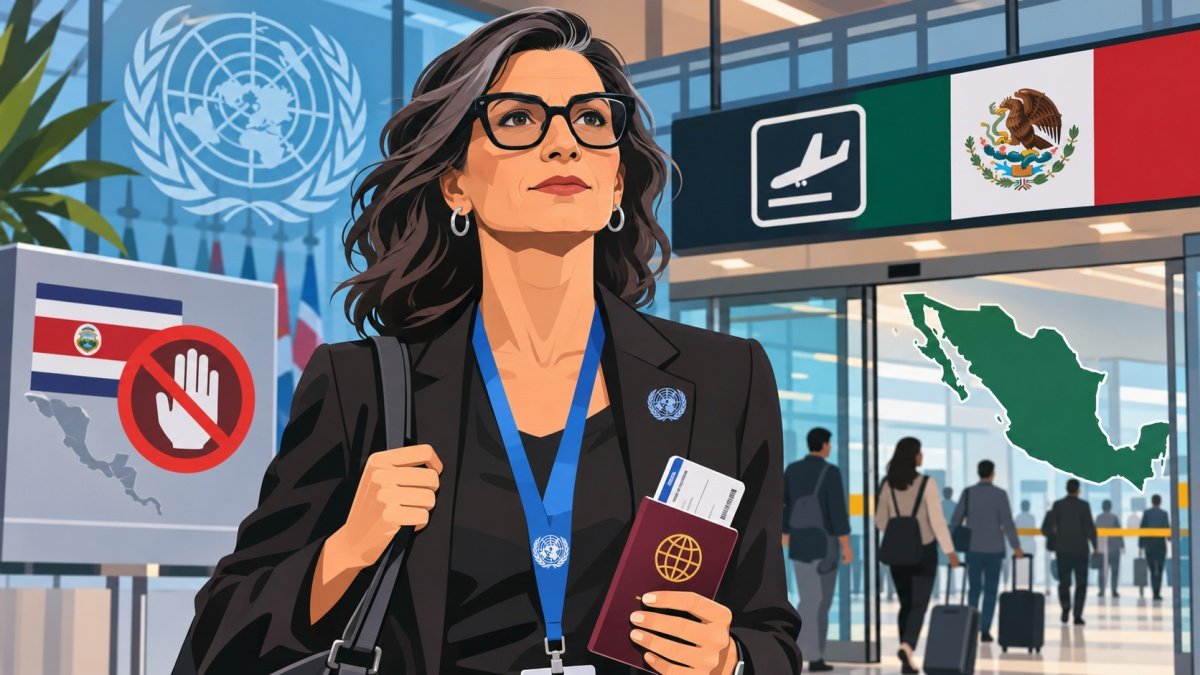
UN special rapporteur Francesca Albanese arrived in Mexico City on Saturday after being denied entry to Costa Rica on national security grounds.
Key Points
- Entry Denied: Costa Rica barred Albanese from entering the country on national security grounds.
- Mexico Arrival: Albanese arrived in Mexico City to participate in several human rights and solidarity events.
- UN Concern: UN human rights chief Volker Turk expressed deep concern over the move by Costa Rica.
- US Praise: The United States praised the decision to bar the rapporteur from the country.
- Accusations Made: Costa Rica’s Finance Minister accused Albanese of ties to terrorist acts on social media.
Arrival in Mexico City
MEXICO CITY: Francesca Albanese, the United Nations special rapporteur on the Israeli-occupied Palestinian territories, landed at Mexico City’s international airport on Saturday (November 28, 2026). Her arrival was met with a warm reception from supporters who greeted her with flowers, Palestinian flags, and a regional musical band.
Ms. Albanese is scheduled to spend five days in the capital, where she will participate in a Palestinian solidarity event, a talk at the human rights commission, and a university lecture regarding responsibility during times of genocide. She was originally intended to travel to Costa Rica to receive an honorary doctorate at the University of Costa Rica.
Costa Rica Entry Ban
The Italian national was denied entry at the Costa Rican airport on Thursday (November 26, 2026) citing national security grounds. According to the UN human rights office, Ms. Albanese was held at the San Jose airport for more than 50 hours before being allowed to leave. During her time stranded, she delivered a keynote lecture at the university remotely.
Ms. Albanese has publicly challenged Costa Rica’s former President and current Finance Minister, Rodrigo Chaves, who accused her of ties to terrorist acts in a social media post. She characterized the accusations as defamation and urged the minister to provide evidence to judicial authorities. She noted that while the region faces pressure from neighboring countries, humanity must prevail.
International Reactions
The decision by Costa Rica sparked a polarized international response. UN human rights chief Volker Turk stated he was deeply concerned by the ban, noting it was difficult to reconcile with Costa Rica’s long-standing commitment to human rights. Conversely, the United States expressed support for the move, with U.S. Ambassador to the UN for management and reform, Jeff Bartos, describing the rapporteur as a liar and a lunatic.
The move comes as Costa Rica aligns more closely with Washington and other rightward-shifting Latin American nations. Costa Rica had previously sanctioned Ms. Albanese in 2025 following her criticisms of U.S. and Israeli policies in Gaza.
Context of the Conflict
Ms. Albanese is a prominent critic of Israel’s military actions in Gaza. Palestinian authorities report that over 74,000 people have been killed in the military operation launched following the October 7, 2023, attacks by Hamas-led fighters. The ongoing operation has triggered a severe hunger crisis and displaced the majority of Gaza’s population.
While a UN inquiry and various scholars have assessed that Israel’s conduct in Gaza amounts to genocide, Israel and the United States have rejected these findings. Israel maintains that its military campaign is a necessary act of self-defence against Hamas.